
Table of Contents
- Why Historic Chimney Preservation Matters for Texas Homeowners
- Understanding Preservation-Sensitive Repair Standards
- Lime Mortar vs. Portland Cement: Why Material Selection Impacts Your Home
- Matching Brick Selection and Color Accuracy
- Professional Repointing Techniques We Employ
- How Our Chimney Experts Assess Your Home's Preservation Needs
- The Long-Term Benefits of Proper Preservation Methods
- Why We Recommend Our Specialized Preservation Approach
- Protecting Your Investment with Expert Craftsmanship
- Getting Your Free Preservation Assessment Today
- Frequently Asked Questions (FAQ)
Why Historic Chimney Preservation Matters for Texas Homeowners
Your chimney isn’t just a functional part of your home. It’s often the oldest and most character-defining feature of a historic Texas property. When we work on chimneys built decades or even a century ago, we’re not just fixing a problem; we’re protecting your home’s structural integrity and its architectural heritage.
Historic chimneys in Austin and San Antonio face unique challenges. The Texas climate cycles through hot, dry summers and cold winters that stress mortar joints. Water infiltration through deteriorated mortar causes the most expensive damage: interior brick erosion, foundation settlement, and hidden mold growth in adjacent walls. Many homeowners discover the real problem only after water stains appear inside.
We’ve learned that improper repairs accelerate damage rather than prevent it. When contractors use standard Portland cement mortar on historic brick, they trap moisture inside the older, softer brick. This trapped water freezes and thaws seasonally, causing spalling and accelerating collapse. That’s why preservation-sensitive methods matter. They use materials and techniques that actually work with your home’s original construction, not against it.
Action you can take now: Schedule a free chimney assessment with us. We’ll evaluate whether your home needs preservation-sensitive repairs and explain exactly what you’re dealing with.
Understanding Preservation-Sensitive Repair Standards
Preservation-sensitive chimney repair follows standards established by groups like the National Park Service and the Brick Industry Association. These aren’t aesthetic guidelines; they’re engineering-based practices that extend chimney life by decades.
The core principle is this: repair materials and methods must match the original construction in strength, breathability, and chemical composition. Your 80-year-old chimney’s brick, mortar, and construction technique created a system in balance. When you introduce incompatible modern materials, you disrupt that balance and create failures.
We follow specific preservation standards during every repointing job:
- Use lime-based mortar that’s softer and more breathable than the surrounding brick
- Never grind out mortar joints deeper than the original joint depth
- Preserve all original brick; replace only severely damaged pieces
- Clean brick only with dry methods or very low-pressure water
- Match mortar color, grain, and finish to the original
These steps require more care and time than standard repairs, but they protect your investment in ways that budget approaches simply cannot. Historic preservation isn’t about perfection; it’s about slowing the deterioration cycle and preventing catastrophic failure.
Lime Mortar vs. Portland Cement: Why Material Selection Impacts Your Home
This is where most homeowners discover why their neighbor’s “cheap chimney repair” failed in three years.
Historic brick and original lime mortar are softer and more permeable than modern Portland cement. Lime mortar breathes. It allows water vapor to migrate through and out of the masonry. Portland cement, by contrast, creates a hard, waterproof seal that traps moisture inside the brick.
When water enters your chimney (through cracks, flashing failures, or worn mortar), it needs a way out. With original lime mortar, that water gradually evaporates outward. With Portland cement repairs mixed with historic brick, water gets trapped. In winter, it freezes and expands inside the brick, causing spalling and structural damage. In summer, it feeds mold growth in hidden cavities.
Here’s what we’ve seen in the field: A chimney repointed with Portland cement in 2015 fails by 2021. The same chimney repointed with proper lime mortar in 1980 is still sound today. The difference is material chemistry, not luck.
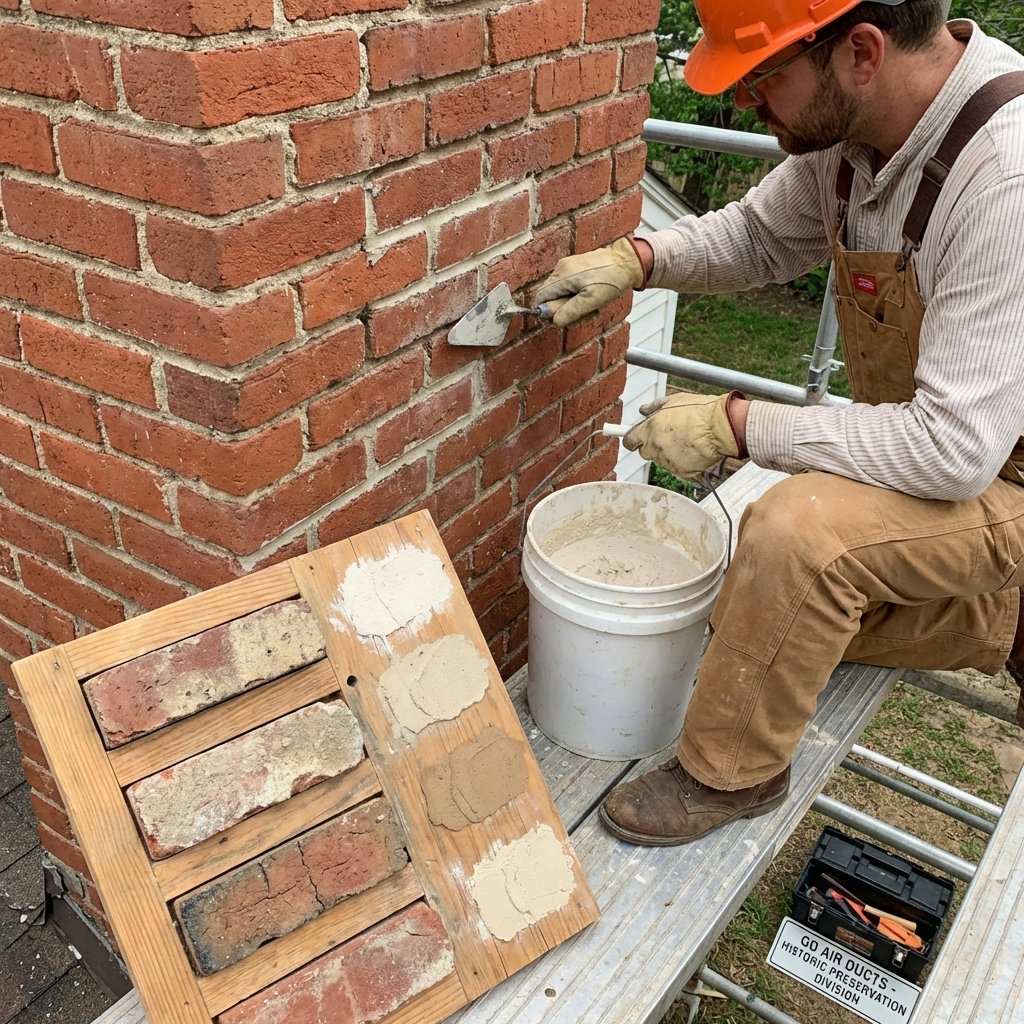
We specify lime mortar for all historic chimney work because it:
- Matches the original mortar’s compressive strength (softer brick requires softer mortar)
- Allows vapor transmission, preventing moisture trapping
- Self-heals minor cracks through carbonation over time
- Remains workable longer, allowing careful joint filling
- Bonds better to historic brick without causing spalling
Portland cement has its place. New construction, contemporary additions, and already-failed chimneys sometimes need cement. But on historic masonry, lime mortar is the only choice that respects your home’s original engineering.
Matching Brick Selection and Color Accuracy
You’ve probably noticed that historic brick varies wildly in color, size, and texture compared to modern standardized bricks. That variation isn’t a defect; it’s proof your brick was hand-made, often on-site or locally sourced.
When we replace damaged brick in a historic chimney, we source reclaimed brick that matches the original as closely as possible. New brick, even when labeled “historic,” rarely matches. The clay composition, firing method, and age create a patina that takes decades to develop.
We work with salvage suppliers across Texas who specialize in reclaimed brick from demolished structures. We’ve built relationships with suppliers in Austin and San Antonio who understand local brick history. A chimney built in 1940s Austin doesn’t need brick from Virginia or Ohio; it needs local sourcing.
The process includes:
- Careful visual matching of color, size, texture, and weathering
- Sampling multiple bricks to ensure consistency
- Testing new brick for compatibility with existing mortar
- Installing salvaged brick in visible locations first
- Filling interior or less-visible areas with careful new matches
This attention to detail means your repaired section blends with the original rather than looking like a patchwork. It also ensures the replacement brick has similar water absorption and strength characteristics as your home’s original material, critical for longevity.
Professional Repointing Techniques We Employ
Repointing is the controlled removal and replacement of mortar joints. It sounds simple; it’s actually one of the most skill-intensive masonry tasks.
We never use power tools or aggressive grinding for joint removal on historic chimneys. Angle grinders and pneumatic chisels fracture the surrounding brick. Instead, our team uses hand tools and careful technique to remove mortar without damaging historic brick edges. This takes more time and requires craftspeople with real training. It also produces results that last.
Our repointing sequence works like this:
Preparation: We carefully examine joint depth, width, and condition. We test existing mortar composition when necessary to inform our lime mortar spec.
Removal: Hand chisels and specialized tools remove old mortar to a depth matching the original joint thickness, typically 2.5 to 3 times the joint width.
Cleaning: We brush out all dust and debris, then lightly mist joints with water. Dry joints absorb water from new mortar too quickly, weakening the bond.
Filling: We pack lime mortar into joints using traditional pointing tools, working in layers rather than forcing mortar in all at once. This creates proper consolidation and joint structure.
Finishing: Joint profiles are carefully matched to the original, whether that’s flush, slightly recessed, or formed with a specific profile tool. We never use sealants or caulk on historic mortar joints.
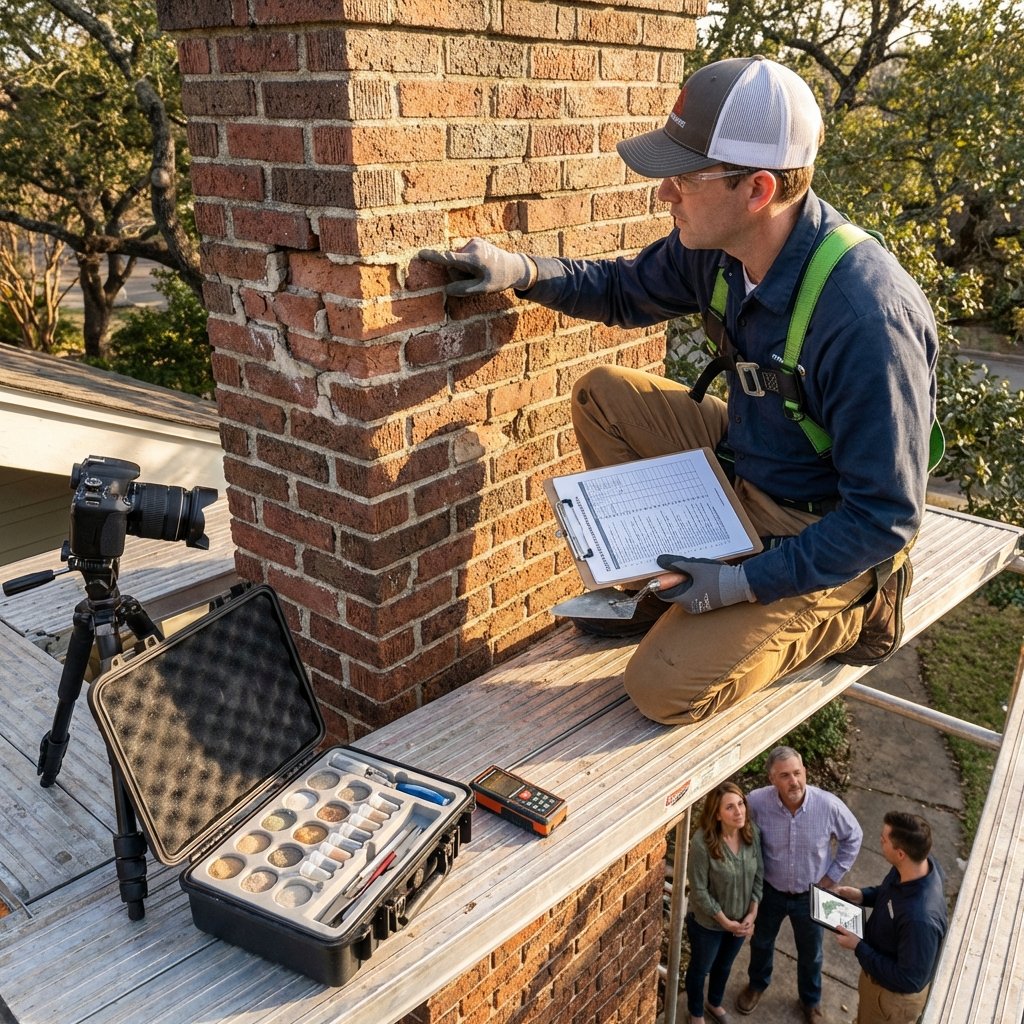
The entire process requires patience and skill that busy, high-volume contractors simply don’t invest in. We see this as non-negotiable on historic properties.
How Our Chimney Experts Assess Your Home’s Preservation Needs
Every historic chimney is different. A 1920s chimney in a central Austin Craftsman has different needs than a 1950s brick ranch in San Antonio. We start every job with a detailed assessment.
Our evaluation includes:
- Visual inspection of exterior brick, mortar, and flashing condition
- Interior camera inspection to identify moisture, deterioration, and structural issues
- Mortar analysis when necessary to determine original composition
- Historical research on your home’s construction date and method
- Assessment of previous repairs and their success or failure
- Identification of water sources: failed flashing, missing caps, foundation cracks
We document everything with photos and detailed notes. You receive a written assessment explaining what we found, what’s urgent, what can wait, and why we’re recommending specific preservation methods over cheaper alternatives.
This honest evaluation sometimes reveals that a chimney isn’t worth preserving in its current form, or that we need to bring in structural engineers for additional analysis. We’ll never oversell you on repairs you don’t need, and we won’t use shortcuts that compromise your home’s long-term condition.
The Long-Term Benefits of Proper Preservation Methods
Preservation-sensitive repair isn’t cheap compared to standard masonry work. You should expect to pay more. What you receive in return is a chimney that functions correctly for decades and maintains your home’s architectural integrity.
We’ve tracked chimneys we repointed 10 and 15 years ago. The ones repaired with proper lime mortar and careful technique show minimal additional deterioration. Mortar joints are slightly worn but stable. The ones patched with Portland cement show new failures around the old repairs, requiring intervention again.
The financial math favors preservation methods:
- Proper repointing extends chimney life 30+ years vs. 8-12 years for budget repairs
- Preventing water infiltration avoids expensive interior damage: water stains, mold remediation, structural repair
- Maintaining architectural integrity protects your home’s market value
- Historic homes with well-maintained original features command higher resale prices
Beyond dollars, there’s the satisfaction of maintaining something real. Your historic chimney connects to the craftspeople who built it, the families who’ve used it, and the neighborhood’s architectural character. That’s worth protecting correctly.
Why We Recommend Our Specialized Preservation Approach
We’ve invested in this expertise because we work in historic neighborhoods every day. Austin’s central areas and San Antonio’s older districts are filled with homes built 60, 80, even 100+ years ago. Standard masonry contractors pass on this work because it requires training, slower pace, and material sourcing that disrupts their efficient workflow.
Our specialized approach exists because your home deserves better than efficient shortcuts.
We maintain relationships with mortar analysis labs, reclaimed brick suppliers, and preservation organizations. Our technicians train regularly on lime mortar application and historic masonry best practices. We document every job so we can reference what works in your specific neighborhood and era.
When you hire us for chimney preservation work, you’re not getting a general contractor applying standard fixes. You’re getting specialists who understand your home’s original construction and how to work within its material system.
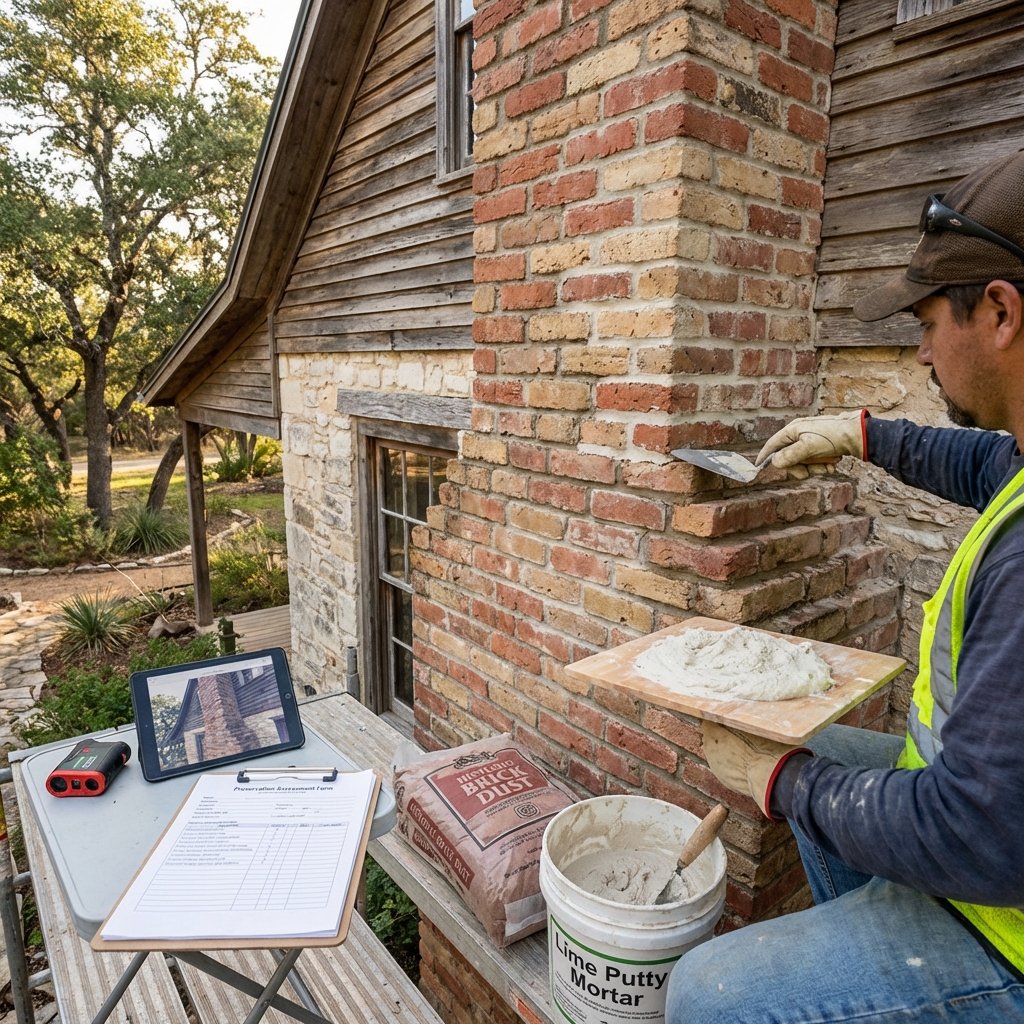
The difference shows in durability, appearance, and protection of your home’s long-term value. We simply won’t recommend shortcuts on historic properties because we’ve seen too many homeowners pay twice: once for the cheap repair, again when it fails.
Protecting Your Investment with Expert Craftsmanship
Your home is likely your largest investment. The chimney might seem like a minor system until water starts appearing in your bedroom or mold develops behind walls. Prevention through proper preservation methods is far less expensive than remediation.
We approach every historic chimney job as if it were our own home. That means honest assessment, proper materials, careful technique, and willingness to spend time getting details right. You won’t rush us, and we won’t rush the work.
We’re also transparent about costs and timelines. Preservation-sensitive repointing takes longer than budget alternatives. We’ll tell you exactly how long a job will take and what materials we’re using and why. You’ll understand the investment and the reasoning behind it.
When we’re finished, your chimney will function safely for decades. Water won’t enter your home through failed mortar joints. You’ll have protection against the seasonal temperature extremes that break down masonry quickly in Texas. And your historic home will maintain the authentic character that drew you to it in the first place.
Getting Your Free Preservation Assessment Today
The first step is understanding what your historic chimney actually needs. We provide free, detailed assessments with no obligation to proceed. We’ll walk you through our findings, explain preservation standards, and answer questions about methods and costs.
Many homeowners discover their chimney isn’t as urgent as feared, or they learn about preventive steps they can take now to avoid expensive repairs later. Either way, you’ll have the information you need to make smart decisions about your home.
We serve Austin, San Antonio, and surrounding areas with same-day and next-day appointments. Call us or request your free assessment online. We’ll schedule a time that works for you, bring our documentation tools, and deliver a thorough evaluation of your chimney’s preservation needs.
Your historic home deserves expert care. Let’s protect your investment together.
If you’re dealing with dust, poor airflow, mold in your ducts, or a clogged dryer vent — don’t wait. These issues can affect your health and safety. Go Air Ducts Group are the local experts in air duct cleaning, mold removal, dryer vent cleaning, and attic insulation. Call now for a free inspection and same-day service in Austin and San Antonio.
Frequently Asked Questions (FAQ)
What’s the difference between lime mortar and Portland cement for historic chimney repair?
We use lime mortar for preservation-sensitive repairs because it’s softer and more flexible than Portland cement, which allows your historic brickwork to move naturally with temperature changes and age. Portland cement is too rigid and can actually damage the original brick by trapping moisture inside. Our team matches the original mortar composition found in your home to ensure repairs blend seamlessly and protect your chimney’s structural integrity for decades to come.
How do we match brick color and material for repairs on older Texas homes?
We source reclaimed or custom-made bricks that closely match your home’s original materials, and we test multiple options against your existing masonry before starting any work. Our specialists examine the texture, size, and weathering patterns of your current brickwork to ensure repairs are virtually indistinguishable from the original construction. Getting the match right is critical because mismatched materials can affect both the appearance of your home and how water moves through the chimney.
Why should we assess my historic chimney before recommending repairs?
Every historic home in Texas has unique preservation needs based on its age, original construction methods, and current condition, so we perform a detailed evaluation to identify exactly what your chimney requires. During our free assessment, we check for structural damage, mortar deterioration, and whether your chimney has been previously repaired with incompatible materials that need correction. This upfront examination helps us recommend the right techniques and materials so you avoid costly mistakes that could damage your home’s historical value.