
Table of Contents
- Why Texas Homeowners Need Real Evidence Before Cleaning
- The Problem With Invisible Air Duct Contamination
- Our Camera Inspection Process Reveals Hidden Problems
- How We Document Particle Counts and Debris Levels
- Comparing Visual Documentation Methods That Matter
- Before Photos Show the Real Contamination in Your Ducts
- After Photos Prove Our Cleaning Effectiveness
- Detailed Inspection Reports You Can Trust and Share
- Why Particle Count Data Protects Your Investment
- What Our Certified Technicians Find During Inspections
- Your Next Step: Schedule Your Professional Camera Inspection
- Go Air Ducts Delivers Complete Documentation You Deserve
- Frequently Asked Questions (FAQ)
Why Texas Homeowners Need Real Evidence Before Cleaning
When you call us about air duct cleaning, you deserve more than a technician’s word that your ducts need service. You deserve to see exactly what’s inside your ductwork, understand the scope of contamination, and verify that the cleaning actually worked. That’s why we built our inspection process around visual evidence, detailed documentation, and particle count data that puts real information in your hands.
Our experience serving Austin, San Antonio, Dallas, and Houston has shown us that homeowners want certainty before investing in any HVAC service. A vague recommendation to “clean your ducts” doesn’t cut it. You need proof that contamination exists, confirmation that cleaning will solve your specific problem, and documentation that justifies the investment.
When we arrive at your home, we don’t guess. We inspect with digital camera systems that let us see deep into your ductwork, capture images of what we find, and share those visuals with you before we recommend any service. This transparency builds trust and helps you make informed decisions about your home’s air quality.
Starting with photographic evidence also protects you financially. You’ll never pay for unnecessary cleaning, and you’ll have before-and-after documentation for your records, warranty claims, or future home sales. That’s the professional standard we’ve adopted across every inspection we perform.
What to do next: Request a free camera inspection with our certified technicians. We’ll provide images and a detailed report at no cost, so you can decide whether cleaning is right for your ducts.
The Problem With Invisible Air Duct Contamination
You can’t see inside your ducts without equipment. That’s the core challenge every homeowner faces. Your ductwork runs through walls, attics, and crawlspaces, hiding dust, debris, mold spores, and dead skin cells from view. Over months and years in Texas’s hot, humid climate, contamination accumulates silently while your HVAC system circulates air through all that buildup.
Many homeowners don’t realize there’s a problem until they notice symptoms: recurring allergies, stuffy rooms, higher energy bills, or visible dust settling on furniture within hours of cleaning. By then, contamination has already been circulating through your home for weeks or months.
The real issue is that standard HVAC maintenance doesn’t address duct contamination directly. Filter changes help, but they don’t remove buildup already inside your ducts. Without visual inspection, you’re operating on assumptions rather than facts. You might have serious contamination and never know it, or you might have clean ducts and spend money on unnecessary service.
This is why we invested in camera inspection technology. Once you see what’s actually inside your ductwork, the decision becomes clear and evidence-based instead of speculative.
Our Camera Inspection Process Reveals Hidden Problems
We use high-definition camera systems designed specifically for ductwork inspection. Our certified technicians feed a flexible camera probe through your duct system, starting at the main return trunk and following each branch to its end point. The camera captures video and still images in real-time, and we can zoom in to examine specific areas of concern.
During this process, we’re looking for:
- Visible dust and debris buildup on duct walls and joints
- Mold growth, which appears as dark staining or fuzzy growth
- Debris from construction, rodent activity, or deteriorated duct insulation
- Blockages that reduce airflow
- Separation or damage to duct seams and connections
- Condensation or moisture signs that indicate humidity problems
The camera gives us a complete picture of your duct system’s condition. We pause the inspection at problem areas, capture high-quality photos, and document exactly what we’re seeing. This methodical approach takes 45 minutes to an hour, depending on your home’s size and duct layout, but it eliminates guesswork.
By the time we finish, you have a visual record of your ductwork’s current state. That’s the foundation for every cleaning recommendation we make.
How We Document Particle Counts and Debris Levels
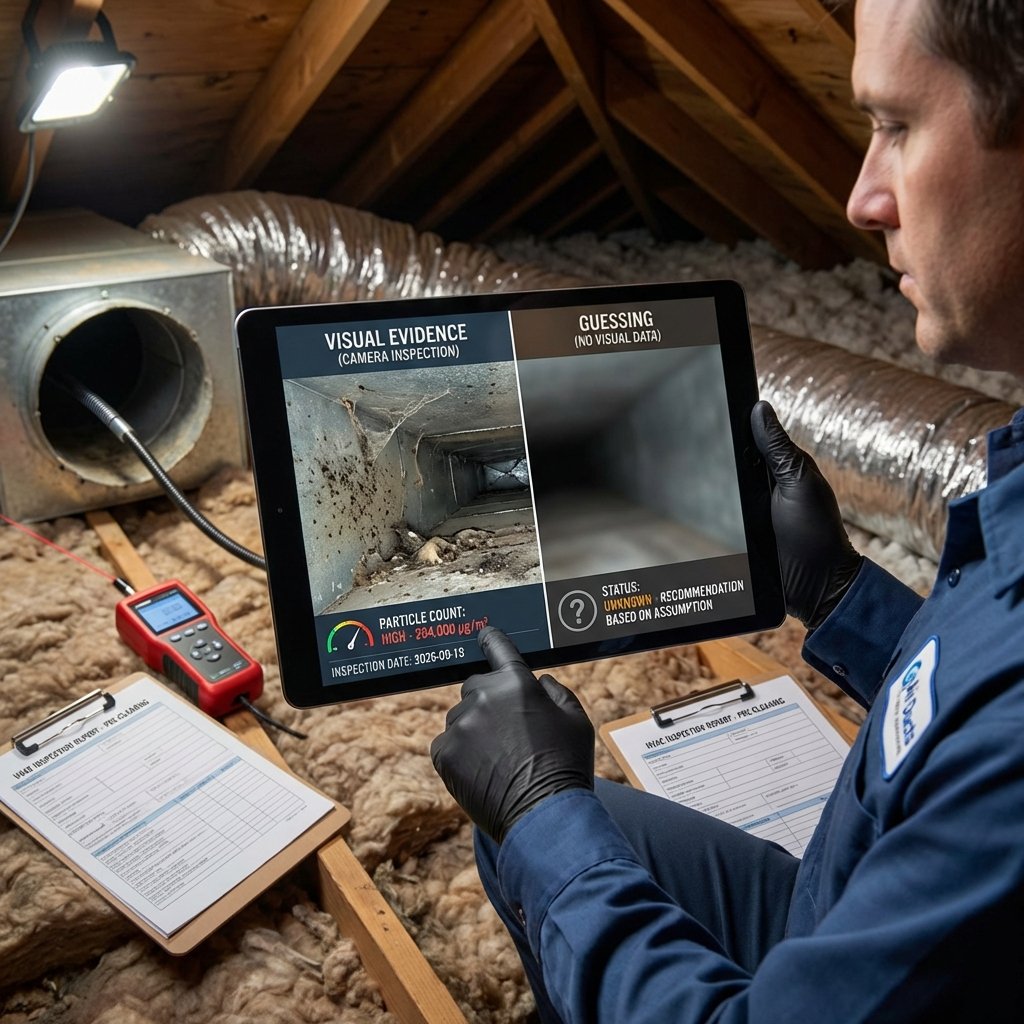
Visual inspection alone tells part of the story, but we take documentation further by measuring particle counts before and after cleaning. We use laser particle counters to quantify dust and debris in your indoor air, establishing a baseline that shows the real impact of contamination.
This involves collecting air samples from multiple rooms in your home and analyzing particle sizes (we measure particles at 0.3 microns, 0.5 microns, 1 micron, 2.5 microns, and 5 microns). The data shows how much particulate matter is circulating through your living spaces. When contamination is severe, these numbers are often 3 to 5 times higher than acceptable indoor air quality standards.
After we complete cleaning, we collect new samples from the same locations. The difference is striking. Homeowners consistently see particle counts drop by 60 to 80 percent after professional duct cleaning combined with filter replacement and system flushing.
We include these measurements in your final inspection report, paired with camera photos and our professional assessment. The combination of visual evidence plus quantified data gives you confidence that the service delivered measurable results for your home’s air quality.
Comparing Visual Documentation Methods That Matter
Not all inspection documentation is equal. Some companies rely on verbal descriptions or generic inspection checklists. Others provide blurry photos taken at poor angles. We’ve found that thorough documentation requires multiple methods working together.
Here’s what we prioritize:
High-definition still photos taken at multiple angles inside each duct section, with lighting positioned to highlight contamination and problem areas clearly
Timestamped video footage showing the camera’s path through your ductwork, which gives you context and helps you understand your system’s layout
Labeled diagrams of your duct system with annotations showing where specific issues were found
Particle count reports with before-and-after measurements and industry-standard comparisons
Professional written assessment that explains findings in plain language and details what cleaning will address
Generic checklists and vague notes don’t tell you much. You need photos you can examine yourself, data you can verify, and explanations you can understand. That’s the documentation standard we maintain because it’s the only approach that truly serves homeowners.
Before Photos Show the Real Contamination in Your Ducts
When we share before photos with you, they often surprise homeowners who assumed their ducts were reasonably clean. It’s one thing to suspect contamination; it’s another to see it in sharp detail.
Common findings in before photos include:
- A layer of gray-brown dust coating duct surfaces, sometimes up to an eighth of an inch thick
- Clumps of debris in corners and joints where dust has compacted
- Dark staining indicating mold growth, particularly in return air ducts where humidity is higher
- Visible rodent droppings or nesting material in attic ductwork
- Deteriorated duct insulation releasing fibers into the airstream
- Accumulated lint and pet hair that has bypassed filters
Seeing these images often shifts homeowners’ perspective from “maybe I should clean my ducts” to “I definitely need to clean my ducts.” The visual evidence is more persuasive than any explanation we could provide verbally. Once you’ve seen dust buildup inside ducts that affect your family’s daily breathing, the urgency becomes real.
These before photos also serve as a baseline for comparison. When we return to complete cleaning, you’ll see the exact same duct sections transformed, which creates undeniable proof of the work performed.
After Photos Prove Our Cleaning Effectiveness
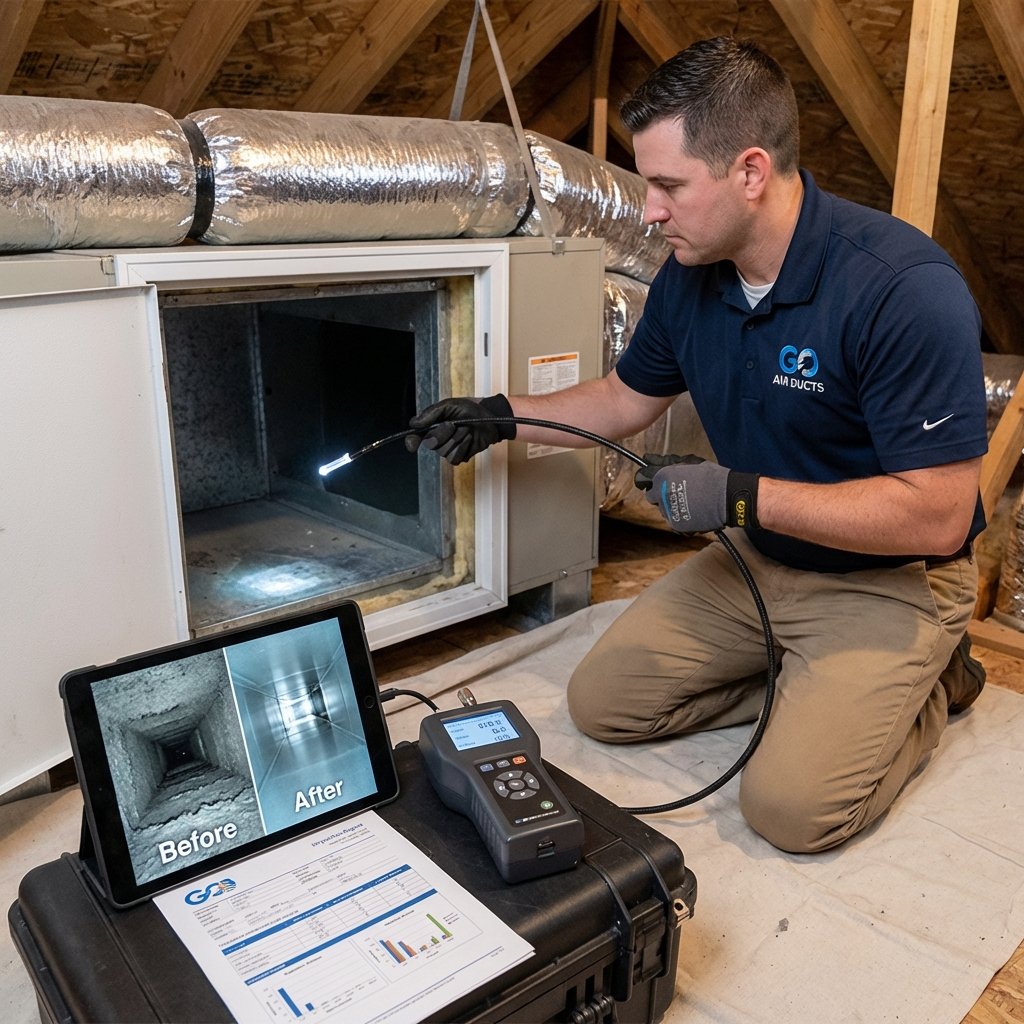
After cleaning, we photograph the same duct sections we documented before. The transformation is visible and dramatic. Duct walls that were gray with dust become clean white metal or fiberglass. Joints that were caked with debris are now clear. Mold staining is gone. Blockages are removed.
Seeing before-and-after photos side by side removes any doubt about whether cleaning was necessary or whether it actually worked. You’re not relying on our assurance; you’re seeing the results with your own eyes.
We also video-record portions of the cleaning process so you understand the equipment and methods we used. You’ll see our truck-mounted vacuum system drawing debris out of your ducts, the manual agitation equipment breaking up compacted dust, and the final verification passes confirming that contamination has been removed.
This documentation creates accountability. We’re confident enough in our work to show you exactly what we did and what your ducts look like afterward. That’s the professional standard every homeowner should expect.
Detailed Inspection Reports You Can Trust and Share
Every inspection concludes with a comprehensive written report. We don’t just hand you photos and leave; we provide a professional document that you can share with your real estate agent, insurance company, or future buyers if you ever sell your home.
Our reports include:
- Executive summary of overall duct system condition
- Detailed findings from each duct section with location references
- High-resolution photos with captions explaining what’s visible
- Particle count data with before-and-after measurements
- Cleaning recommendations and scope of work
- Industry-standard air quality comparisons
- Timeline and pricing for recommended services
- Warranty and follow-up information
The report is formatted professionally, easy to understand, and complete enough to serve as documentation of the work performed and results achieved. If you ever need to file an insurance claim related to mold or contamination, or if you’re preparing your home for sale, these reports provide third-party evidence of the condition and remediation work.
We also provide digital copies via email and keep records on file, so you can access your inspection history anytime you need it.
Why Particle Count Data Protects Your Investment
Particle count testing might seem like an optional add-on, but we include it as standard in every comprehensive inspection because it quantifies the real-world impact of contamination on your home’s air quality.
Here’s why this matters financially: Insurance companies, real estate professionals, and indoor air quality specialists recognize particle count data as objective evidence. If you’re dealing with a mold remediation claim, selling your home, or concerned about asthma or allergy triggers, particle count reports provide documentation that proves air quality issues exist and have been resolved.
Without this data, you’re relying on visual assessment and professional opinion, which are valuable but subjective. Particle counts are measurable, repeatable, and comparable to industry standards. They show that the investment in professional cleaning delivered measurable improvement to the air your family breathes.
We’ve found that homeowners with particle count documentation often feel more confident about the service and more willing to maintain clean ducts through regular filter changes and occasional cleaning. The data motivates better maintenance because you understand the real impact of your HVAC system’s cleanliness.
What Our Certified Technicians Find During Inspections
Our technicians have performed thousands of inspections across Texas homes, and certain patterns consistently emerge. In homes with high dust production, we find duct contamination has reached concerning levels within 3 to 5 years. In older homes with original ductwork, mold growth is common, especially in return air ducts where humidity concentrates.
New construction homes often surprise owners with construction debris inside ducts that was never removed after building completion. Homes that have undergone renovations frequently have drywall dust or insulation fibers throughout ductwork if ducts weren’t sealed off during work.
Pet owners typically show elevated pet hair and dander throughout their duct systems, despite regular filter changes. This is one of the most common sources of odor and reduced airflow we discover.
Our technicians are HVAC certified and trained to recognize not just dust and debris, but also signs of deeper problems: inadequate duct sealing that wastes conditioned air, undersized ducts causing pressure imbalances, or disconnected branches that explain why certain rooms run hot or cold.
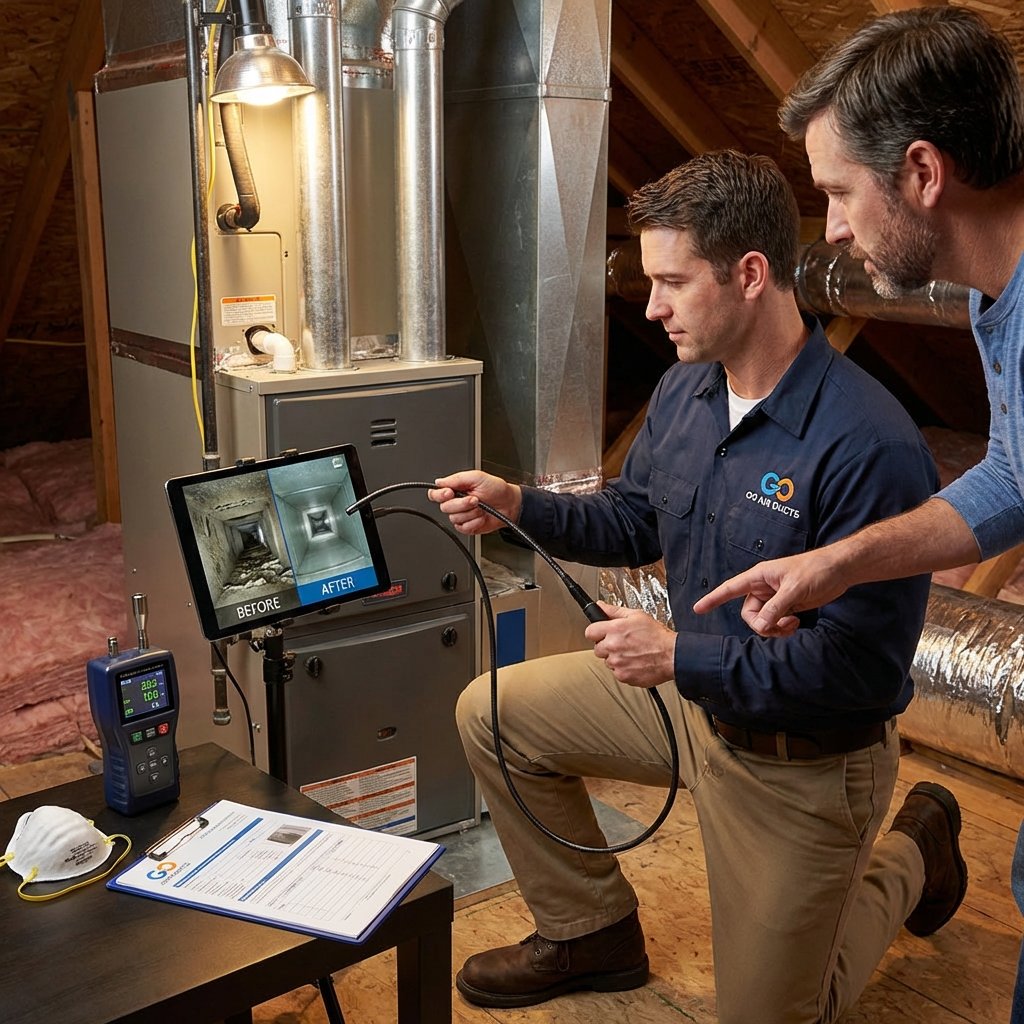
This expertise means our inspections reveal not just what to clean, but also what systemic issues your HVAC setup may have. Sometimes cleaning alone isn’t enough; sometimes our recommendations include sealing, insulation, or equipment adjustments that produce better long-term results.
Your Next Step: Schedule Your Professional Camera Inspection
Now that you understand why visual evidence and documented data matter for air duct cleaning decisions, the next step is simple: contact us for a free camera inspection and detailed report.
We’ll schedule a convenient time, arrive with our inspection equipment, perform a thorough visual assessment of your ductwork, and provide you with professional documentation of what we find. If cleaning is recommended, we’ll explain exactly what we’ll address and how it will benefit your home’s air quality and HVAC efficiency.
You’re not obligated to move forward with any service based on the inspection. Many homeowners book an inspection simply to understand their duct system’s current condition. That baseline knowledge is valuable regardless of whether you decide to clean immediately or wait.
Call us today or visit Go Air Ducts to request your free inspection. We serve Austin, San Antonio, Dallas, and Houston with same-day and next-day scheduling available in most areas.
Go Air Ducts Delivers Complete Documentation You Deserve
We built our inspection process around transparency because we know that professional air duct cleaning is an investment that deserves clarity, not pressure or guesswork. From the moment our technicians arrive with camera equipment, you’re getting evidence-based assessment rather than recommendations based on assumptions.
When we show you before and after photos, particle count data, and detailed inspection reports, you’re seeing exactly what exists in your ductwork and exactly what our cleaning accomplished. No vague promises. No generic recommendations. No hidden contamination.
That’s the Go Air Ducts difference. We document thoroughly, explain clearly, and deliver results you can see and verify. Whether you’re concerned about indoor air quality, allergies, mold, or simply want to optimize your HVAC system’s performance, our camera inspections provide the foundation for smart decisions and effective solutions.
Your ducts deserve professional attention, and you deserve complete transparency about what’s happening inside them. Let us show you what we find, explain what it means, and help you breathe more comfortably in your home.
For further reading: Duct cleaning before heater, Hidden dust problems.
If you’re dealing with dust, poor airflow, mold in your ducts, or a clogged dryer vent — don’t wait. These issues can affect your health and safety. Go Air Ducts Group are the local experts in air duct cleaning, mold removal, dryer vent cleaning, and attic insulation. Call now for a free inspection and same-day service in Austin and San Antonio.
Frequently Asked Questions (FAQ)
Why should I request camera inspection photos before and after our air duct cleaning service?
We include camera inspection documentation because you deserve to see exactly what we’re removing from your ducts. Our before photos show the contamination, particle buildup, and debris that’s affecting your indoor air quality, while our after photos prove the results you’re paying for. This visual evidence protects your investment and gives you concrete proof that your HVAC system is actually cleaner.
How do particle count tests strengthen our inspection reports?
We use particle count data to measure the actual contamination levels in your ductwork before cleaning and again after we finish. This scientific documentation backs up what our camera inspection reveals and shows you the measurable improvement in your air quality. When we provide you with this data in your inspection report, you have objective proof of the problem and the solution we delivered.
What can I expect to find in my detailed inspection report from Go Air Ducts?
Our reports include camera inspection photos, particle count measurements, documentation of any mold or debris we discovered, and a breakdown of problem areas in your specific ductwork. We give you this information so you understand your home’s air quality condition and can make informed decisions about additional services like insulation upgrades or chimney inspection. You’ll receive a professional document you can reference or share with future buyers or your insurance company.