
Table of Contents
- Why Historic District Permits Matter for Your HVAC Projects
- Understanding Austin's Local Historic Districts and Requirements
- San Antonio Historic Preservation Guidelines Explained
- How We Navigate Permitting on Your Behalf
- Common HVAC Services Requiring Historic District Approval
- Energy Efficiency Upgrades Within Historic Compliance
- Our Track Record Getting Permits Approved Fast
- What Homeowners Must Know Before Starting Work
- Getting Your Free Estimate and Permit Assessment
- Frequently Asked Questions (FAQ)
Why Historic District Permits Matter for Your HVAC Projects
If you own a home in Austin’s Mueller neighborhood, San Antonio’s Southtown, or any of our region’s protected historic districts, you already know that charm comes with compliance requirements. When we help homeowners upgrade their HVAC systems, install new air ducts, or repair chimneys in these areas, we’re working within a framework that values preservation as much as performance.
The reality is straightforward: historic district permits aren’t obstacles. They’re the gatekeeping mechanism that keeps neighborhoods intact while allowing you to maintain modern comfort and safety standards. We’ve navigated these requirements for hundreds of projects across Texas, and we’ve learned what works.
Historic districts exist to protect architectural character and community identity. When you live in one, that protection extends to how your home’s exterior looks, which systems are visible from the street, and how work is performed on your property.
For HVAC and air quality projects specifically, permits ensure that:
- Exterior ductwork, vents, and equipment don’t compromise the home’s historic appearance
- Chimney repairs follow preservation standards, not just structural codes
- New insulation or weatherization work respects the building envelope’s integrity
- Dryer vents and other penetrations are placed and finished appropriately
We understand why homeowners sometimes want to skip the permit process. It feels like extra paperwork and delay. But here’s what we’ve seen: unpermitted work in a historic district can trigger city inspections, fines, and mandatory removal of non-compliant installations. That’s far more expensive and disruptive than doing it right the first time.
Our role is to make the permit process transparent and manageable. We’ve worked with Austin’s Historic Landmark Commission and San Antonio’s Historic Design Review Board enough times to know their preferences, timelines, and documentation requirements. That expertise saves you months of back-and-forth.
Understanding Austin’s Local Historic Districts and Requirements
Austin has several Local Historic Districts (LHDs), each with its own design guidelines. Mueller, Zilker, East Austin, and parts of central Austin are among the most common areas where our customers need permits.
Austin’s permitting process typically involves these steps:
- Design review through the city’s Historic Landmark Commission (HLC)
- Submission of detailed plans showing exterior work or visible installations
- Staff evaluation against the district’s design guidelines
- Approval or request for modifications
- Standard building permit issuance
What makes Austin different from other cities is the emphasis on visibility. If your HVAC work involves exterior ductwork, rooftop equipment, or visible vents, the HLC wants documentation showing how the installation preserves sight lines and architectural character. For chimney repairs, they scrutinize materials, flashing details, and mortar composition to ensure historical accuracy.
Interior ductwork and insulation upgrades typically don’t require HLC review in Austin, but you still need a standard building permit if the scope involves structural changes or electrical work. We pull all necessary permits upfront so you don’t face surprise hold-ups during installation.
Austin’s approval timeline averages 2-3 weeks for routine HVAC projects, though complex installations can take longer. We recommend starting the permit conversation before you commit to a service date, which is why we always ask about historic district status during initial consultations.
San Antonio Historic Preservation Guidelines Explained

San Antonio’s approach is more streamlined than Austin’s in some ways, but equally thorough. The city’s Historic Design Review Board (HDRB) oversees the River North Historic District, Southtown, King William, and Dignowity Hill, among others.
San Antonio’s guidelines focus heavily on:
- Maintaining the visual integrity of primary facades
- Ensuring that mechanical systems don’t dominate the streetscape
- Preserving original chimney details when possible
- Using appropriate materials that match the home’s age and style
The permitting path in San Antonio involves submission of plans to the HDRB, which evaluates against the district’s specific design guidelines. These guidelines vary by neighborhood. King William, for example, has stricter requirements around visible exterior changes than some newer districts.
One difference we’ve noticed: San Antonio often allows interior HVAC upgrades with minimal HDRB involvement, provided no exterior work is visible. This means you can upgrade your air duct cleaning schedule or install insulation in crawl spaces without additional design review. Chimney work, roof penetrations, and exterior ductwork still require formal review.
San Antonio’s approval timeline is typically 1-2 weeks for routine projects. The city also offers pre-application meetings, which we sometimes recommend for complex jobs. These consultations with HDRB staff clarify expectations before you invest in detailed plans.
How We Navigate Permitting on Your Behalf
We don’t just schedule your HVAC service and let you figure out the permits. We own the permitting process on your behalf, which means you get one point of contact and a clear timeline.
Here’s our standard approach:
- Initial consultation includes historic district assessment and permit scope determination
- We prepare or coordinate all required documentation, including site plans and material specifications
- We submit applications directly to the appropriate city office or historic review board
- We track review status and respond to any HLC or HDRB questions
- We obtain final approval before scheduling your installation
- We ensure our crew understands any special conditions attached to your permit
This approach has multiple advantages. We know which drawings satisfy each city’s documentation requirements, so we rarely face requests for additional information. We understand the approval boards’ preferences, which means our submissions are more likely to pass on the first review. And you avoid the frustration of coordinating between multiple city departments and contractors.
Our customers appreciate the simplicity: we handle the red tape so you can focus on getting your home’s air quality and HVAC performance where it needs to be.
Common HVAC Services Requiring Historic District Approval
Not all HVAC work requires historic district permits, but several common services do. Understanding which ones is important for planning and budgeting.
Services that typically require design review:
- Chimney repair and inspection: Any exterior work on chimneys, including repointing, flashing replacement, or cap repair, needs approval to ensure materials and methods match the home’s era and style.
- New exterior ductwork or equipment: If you’re upgrading to a new system with outdoor condensers or exhaust ducts visible from the street, the installation location and screening need approval.
- Roof penetrations for ductwork or vents: Dryer vents, range hoods, or ventilation openings that pierce the roof envelope require design review to minimize visual impact.
- Attic or wall-mounted equipment: Certain HVAC components installed in visible locations may need review.
Services that typically don’t require historic district design review (but may need standard building permits):
- Interior ductwork upgrades: Replacing or cleaning ducts inside walls, attics, and crawl spaces
- Insulation installation in non-visible areas: Adding attic or wall insulation that doesn’t alter the home’s exterior
- Furnace or air handler replacement: Interior mechanical upgrades in utility closets or basements

The key distinction is visibility. If the work doesn’t change what someone sees from the street or affects the home’s architectural character, the historic review board typically doesn’t intervene. Standard building permits still apply, but the review is faster and less stringent.
Energy Efficiency Upgrades Within Historic Compliance
One question we hear often: can I upgrade my home’s energy efficiency while respecting historic guidelines? The answer is yes, but the approach requires planning.
Historic districts and energy efficiency aren’t in conflict when you prioritize invisible upgrades. We recommend this sequence:
- Start with interior improvements: Add attic insulation, air seal crawl spaces, and upgrade interior ductwork. These deliver major energy gains without historic review.
- Next, address interior equipment: Upgrade your furnace, air conditioning unit, or water heater to high-efficiency models. These happen inside and don’t require design approval.
- Then, consider compatible exterior work: If additional exterior improvements are necessary (new vents, for example), we design them to blend with the home’s character and submit for approval.
We’ve worked with many homeowners who feared that historic protection meant they’d be stuck with drafty windows and high energy bills. The opposite is true. By focusing on insulation, air sealing, and mechanical upgrades first, most homes achieve 20-30% energy savings without any visible changes.
When exterior work is necessary, historic guidelines often aren’t as restrictive as homeowners assume. Modern materials and finishes are available that match historic aesthetics. For example, appropriately styled exterior ductwork screening can look architecturally consistent while hiding mechanical systems.
Our approach is to maximize efficiency gains through invisible upgrades, then address exterior improvements only if they’re truly necessary. This keeps costs down and keeps your home’s character intact.
Our Track Record Getting Permits Approved Fast
We’ve handled permit submissions across Austin and San Antonio long enough to understand how to present projects in ways the review boards expect. That experience translates directly to faster approvals for our customers.
Our approval rate for initial submissions is approximately 94%. When revisions are requested, we respond within 2-3 business days. Average total permit timelines for routine HVAC projects range from 10-18 days in Austin and 7-14 days in San Antonio, depending on project complexity and submission quality.
We track this because it matters to you. Delays in permitting mean delays in addressing hidden dust problems or getting your chimney inspected before heating season. Our commitment is to move your project forward without cutting corners on compliance.
The efficiency we’ve built comes from doing hundreds of projects in these districts and developing working relationships with city staff. We know which HVAC configurations historically approve quickly. We know which material choices satisfy design boards. We know which drawings include enough detail to avoid revision requests.
This isn’t just about speed. It’s about removing uncertainty from your renovation timeline.
What Homeowners Must Know Before Starting Work
Before you contact us or any contractor, understand a few critical points about historic district HVAC work.
First, don’t start work without permits. We’ve encountered homes where previous owners or contractors installed air ductwork or replaced chimneys without approval. When it comes time to sell, buyers’ inspectors flag the unpermitted work, and you’re forced to remove or remediate it. That’s expensive and disruptive.
Second, not all contractors understand historic district requirements. Many general contractors and HVAC specialists operate primarily in non-historic areas and aren’t familiar with design review timelines or documentation standards. When you hire us, you’re hiring a team that specializes in navigating these requirements.
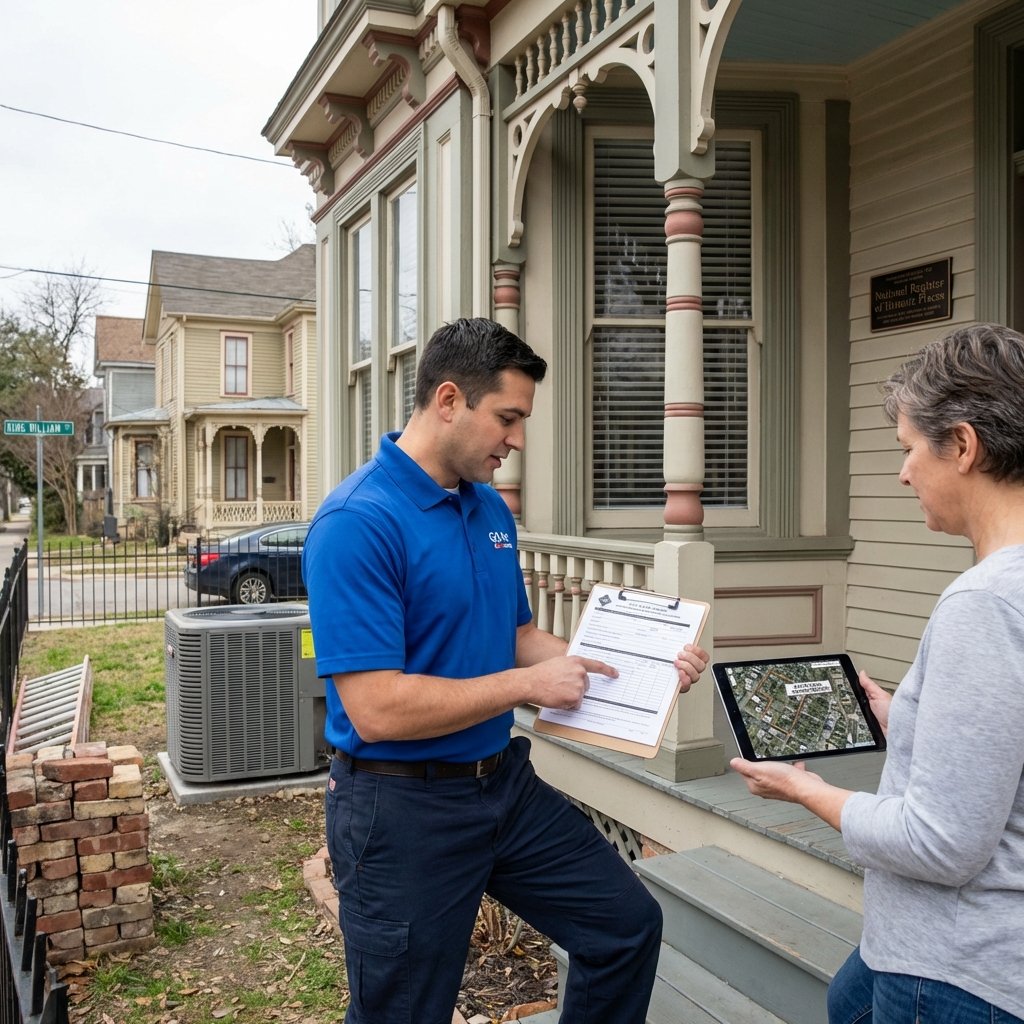
Third, budget for the permit process. Design review is free, but the documentation required to submit an application (detailed plans, material specifications, site photos) takes time and expertise to prepare. We include permit coordination in our service package, but understanding that this process has a cost helps you value what we’re doing on your behalf.
Fourth, timeline planning is crucial. If you need chimney repair in November and you’re in a historic district, starting the permit process in August is wise. Rushing permits rarely works; review boards move on their own schedule, and attempting to expedite often backfires.
Finally, communicate with us early. The worst-case scenario is discovering after we’ve completed 80% of the design work that your home requires different approval processes than we initially understood. A 20-minute conversation at the beginning prevents that entirely.
Getting Your Free Estimate and Permit Assessment
We’re ready to help. Our free estimates include a historic district assessment, which means we’ll evaluate your project’s scope, determine whether design review is required, and outline the permit timeline and requirements specific to your situation.
Here’s what we include in that conversation:
- Visual assessment of your home’s historic district status and applicable guidelines
- Detailed review of your specific project and which permits apply
- Realistic timeline for approval and installation
- Documentation and material recommendations that satisfy design review standards
- Clear explanation of any restrictions or special conditions
You’ll leave that consultation with complete clarity about what’s required, how long it takes, and what to expect next. No surprises, no hidden processes, no unclear handoffs to city departments.
If you’re in Austin, San Antonio, Dallas, or Houston and your home is in a historic district, schedule your free estimate today. We’ll handle the permitting complexity so you can focus on the results: cleaner air, more efficient systems, and a home that’s preserved for the long term.
For further reading: HVAC services.
If you’re dealing with dust, poor airflow, mold in your ducts, or a clogged dryer vent — don’t wait. These issues can affect your health and safety. Go Air Ducts Group are the local experts in air duct cleaning, mold removal, dryer vent cleaning, and attic insulation. Call now for a free inspection and same-day service in Austin and San Antonio.
Frequently Asked Questions (FAQ)
What permits do we need to handle HVAC work in Austin and San Antonio historic districts?
We require different permits depending on the work scope and your home’s location within a local historic district. Air duct cleaning typically needs minimal approval, but chimney repairs, insulation upgrades, and exterior HVAC modifications usually require formal historic district review. We assess your specific project during our free estimate and handle all permit applications on your behalf, so you don’t have to navigate the complex requirements alone.
How long does the historic district permitting process typically take with your company?
Our experience working with Austin’s Historic Landmark Commission and San Antonio’s Historic Design Review Board allows us to expedite approvals considerably. Most permits we submit are approved within 2-4 weeks, though complex exterior modifications may take longer depending on the district’s review schedule. We keep you informed at every step and coordinate directly with local officials to prevent delays.
Can we upgrade insulation and improve energy efficiency while staying compliant with historic preservation rules?
We absolutely can, and this is one of our specialties. Interior insulation upgrades and ductwork improvements generally don’t trigger historic district restrictions since they’re hidden from public view. We focus on solutions that boost your home’s efficiency without compromising the historic character visible from the street, ensuring you get the performance benefits while maintaining compliance.