
Table of Contents
- Why Texas Homeowners Need Advanced Air Purification
- Understanding UV Light Purification Technology
- How HEPA Whole-Home Filtration Works
- Comparing Effectiveness Against Allergens and Mold
- Long-Term Maintenance and Cost Considerations
- Why We Recommend Combining Both Systems
- Our Professional Installation Advantage
- Real Results Our Customers Experience
- Getting Your Free In-Home Air Quality Assessment
- Next Steps to Cleaner Indoor Air
- Frequently Asked Questions (FAQ)
Why Texas Homeowners Need Advanced Air Purification
Texas heat and humidity create the perfect environment for dust, mold spores, and allergens to thrive inside your home. If you’re noticing dust settling on surfaces within days of cleaning, or if family members experience allergies year-round, your current HVAC system likely isn’t capturing what’s circulating through your ducts.
We’ve inspected hundreds of homes across Austin and San Antonio, and the pattern is consistent: standard 1-inch disposable filters catch only large particles while microscopic allergens, pet dander, and mold spores slip right through. When these contaminants circulate repeatedly through your ductwork, they accumulate on coils, in registers, and deep within your ducts themselves. This buildup reduces airflow, forces your system to work harder, and drives up energy bills while degrading indoor air quality.
Advanced air purification goes where traditional filters stop. Whether through UV light technology or HEPA-grade whole-home systems, these upgrades intercept particles before they settle in your living spaces. For Texas homeowners dealing with seasonal mold concerns, pet allergies, or dust sensitivities, the right system can transform how your home feels and breathes.
The key question isn’t whether you need better air purification, but which technology best fits your home’s specific challenges.
Understanding UV Light Purification Technology
UV-C light air purification works by using ultraviolet radiation to neutralize biological contaminants as air passes through your HVAC system. When installed at the furnace or air handler, the UV bulb emits light at a wavelength that damages the DNA of bacteria, viruses, and mold spores, preventing them from reproducing.
Here’s what makes UV systems effective: they target microscopic organisms directly rather than trying to catch them mechanically. A mold spore trying to settle in your ductwork gets eliminated before it colonizes. Bacteria that would otherwise thrive in humid ductwork are neutralized. During Texas humidity spikes, this becomes especially valuable because our damp conditions naturally encourage microbial growth.
The practical advantage is straightforward. UV systems require minimal maintenance beyond replacing the bulb annually. They don’t slow airflow like dense filters do, so your HVAC system maintains efficiency. They’re also compact and integrate cleanly into existing ductwork without major modifications.
The limitation: UV light only works on organisms passing directly under the bulb. Dust, pollen, and particulate matter aren’t eliminated by UV light; they’re simply allowed to pass through if not captured by other filtration. This is why UV systems excel at biological contamination but need backup filtering for comprehensive particle removal.
How HEPA Whole-Home Filtration Works
HEPA filters (High-Efficiency Particulate Air) capture 99.97% of particles 0.3 microns and larger. At that scale, you’re trapping pollen, dust mites, pet dander, and most mold spores. These filters are woven with random fibers that create a mechanical barrier; particles can’t bypass them the way they slip through standard filters.
We install HEPA systems as part of your home’s central return air ductwork, meaning all air circulating back to your furnace passes through this single, highly efficient stage. That centralized placement makes a critical difference compared to portable room filters, which only clean one space at a time.
The engineering is straightforward but powerful. HEPA filtration doesn’t rely on electricity to function; it’s purely mechanical capture. The filter media itself does all the work, which means no additional components to malfunction. When properly installed, a whole-home HEPA system begins working immediately and catches particles consistently throughout the day.
One reality to understand: HEPA filters are denser than standard filters, which means they restrict airflow slightly more. Your furnace blower has to work a bit harder to push air through. It’s not a deal-breaker, but it’s worth accounting for in your system design. We ensure your equipment is properly sized to handle the increased resistance without compromising comfort or efficiency.
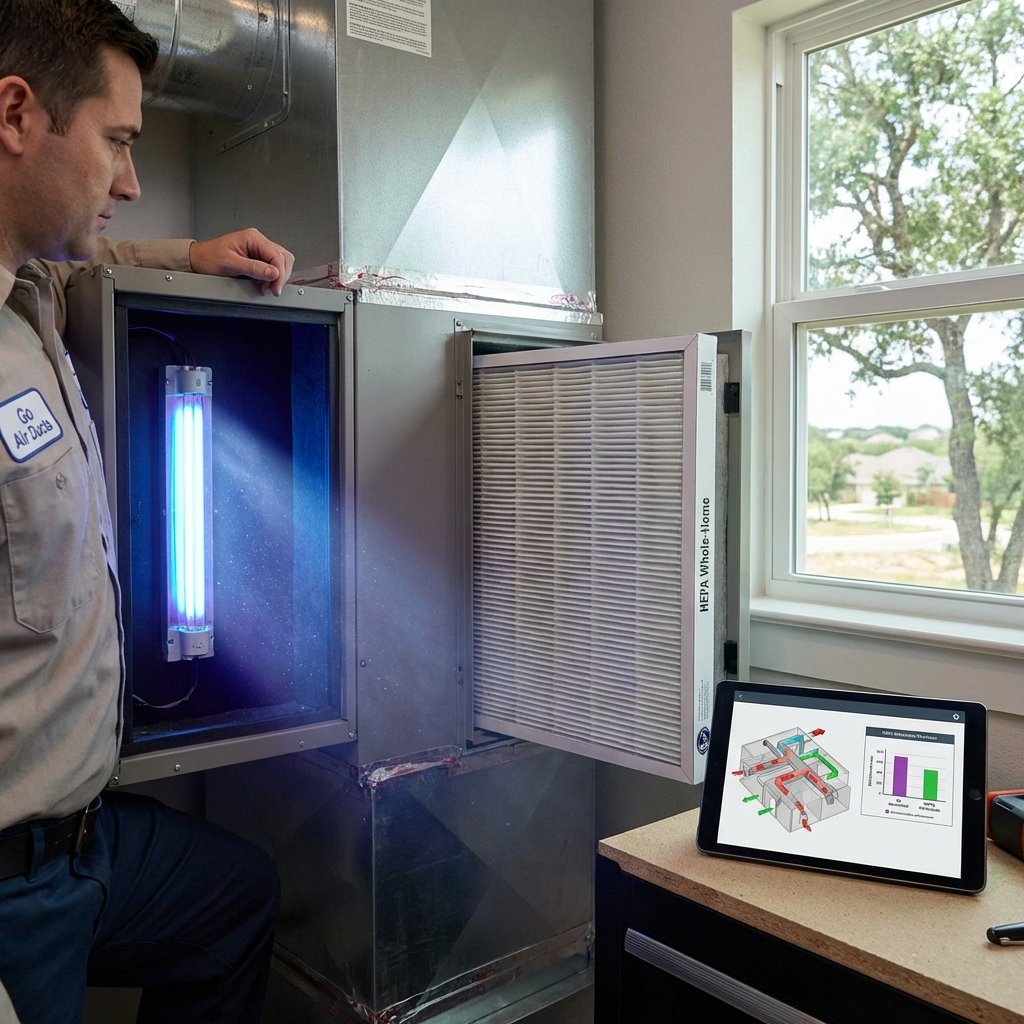
Comparing Effectiveness Against Allergens and Mold
In our experience servicing homes across Texas, these two contaminants cause the most complaints: airborne allergens triggering symptoms daily, and mold developing inside ducts where moisture settles.
HEPA filtration dominates for dust-based allergens. If your household struggles with pet dander, pollen, or dust mite populations, a HEPA whole-home system delivers rapid relief. Families report noticing cleaner surfaces and fewer allergy symptoms within the first week. The mechanical capture is immediate and doesn’t require biological processes to work; it simply traps particles.
UV light excels where mold becomes a problem. If we discover active mold growth during an inspection, or if your ducts have a musty odor indicating microbial activity, UV purification directly addresses the source. The UV radiation prevents spore reproduction at the root, rather than trying to catch every spore after it’s already present.
Here’s what we’ve observed in practice: homes with both dust sensitivity and recurring mold issues benefit most from combining both technologies. Someone dealing only with seasonal pollen allergies might find HEPA sufficient. A home with known duct mold and humidity control challenges benefits more from UV. Most Texas homes have elements of both problems, which is why we increasingly recommend integrated solutions.
The honest assessment: neither system alone is a substitute for proper duct cleaning. If your ducts already contain significant mold colonies or thick dust layers, even the best purification system can’t clean them retroactively. That’s where our professional duct cleaning service matters first, followed by upgrading to advanced purification to prevent recurrence.
Long-Term Maintenance and Cost Considerations
Budget matters for air purification upgrades, and understanding the real costs helps you make an informed decision.
HEPA whole-home filtration requires filter replacement every 6-12 months depending on household dust levels, pets, and occupancy. Quality HEPA filters cost between $150-$300 per replacement. That’s an annual maintenance expense, but the cost is predictable and straightforward. You’re not repairing components; you’re simply replacing wear items.
UV light systems involve bulb replacement annually, typically costing $75-$150 per year. The systems themselves are durable, with minimal moving parts. Once installed, operational costs are low. The initial investment for UV installation ranges from $500-$1,000 depending on your ductwork configuration.
HEPA whole-home systems cost more upfront, generally $1,200-$2,500 installed, but the investment pays dividends across energy efficiency over time. Because HEPA filters are centralized, they’re easier to maintain than replacing filters in multiple locations throughout a home.
Long-term math tells the story: a HEPA system might cost $200-$300 annually in filter replacements, while providing superior particle removal. UV adds roughly $100-$150 yearly in bulb maintenance. The combined cost of both systems, roughly $300-$450 annually, is substantially less than what most homeowners spend managing allergies through medication, air purifier repairs, or dealing with energy loss from restricted airflow in undersized filtration.
When you factor in that these systems typically last 15-20 years before replacement, the per-month investment becomes minimal relative to the quality-of-life improvement and energy savings you’ll experience.
Why We Recommend Combining Both Systems
After years of installing air purification across Austin and San Antonio, we’ve learned that Texas homes need layered defense.
HEPA filtration and UV light target different problems. HEPA traps particles mechanically; UV neutralizes organisms biologically. In a home with pets, residents with allergies, and our region’s humidity challenges, relying on one technology leaves vulnerabilities. During summer months when moisture peaks, mold pressure increases even with good filtration. During spring pollen season, particle volume spikes beyond what UV alone handles.
A combined approach means your home benefits from particle capture (HEPA) and biological contamination prevention (UV) simultaneously. The systems work in tandem rather than competing. Your return air gets filtered mechanically before passing through the UV chamber, meaning the UV bulb stays cleaner longer because it’s not overwhelmed with visible debris. That actually extends UV bulb life and improves effectiveness.
We’ve observed families who invested in both systems report the most consistent results: fewer allergy flare-ups, no musty duct odors, and stable humidity levels even during humid months. The investment is reasonable when spread across the system’s lifespan, and it represents genuine comprehensive protection rather than a partial solution.
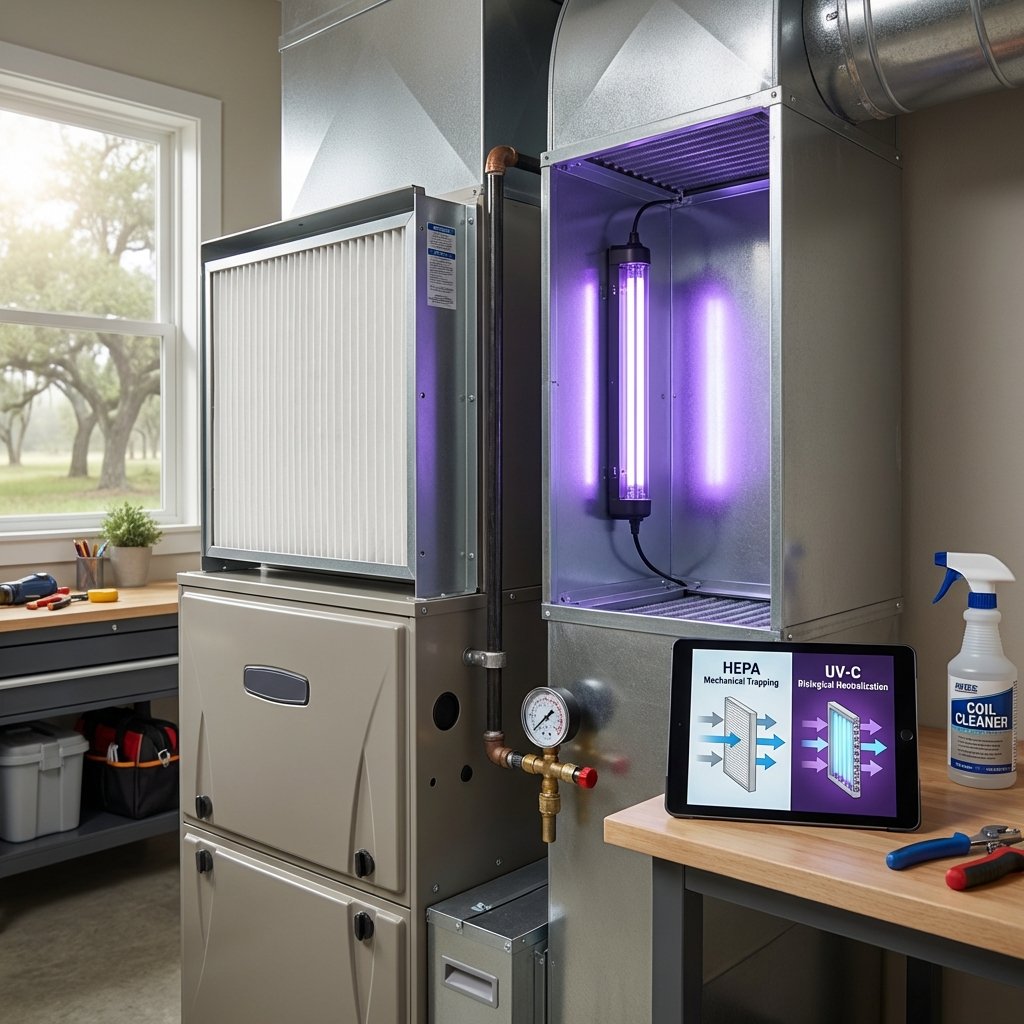
Most importantly, combining both creates redundancy. If one component needs service, the other continues protecting your home. This matters in Texas, where taking your air quality offline for extended periods isn’t practical during peak heat months.
Our Professional Installation Advantage
Installation quality separates systems that work from systems that fail. We’ve seen amateur installations where ductwork wasn’t properly sealed, creating bypass routes that eliminate the benefits of expensive filtration. That’s not just ineffective; it wastes your investment.
Our certified HVAC technicians handle installation with precision. We assess your specific ductwork configuration, measure airflow requirements, and size components correctly so your system operates efficiently without creating pressure issues. When we install HEPA whole-home filtration, we ensure your return air plenum is sealed properly so all air flows through the filter rather than around it.
For UV systems, we position bulbs strategically within your air handler where maximum air exposure occurs. We verify electrical connections meet code and ensure the UV chamber allows adequate dwell time for germicidal effectiveness. We don’t just install equipment; we design systems that solve your particular home’s air quality challenges.
We also provide clear maintenance guidance specific to your installation. You’ll understand when filters need replacing, how to safely access components for cleaning, and what signs indicate a system needs service. This transparency prevents surprise failures and keeps your system performing at peak efficiency.
Every installation includes our free system assessment afterward. We verify airflow, test filtration effectiveness, and adjust settings to optimize both efficiency and air quality. That follow-up is where we catch installation issues before they become problems.
Real Results Our Customers Experience
Our customers across Austin and San Antonio report consistent improvements once they upgrade to advanced purification systems.
One customer with two active dogs reported that within two weeks of installing our HEPA whole-home system, pet odor in the home noticeably decreased. She wasn’t constantly vacuuming to manage dust, and her asthmatic daughter had fewer nighttime symptoms. The improvement was dramatic enough that she scheduled a follow-up duct cleaning because she realized how much dust had been hiding in the system itself.
Another family in San Antonio had recurring mold odors despite regular HVAC service. We installed both UV light purification and had them invest in proper duct sealing to eliminate pressure imbalances. Within a month, the musty odor was gone, humidity levels stabilized, and they reported their energy bills actually decreased because their system wasn’t working overtime fighting mold buildup.
A commercial client with a mid-size office documented energy cost reduction of 18% after installing our HEPA whole-home system properly sized for their ductwork. Because the system was correctly engineered, airflow restrictions were minimal, and their furnace ran more efficiently. Lower operating costs plus improved employee comfort creating fewer sick days.
These aren’t outlier stories; they’re typical results we see repeatedly. The pattern is consistent: when homeowners invest in proper air purification combined with professional installation, they experience measurable health improvements and often discover unexpected energy savings because their HVAC system finally operates without fighting airflow restrictions.
Getting Your Free In-Home Air Quality Assessment
Understanding your home’s specific air quality challenges is the only way to recommend the right solution. That’s why we offer free in-home assessments for all Austin and San Antonio customers.
During your assessment, our certified technician evaluates your current ductwork, checks for mold or contamination, measures humidity levels, and discusses your household’s specific challenges. Are allergies seasonal or year-round? Do you have pets or occupants with respiratory sensitivity? Have you noticed dust settling quickly or any odors from your HVAC system?
We’ll inspect your air handler and existing filtration to understand what you’re currently capturing and what’s bypassing filters. If we discover mold during inspection, we’ll explain options for remediation. We’ll assess whether your current ductwork is sealed properly, as leaks can undermine even premium filtration systems.
The assessment includes a detailed recommendation for your home. We don’t push expensive solutions unnecessarily; we’re honest about what your home actually needs. If a HEPA system alone would solve your primary issue, we say so. If combining both UV and HEPA makes sense, we explain why and show the cost-benefit clearly.
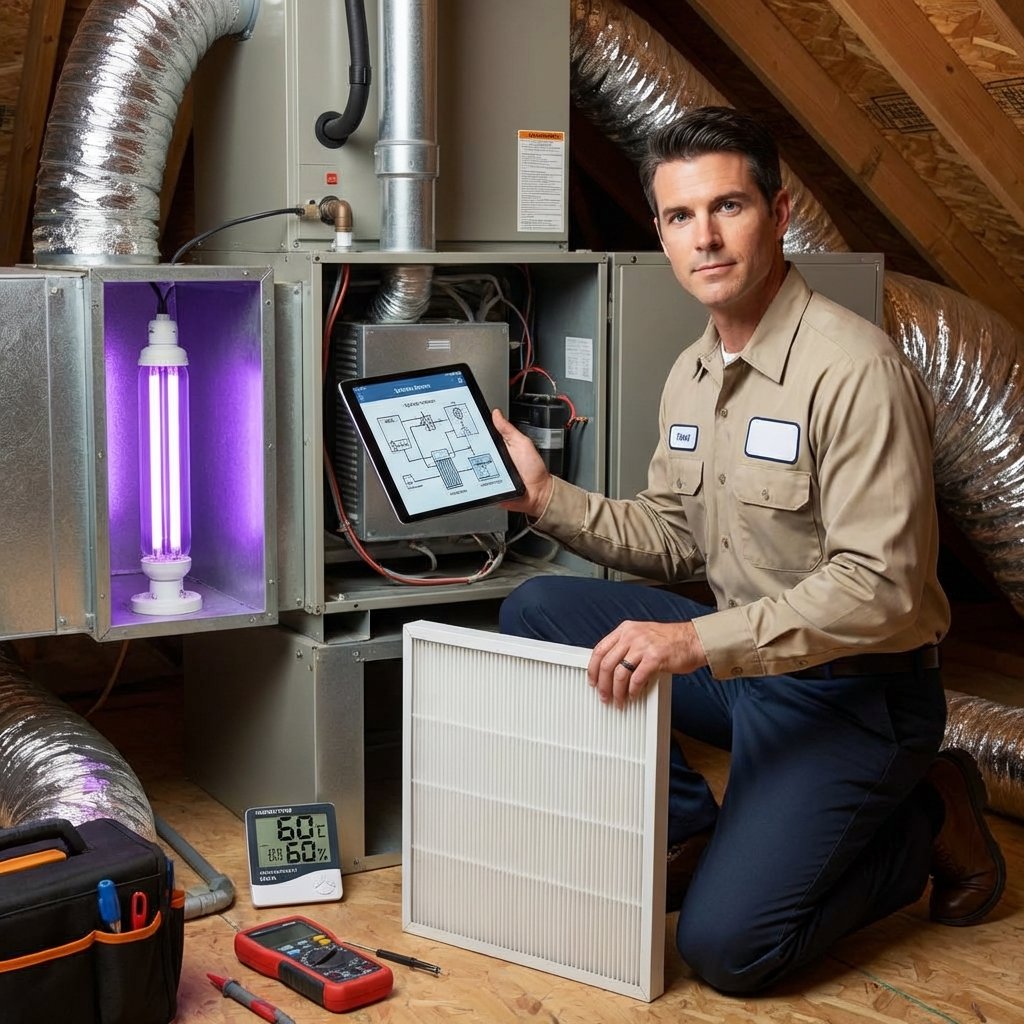
You’ll leave the assessment with a written proposal including installation costs, ongoing maintenance expenses, and realistic timelines. There’s no obligation, and you’ll have the information you need to make a confident decision.
To schedule your free assessment, call us or visit our website. Same-day availability is common, and we can often schedule within your preferred timeframe across our Dallas, Houston, Austin, and San Antonio service areas.
Next Steps to Cleaner Indoor Air
If you’re experiencing allergies, noticing dust buildup, or detecting musty odors from your HVAC system, the solution is actionable and affordable. You don’t need to live with compromised indoor air quality.
The immediate step is scheduling that free assessment. Come prepared with a list of air quality issues you’ve noticed: Do you dust weekly only to see surfaces dirty again? Do family members have allergy symptoms that seem tied to seasons? Has someone commented that your home smells musty or stale? These details help us recommend accurately.
Once we assess your home, you’ll understand exactly what’s needed and what it costs. Most customers are surprised at how affordable comprehensive air purification becomes when installed correctly as part of a broader HVAC strategy rather than as an isolated add-on.
We stand behind our installations with warranties and ongoing support. If something isn’t performing as expected, we troubleshoot and adjust. Your investment in cleaner air is backed by our commitment to your satisfaction.
Cleaner air means fewer allergy symptoms, more energy for daily activities, and a home that simply feels fresher and healthier. That’s what our customers experience, and it’s what we’re ready to deliver for your family.
Contact us today to schedule your free in-home air quality assessment. We’ll design a solution that solves your specific challenges, install it professionally, and ensure it performs exactly as promised.
For further reading: HVAC air purification solutions.
If you’re dealing with dust, poor airflow, mold in your ducts, or a clogged dryer vent — don’t wait. These issues can affect your health and safety. Go Air Ducts Group are the local experts in air duct cleaning, mold removal, dryer vent cleaning, and attic insulation. Call now for a free inspection and same-day service in Austin and San Antonio.
Frequently Asked Questions (FAQ)
What’s the difference between UV light purification and HEPA filtration, and which one should we choose?
We recommend understanding that these systems work differently. UV light purification kills bacteria, viruses, and mold spores as air passes through the light, while HEPA filters trap particles like dust, pollen, and pet dander through mechanical filtration. Most Texas homes benefit most from combining both systems since UV handles biological contaminants and HEPA catches particulate matter that UV alone cannot address.
How much will it cost us to install a whole-home air purification system?
Costs vary based on your home’s size, existing HVAC setup, and whether you choose UV, HEPA, or both systems. Our free in-home assessments help us provide accurate pricing tailored to your specific needs and budget. We typically find that homeowners investing in these upgrades see long-term savings through improved HVAC efficiency and reduced replacement costs.
How often do we need to maintain or replace filters and UV bulbs?
We recommend replacing HEPA filters every 6 to 12 months depending on your home’s air quality and usage patterns, while UV bulbs typically last 12 to 24 months before losing effectiveness. During our maintenance visits, we check both components and advise you on replacement schedules so your system continues protecting your family’s health.