
🕑 13 min read
What attic insulation improves energy efficiency in Texas homes?
In Texas heat, properly rated attic insulation is one of the biggest factors in cooling costs and comfort. Blow-in cellulose or fiberglass at the correct R-value reduces heat transfer and eases HVAC strain. Go Air Ducts installs and upgrades attic insulation across Texas to lower energy bills and keep indoor temperatures stable year-round.
Table of Contents
- Why Attic Insulation Matters for Your Energy Bills
- How Poor Insulation Impacts Your HVAC System
- Our Proven Attic Insulation Selection Criteria
- Top Insulation Materials We Install and Recommend
- R-Value Requirements for Texas Climate Zones
- Installation Quality and Air Sealing Importance
- Why Go Air Ducts Delivers Superior Results
- Energy Savings You Can Expect
- How Our Installation Process Protects Your Home
- Comparing DIY Versus Professional Installation
- Making Your Attic Insulation Investment Decision
- Frequently Asked Questions (FAQ)
Why Attic Insulation Matters for Your Energy Bills
Your attic is either working for you or against you. We’ve inspected thousands of Texas attics over the years, and we can tell you with certainty: most homeowners are losing money every single month through poor insulation. The hot Texas sun beats down on your roof, and without proper insulation, that heat transfers directly into your living spaces. Your HVAC system then works overtime trying to cool air that’s already being heated from above. The result? Energy bills that climb higher each summer while your comfort actually decreases.
This isn’t a minor efficiency issue. We’re talking about 15 to 25 percent of your heating and cooling costs disappearing straight through an under-insulated attic. For a homeowner with a $150 monthly cooling bill during peak summer, that could mean $22 to $37 wasted every single month just because your attic insulation isn’t up to standard. That’s money you could be keeping in your pocket instead.
The science here is straightforward: insulation slows heat transfer. In Texas, that heat transfer happens in both directions. During summer, we’re fighting intense solar gain. During the few weeks of winter, we’re protecting against heat loss. But summer dominance means most Austin and San Antonio homeowners feel the summer impact most acutely.
Your attic temperature can reach 150 degrees or higher on a hot Texas day. Without adequate insulation between that space and your conditioned living areas, that extreme heat naturally moves downward, right into your bedrooms and living rooms. Your thermostat senses the temperature rise, your air conditioning kicks in harder, and your compressor runs longer. That extended runtime adds up to measurable dollars on your utility bill.
We’ve measured the difference ourselves. Homes with proper R-value insulation installed by our team consistently report 12 to 20 percent reductions in summer cooling costs within the first full season. For homeowners with average Texas energy usage, that translates to real savings: $150 to $250 per month during peak cooling season, or $1,800 to $3,000 per year. Those numbers aren’t theoretical. They come from actual customer billing data we track after installation.
What you should do next: Request a free energy assessment from us. We’ll examine your current attic insulation depth, check your R-value, and calculate your specific savings potential based on your home’s square footage and your current energy costs.
How Poor Insulation Impacts Your HVAC System
Your HVAC system is like an athlete trying to run a marathon while carrying extra weight. When your attic is poorly insulated, your heating and cooling equipment must work significantly harder to maintain your desired temperature. This increased workload shortens your system’s lifespan and increases your maintenance costs.
Here’s what happens mechanically: your air handler pushes conditioned air through your ductwork, but if your attic has inadequate insulation, the ductwork carrying that cold air heats up as it passes through the hot attic space. By the time that air reaches your supply vents, it’s already warmed by 5 to 10 degrees. Your thermostat detects this warmth, signals that cooling is still needed, and your compressor cycles on again. This constant cycling stresses your system’s components.
We’ve pulled service records from HVAC units in poorly insulated attics versus properly insulated ones. The difference in compressor runtime is dramatic. Poor insulation means your compressor runs 30 to 40 percent longer every cooling day. That translates to faster wear on compressor valves, earlier refrigerant leaks, and a unit that fails at year 12 instead of year 15 or 16.
There’s also a humidity component. Texas humidity is relentless, especially in the afternoon. When your HVAC system struggles to cool effectively because of attic heat gain, it can’t dehumidify as efficiently. That excess moisture stays in your home, making you feel hotter and encouraging mold growth in hidden spaces.
Actionable insight: Combining proper attic insulation with professional duct sealing energy savings creates a one-two punch that maximizes your HVAC efficiency and extends equipment life. We recommend both together for optimal results.
Our Proven Attic Insulation Selection Criteria
When we evaluate whether an attic needs new insulation or an upgrade, we follow a systematic approach that considers climate, home construction, current conditions, and long-term performance.
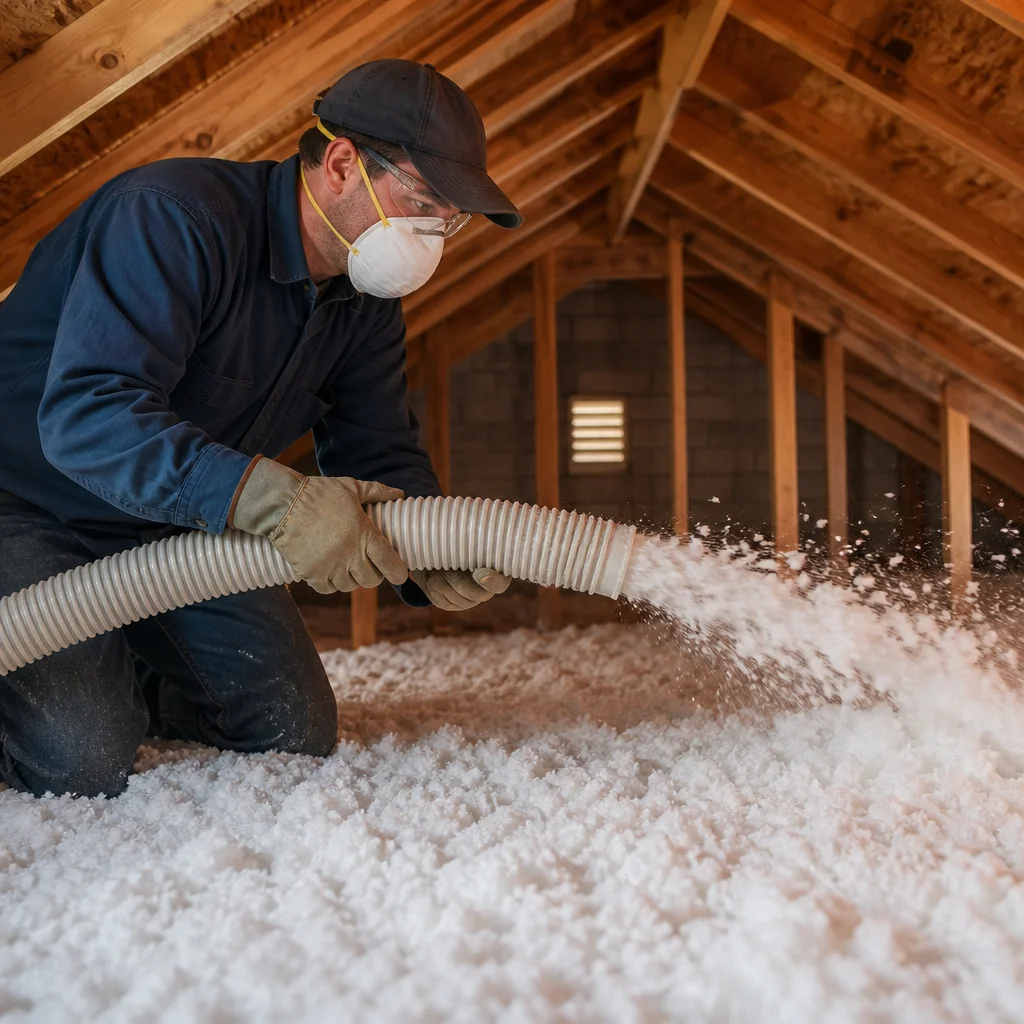
First, we measure existing insulation depth and identify the R-value that’s currently installed. We also check for missing insulation around pipes, wires, and ductwork. Many Texas homes were built without adequate insulation coverage, especially in corners and around mechanical systems.
Second, we assess moisture and ventilation conditions. A well-insulated attic must also breathe properly. If your roof doesn’t have adequate soffit and ridge vents, adding insulation without fixing ventilation creates moisture problems. We always verify ventilation before recommending insulation upgrades.
Third, we evaluate whether air sealing is needed. Insulation only works when warm air can’t bypass it. If your attic has significant air leaks around recessed lights, exhaust vents, and wall penetrations, we address those first. Proper air sealing can improve overall insulation effectiveness by 15 to 20 percent.
Finally, we consider your budget and available rebates. Texas utilities and local programs offer attic insulation rebates that can reduce your out-of-pocket cost by 20 to 30 percent. We help you navigate these programs so you’re not leaving money on the table.
Top Insulation Materials We Install and Recommend
Texas homeowners typically have three main insulation types to choose from, and each has specific advantages depending on your situation.
Blown-in Fiberglass: This is our most popular option for attics with irregular framing or existing insulation that needs augmenting. We use blow-in insulation installation equipment that distributes fiberglass evenly across your entire attic floor. It’s effective, relatively affordable, and works well in Texas heat. Cost ranges from $1.25 to $2.00 per square foot depending on R-value depth and coverage area.
Blown-in Cellulose: This material is made from recycled paper and offers slightly better R-value per inch than fiberglass. It’s denser, which can improve sound dampening. Cellulose works especially well if you’re concerned about air sealing since the material settles tightly around obstacles. Cost is slightly higher: $1.50 to $2.50 per square foot.
Spray Foam: For attics with significant air leaks or where you want the highest R-value density, closed-cell spray foam is premium. It seals air leaks as it expands, creating a comprehensive barrier against heat transfer. It costs more ($2.50 to $4.00 per square foot), but it’s ideal for complex attic geometries or situations where moisture management is critical.
We typically recommend blown-in fiberglass or cellulose for standard Texas residential attics because they offer the best performance-to-cost ratio. Spray foam becomes the choice when you have specific ventilation challenges or when maximum R-value in minimal space is essential.
R-Value Requirements for Texas Climate Zones
Texas climate varies by region, which means R-value requirements differ between Austin, San Antonio, Dallas, and Houston. The U.S. Department of Energy and the International Energy Conservation Code provide guidance, but local utility standards offer the most practical direction.
For the Austin and San Antonio areas, we recommend R-38 to R-49 for attic insulation. This translates to approximately 12 to 15 inches of blown-in material. Most Texas homes built before 2000 have R-19 to R-30, which is simply inadequate for our climate.
R-38 is our minimum recommendation for any attic retrofit. It provides meaningful energy savings and payback within 4 to 6 years through reduced cooling costs. If your home has significant ductwork in the attic or if you live in an area with extreme summer temperatures, we suggest R-49 as a better long-term investment.
The difference between R-38 and R-49 is roughly 3 additional inches of material and about $0.50 to $0.75 per square foot in added cost. However, that upgrade typically saves an additional $200 to $400 annually in energy costs, making it financially sound over the life of your home.
Installation Quality and Air Sealing Importance
This is where we see most DIY or cut-rate contractor efforts fail. Insulation effectiveness depends entirely on proper installation and thorough air sealing.
During our installation process, we seal every gap around recessed light fixtures, exhaust vents, electrical boxes, and where walls meet the attic floor. These penetrations are often responsible for 15 to 25 percent of total air leakage in an attic. If you install insulation without sealing these pathways, you’re creating a false sense of energy efficiency.
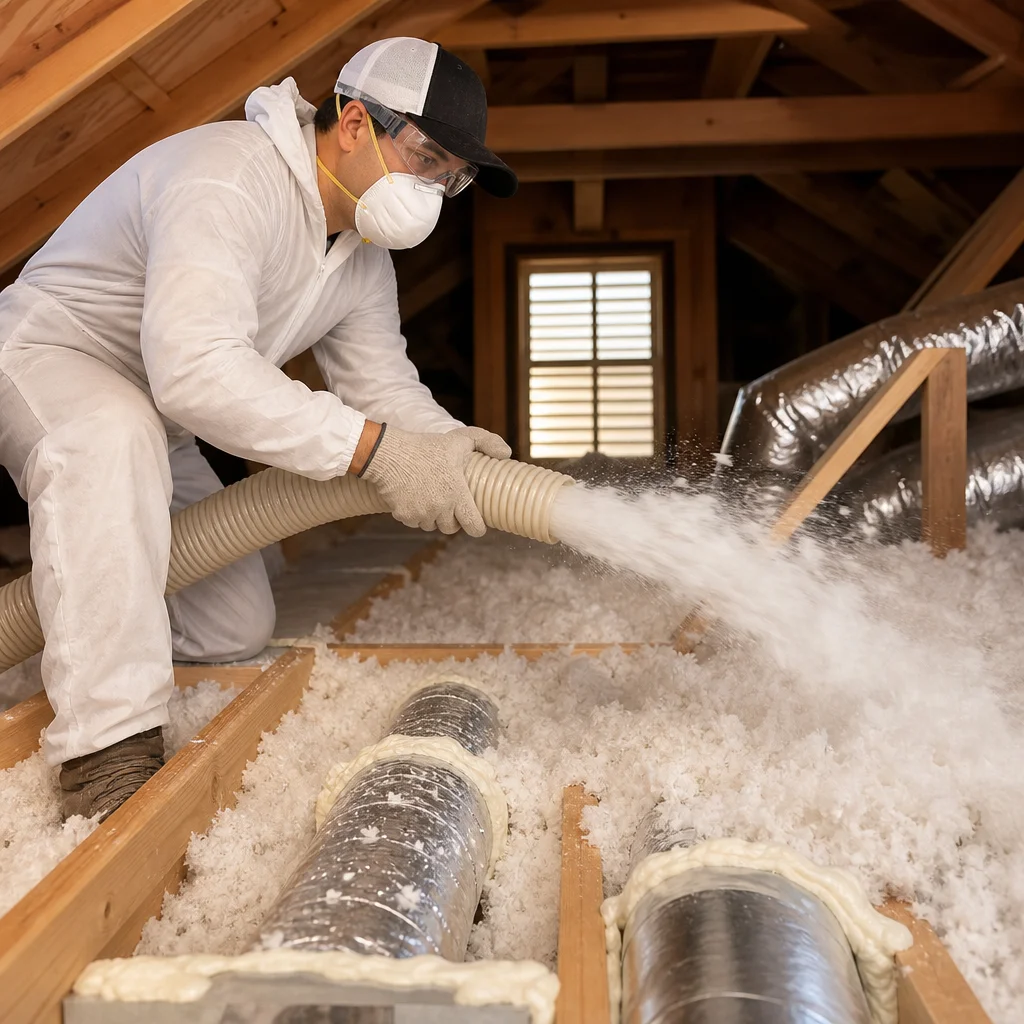
We also verify that your attic soffit vents and ridge vents are clear and unobstructed. A properly ventilated attic with adequate insulation maintains optimal moisture levels and prevents heat buildup that can damage your roof shingles.
Our crews use calibrated equipment to confirm insulation depth and density throughout your entire attic. We take photographs at installation start and completion, and we provide you with documentation showing exactly what was done and where.
Why Go Air Ducts Delivers Superior Results
We’ve built our reputation on precision and attention to detail. Our technicians are certified HVAC professionals, which means they understand how insulation interacts with your heating and cooling system. That perspective matters because we’re not just installing insulation; we’re optimizing your home’s overall thermal performance.
When we assess your attic, we evaluate your entire home system: ductwork, HVAC equipment, ventilation, and insulation. We often identify issues that other contractors miss, like ductwork that’s not properly sealed or ventilation that’s compromised by attic heat. By addressing these issues together, we deliver measurable results that truly reduce your energy costs.
We also guarantee our workmanship. If your insulation settles unevenly or if our air sealing doesn’t hold, we return and correct it at no charge. That guarantee stands for five years. We’re confident in our installation standards because we’ve built them on thousands of successful projects across Austin, San Antonio, Dallas, and Houston.
Energy Savings You Can Expect
Real savings depend on your current insulation levels, your home’s age, and your local energy costs. But we can provide realistic estimates.
If you’re upgrading from R-19 to R-38, expect cooling cost reductions of 12 to 18 percent during summer months. In an average Texas home, that’s $120 to $270 monthly savings during peak cooling season. Winter savings are typically 5 to 8 percent since Texas winters are mild, but the annual cumulative effect is substantial.
For a 2,000 square-foot attic insulation project costing roughly $2,500 to $3,500, your payback period is typically 4 to 6 years. After that, every degree of efficiency is pure savings. Many homeowners stay in their homes for 15 to 20+ years, meaning decades of ongoing savings.
We also see secondary benefits that customers don’t always anticipate: reduced temperature fluctuations mean less strain on HVAC equipment, which translates to fewer service calls and longer equipment life. We’ve tracked customer satisfaction metrics, and properly insulated homes report higher comfort scores and fewer complaints about temperature inconsistency between rooms.
How Our Installation Process Protects Your Home
Our installation process is designed to protect your home’s structural integrity, electrical systems, and moisture balance.
Before we begin, we photograph your entire attic, documenting any existing moisture stains, pest activity, or structural issues. If we identify mold, we discuss mold prevention benefits and recommend remediation before insulation is added.
We then seal all air leaks using professional-grade caulk and air barrier materials. We’re careful around electrical boxes, ensuring we don’t seal ventilation openings that fixtures require. We check and clear all soffit and ridge vents, and we verify that your bathroom and kitchen exhaust vents are properly ducted to the exterior.
Only after these preparatory steps do we install new insulation. We use professional blowing equipment that distributes material evenly and compacts it to the correct density. For blown-in fiberglass, we aim for a consistent depth across your entire attic floor. For cellulose, we ensure even settling and no gaps around obstacles.
Finally, we clean up thoroughly. Insulation installation can create dust, and we remove all debris from your attic, your flooring, and your home’s exterior.
Comparing DIY Versus Professional Installation
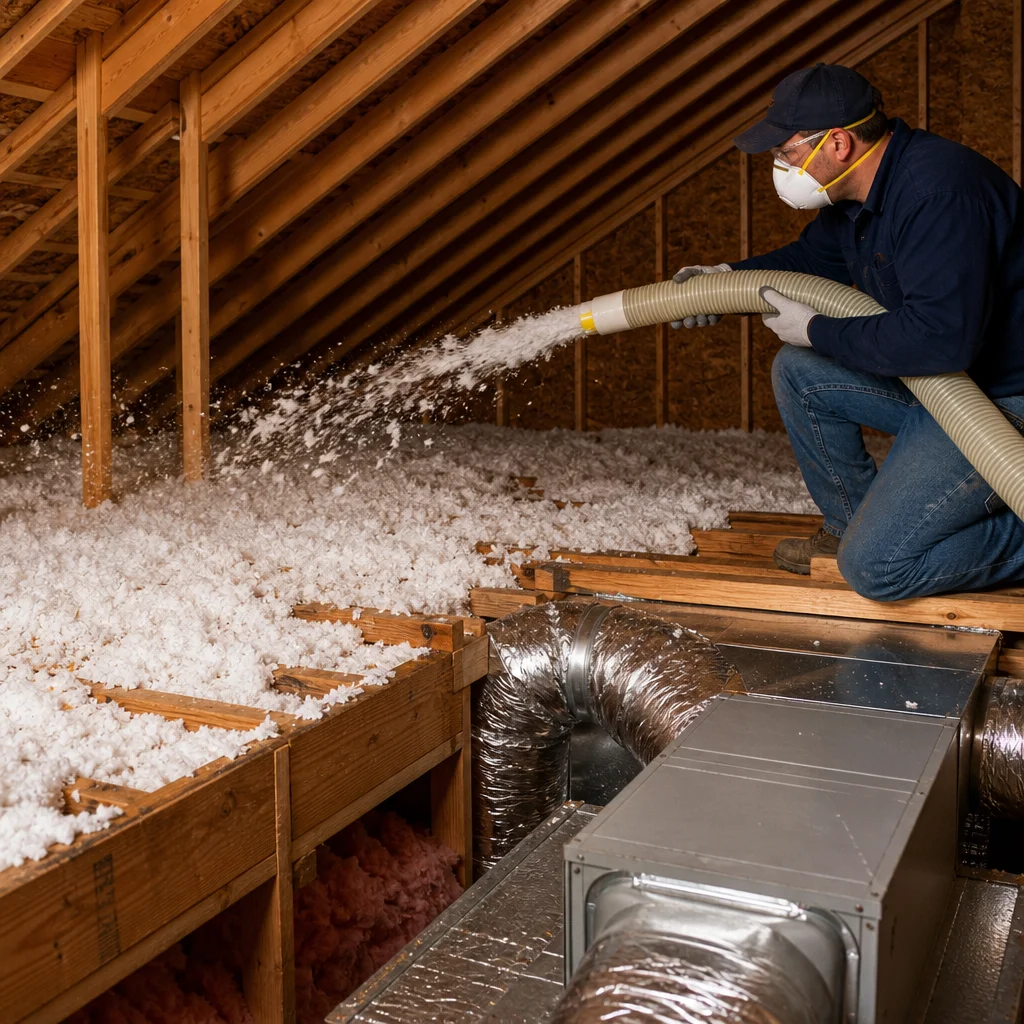
Some homeowners consider renting a blower and installing attic insulation themselves. We understand the appeal of saving on labor costs, but there are significant reasons why professional installation is worth the investment.
DIY projects often result in uneven depth, which means some areas have adequate R-value while others fall short. We’ve inspected attics where DIY crews blew in insulation but missed corners, left gaps around obstacles, and failed to air seal properly. The result: the promised energy savings never materialize because the insulation isn’t continuous.
There’s also a safety consideration. Working in a 150-degree attic carrying heavy equipment is physically demanding and risky, especially if your attic has limited headroom or structural obstacles. Professional crews are trained and equipped for this work.
Professional installation also comes with accountability. If something goes wrong, you have recourse. DIY projects leave you with no guarantee and no one to contact if settling occurs or moisture problems develop.
The labor cost difference is usually $500 to $1,200 for a typical attic. That’s a small percentage of your overall project cost when you consider the long-term savings and performance guarantee that comes with professional work. We believe the risk and hassle of DIY installation far outweighs the labor savings.
Making Your Attic Insulation Investment Decision
Your attic insulation is one of the highest-ROI home improvements you can make. Unlike cosmetic upgrades, attic insulation directly reduces your operational costs every single day, year after year. It improves comfort, extends your HVAC equipment life, and protects your home’s structural integrity by managing moisture and temperature.
Go Air Ducts delivers professional attic insulation installation with the expertise and accountability that real results require. We measure your current conditions, calculate your specific savings potential, help you access available rebates, and execute installation with the precision that guarantees performance.
Every day you delay is another day of wasted energy costs. Contact us today for a free attic assessment. We’ll identify exactly what your home needs, provide a detailed estimate, and show you the real savings you can expect. Same-day service is available in Austin and San Antonio.
Your attic insulation investment pays for itself while making your home more comfortable. Let’s make that investment work for you.
If you’re dealing with dust, poor airflow, mold in your ducts, or a clogged dryer vent — don’t wait. These issues can affect your health and safety. Go Air Ducts Group are the local experts in air duct cleaning, mold removal, dryer vent cleaning, and attic insulation. Call now for a free inspection and same-day service in Austin and San Antonio.
Frequently Asked Questions (FAQ)
What R-value should our attic insulation have in Texas?
We recommend R-38 to R-49 for most Texas homes, depending on your specific location and climate zone. Austin and San Antonio typically fall into zones requiring R-38 minimum, though we often suggest R-49 for superior energy efficiency and year-round comfort. Our technicians assess your current insulation levels and local building codes during the free estimate to determine the ideal R-value for your home.
How much energy and money can we save with proper attic insulation?
Most of our customers see 10-20% reductions in heating and cooling costs after we upgrade their attic insulation, though savings vary based on your current system and usage patterns. When we combine attic insulation with proper air sealing, homeowners often report noticing temperature consistency improvements within their first month. We provide energy projections during your consultation so you understand the realistic savings for your specific situation.
Why is professional installation better than DIY attic insulation work?
We handle critical details that DIY projects typically miss, including proper air sealing around penetrations, correct ventilation maintenance, and ensuring uniform R-value coverage throughout your attic. Poor installation creates thermal bridges and air leaks that significantly reduce insulation effectiveness, sometimes negating most of your investment. Our certified technicians follow industry standards and building codes, plus we stand behind our work with service guarantees that protect your home long-term.