
🕑 11 min read
Flexible or metal ducts: which is best for San Antonio homes?
Flexible ducts are affordable and easy to route, while metal ducts are more durable and resist mold; the best choice depends on your home's layout and budget. Go Air Ducts helps San Antonio homeowners choose and install the right ductwork for efficiency and longevity.
Table of Contents
- Why Your San Antonio Home's Ductwork Matters
- The Problem with Aging or Damaged Ducts
- Understanding Flexible Ducts: Benefits and Limitations
- Understanding Metal Ducts: Durability and Performance
- How San Antonio's Climate Affects Your Duct Choice
- Cost Comparison: Flexible vs. Metal Installation
- How We Assess Your Ductwork Needs
- Our Professional Duct Replacement Process
- Why Local Experience Matters in San Antonio
- Signs You Need Duct Replacement Now
- Energy Efficiency and Your Bottom Line
- Schedule Your Free Duct Evaluation Today
- Frequently Asked Questions (FAQ)





Why Your San Antonio Home’s Ductwork Matters
Your home’s ductwork is the backbone of your HVAC system. It’s responsible for distributing heated or cooled air throughout your house, maintaining indoor air quality, and keeping your energy bills under control. When ducts are in good condition, you barely notice them. When they’re failing, you notice everything: uneven temperatures between rooms, higher utility costs, and sometimes even health issues from poor air circulation.
We’ve inspected thousands of duct systems across San Antonio, and we can tell you with certainty that most homeowners underestimate how critical their ductwork is. A failing duct system doesn’t just waste energy—it can allow dust, mold, and allergens to circulate through your home, making indoor air quality worse, not better. The choice between flexible and metal ducts during replacement isn’t just about cost; it’s about what will perform best for your specific home and climate.
The Problem with Aging or Damaged Ducts
Ductwork typically lasts 15 to 20 years before it starts to deteriorate. In San Antonio, where heat and humidity work together to stress HVAC systems, ducts can fail faster. Common problems we see include:
- Deteriorating insulation and visible tears in flexible duct walls
- Separation of duct joints, allowing conditioned air to escape into walls and attics
- Mold and moisture accumulation inside ducts due to humidity
- Kinks, crushing, or sagging sections that reduce airflow
- Pest damage and corrosion in older metal ducts
When ducts develop these issues, your system has to work much harder to maintain temperature, your energy bills spike, and uneven heating or cooling becomes a daily frustration. In the worst cases, you’re spending money to condition air that never reaches your living spaces. That’s why identifying the problem early and choosing the right replacement material matters.
Understanding Flexible Ducts: Benefits and Limitations
Flexible ductwork, made from a spiral wire core wrapped in insulation and covered with a plastic-lined fabric exterior, offers real advantages in retrofit situations. It’s easier to install in tight spaces, around corners, and in homes where rigid ductwork can’t physically fit. The initial material cost is also lower than metal alternatives.
For San Antonio homeowners, flexible ducts work best when:
- You’re working in retrofits where space is extremely limited
- Your home has awkward routing between the HVAC unit and registers
- Budget constraints are a primary concern and ducts will be properly supported
However, flexible ducts come with trade-offs. The inner lining can deteriorate over time, especially in humid conditions. The material is also more vulnerable to punctures, crushing, and pest damage. If not properly supported and maintained, they can sag and trap moisture, creating conditions for mold growth. In our experience, homeowners often choose flexible ducts for initial savings, then regret the choice when they face cleaning costs or premature replacement a decade later.
Understanding Metal Ducts: Durability and Performance
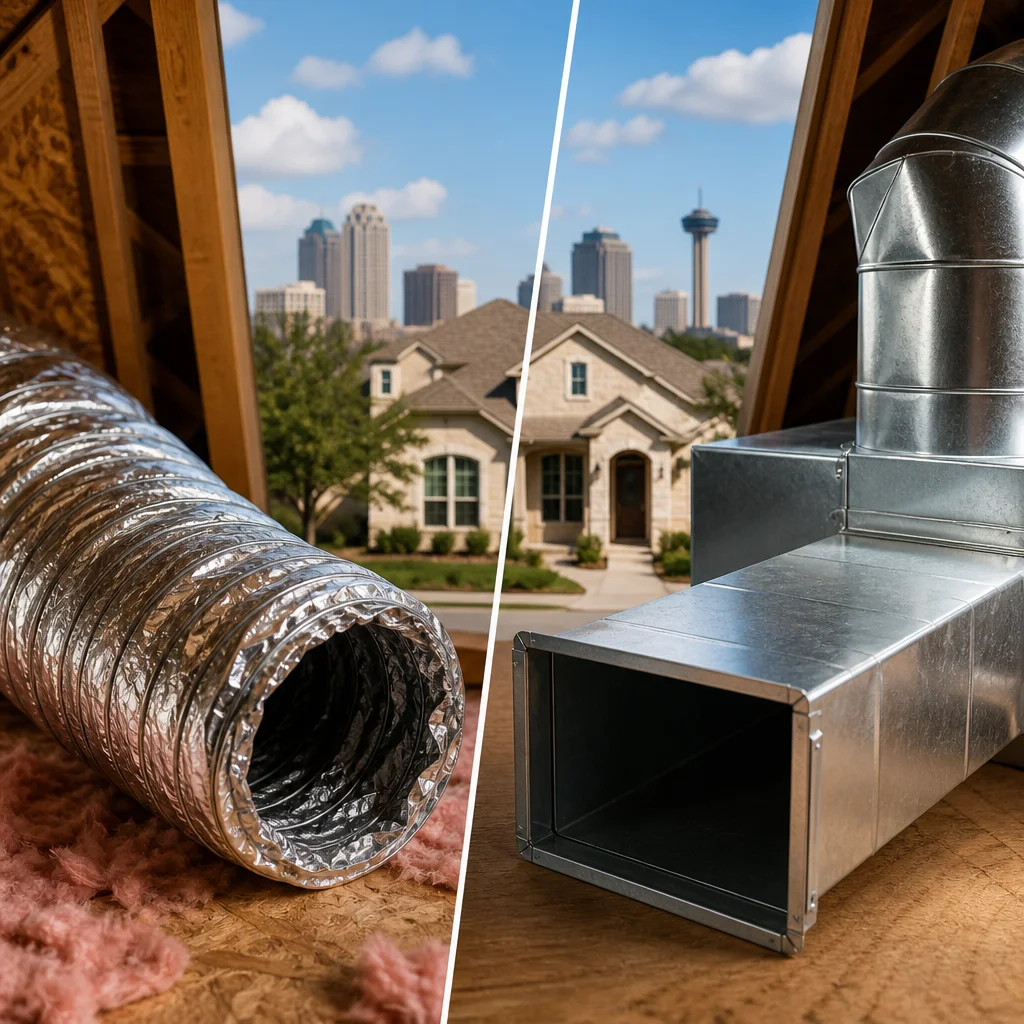
Metal ductwork, typically made from galvanized steel or aluminum, is the gold standard for longevity and performance. It resists crushing, doesn’t degrade over time the way flexible ducts do, and provides superior airflow due to smooth interior surfaces. Metal ducts also offer better resistance to pest damage and moisture-related deterioration.
The advantages are clear:
- Lifespan of 25 to 30+ years with proper maintenance
- Superior durability in humid, high-temperature conditions like San Antonio
- Better airflow efficiency and lower operating stress on your HVAC unit
- Easier to clean and sanitize if mold or dust accumulation occurs
- No risk of interior lining breakdown or off-gassing
Metal ductwork does cost more upfront and requires more skilled installation. But when you calculate the cost-per-year over the system’s lifespan, metal ducts typically prove more economical. They’re also the material we recommend for homes where air quality is a concern, since they won’t shed fibers or develop weak spots that allow unfiltered air to bypass your system.
How San Antonio’s Climate Affects Your Duct Choice
San Antonio’s climate is a key factor in duct material selection. Our summers are brutally hot and humid, with temperatures regularly exceeding 95 degrees. That heat, combined with high humidity levels, creates stress on ductwork that homeowners in drier climates simply don’t face.
Flexible ducts struggle in these conditions. The insulation can compress under thermal stress, reducing its R-value over time. Humidity creates an ideal environment for mold growth inside flexible ducts, especially if there’s any condensation on the outer surface due to temperature differentials. We’ve cleaned duct systems where the interior was visibly coated with mold that had accumulated over just 10 to 12 years.
Metal ducts handle San Antonio heat and humidity far better. They don’t degrade from thermal cycling, they don’t provide hospitable conditions for mold growth, and they maintain consistent airflow performance year-round. If you want your duct system to last through multiple Texas summers without requiring remediation or premature replacement, metal is the smarter choice. Learn more about how humidity impacts duct efficiency in our detailed guide.
Cost Comparison: Flexible vs. Metal Installation
Let’s get specific about pricing, since cost is usually a deciding factor.
For a typical San Antonio home (2,000 to 2,500 square feet), flexible duct replacement typically runs $2,500 to $4,500 total, including labor and materials. Metal duct replacement for the same home usually costs $4,500 to $7,500. That’s a real difference, and it’s why some homeowners initially lean toward flexible ducts.
However, that comparison doesn’t tell the whole story. If a flexible duct system needs replacement at 15 to 18 years due to mold remediation, lining failure, or sagging sections, you’ve paid for two replacements where one quality metal system would have lasted 25 to 30 years. When you factor in potential mold remediation costs (which can easily exceed $1,500 to $3,000) and the cost of cleaning and repairs over the lifespan, metal ducts often cost less per year of service.
We provide free, detailed estimates that break down material costs, labor, timeline, and long-term value so you can make an informed decision based on your situation, not just the lowest number.
How We Assess Your Ductwork Needs
Our assessment process starts with a thorough visual inspection of your entire duct system, using video equipment to examine interior conditions and identify damage, mold, or deterioration. We measure airflow at your registers, take photos of problem areas, and check for leaks using smoke testing if needed.
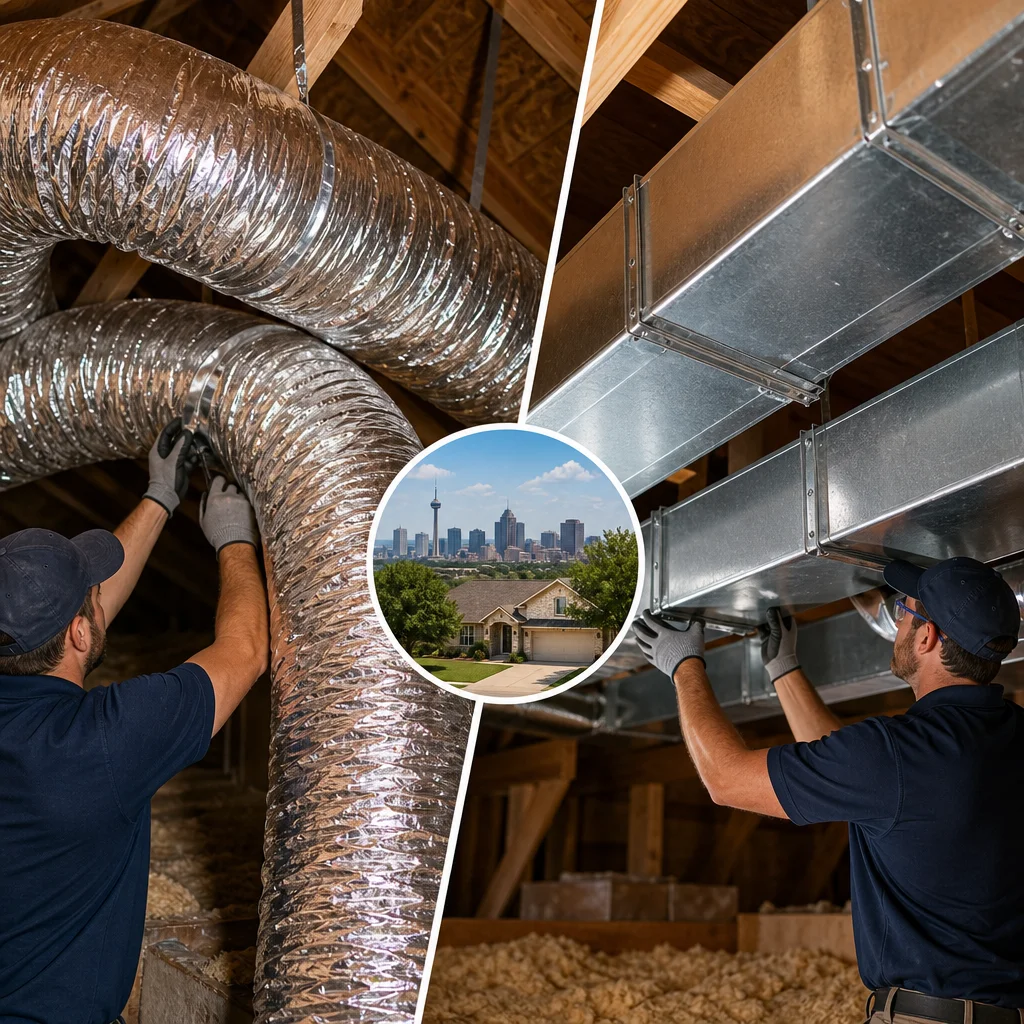
We also evaluate your home’s specific factors:
- Age and condition of existing ductwork
- Your HVAC system’s capacity and type
- Insulation levels in walls and attics where ducts run
- Moisture and humidity patterns in your home
- Your budget and timeline
Only after we understand your full situation do we recommend a specific material and approach. This is why a free estimate from us is genuinely valuable. We’re not just quoting a job; we’re giving you expert guidance based on your home’s needs.
Our Professional Duct Replacement Process
Our replacement process is designed to minimize disruption while ensuring long-term reliability. Here’s how it works:
First, we isolate the work area and protect your home from dust and debris. Next, we carefully disconnect and remove old ductwork, taking care not to damage surrounding areas or allow mold spores to spread. We then install new ducts according to HVAC standards, ensuring proper sizing, support, and insulation. All joints are sealed with mastic (not tape), and we test airflow and pressure balance before we finish.
The entire process typically takes one to three days, depending on the scope. We clean up completely and test your system to confirm it’s operating at peak efficiency. If you’re choosing metal ducts, we can often schedule the work quickly since metal fabrication and installation is more straightforward than flexible duct routing.
Why Local Experience Matters in San Antonio
Not all HVAC contractors are equal. We’ve been serving San Antonio homeowners for years, and that experience has taught us exactly what works and what doesn’t in our specific climate. We understand San Antonio’s humidity patterns, seasonal stress on HVAC systems, and the long-term performance of different materials in our heat.
That local knowledge also means we understand your neighborhood. We know which homes have foundation settling that affects ductwork alignment, which areas have higher mold risk due to proximity to the Edwards Aquifer and soil conditions, and which installation approaches work best for common San Antonio home designs.
When you work with us, you’re hiring a team that knows your city’s specific challenges and has solved these problems hundreds of times.
Signs You Need Duct Replacement Now
If you’re experiencing any of these issues, duct replacement should be on your priority list:
- One or more rooms feel significantly warmer or colder than others, even with your thermostat set properly
- Your energy bills have increased 15 to 20 percent or more without a change in usage patterns
- You notice visible mold, musty odors, or dust accumulation around vents or inside ductwork
- Your HVAC system runs constantly but struggles to maintain temperature
- You see disconnected ducts or visible damage during attic inspections
- Ducts are sagging or kinked, restricting airflow
Any of these signs means air isn’t reaching your living spaces efficiently. The longer you wait, the more money you waste on ineffective cooling and heating. A professional ductwork inspection can confirm whether replacement is necessary or if cleaning and sealing might resolve the issue.

Energy Efficiency and Your Bottom Line
Here’s what most homeowners don’t realize: your HVAC system’s efficiency rating is only meaningful if your ductwork is in good condition. A 16 SEER air conditioning unit connected to leaky, undersized, or damaged ducts is like having a high-performance engine with a clogged fuel filter.
Replacing old, damaged ductwork with properly sized, sealed metal ducts can reduce your cooling costs by 15 to 30 percent, depending on how much damage existed in the old system. That translates to real savings month after month. In San Antonio’s hot climate, where cooling runs much of the year, the payback period on quality duct replacement is typically three to five years.
If you’re interested in maximizing efficiency, explore our energy-efficient duct replacement options designed specifically for San Antonio homes. We can also discuss insulation upgrades and other complementary improvements that work together with new ductwork to optimize your entire HVAC performance.
Schedule Your Free Duct Evaluation Today
The decision between flexible and metal ducts isn’t one-size-fits-all, but it’s one you shouldn’t make without expert guidance. Our team is ready to inspect your ductwork, identify problems, and provide a clear recommendation based on your home’s specific needs and your budget.
Contact us today for a free evaluation. We’ll give you honest insight, transparent pricing, and a clear path forward. Whether you need complete duct replacement or a targeted repair, we’re here to ensure your San Antonio home has the air distribution system it deserves.
If you’re dealing with dust, poor airflow, mold in your ducts, or a clogged dryer vent — don’t wait. These issues can affect your health and safety. Go Air Ducts Group are the local experts in air duct cleaning, mold removal, dryer vent cleaning, and attic insulation. Call now for a free inspection and same-day service in Austin and San Antonio.
Frequently Asked Questions (FAQ)
What’s the typical cost difference between flexible and metal duct replacement in San Antonio?
We generally find that flexible ducts run 20-30% less upfront than metal ductwork, but metal ducts often provide better long-term value since they last longer and maintain efficiency better in our Texas heat. The final price depends on your home’s layout, the extent of replacement needed, and whether you’re upgrading insulation at the same time. We provide free estimates so you can see exact pricing for your specific situation.
How do we know which duct type is right for my San Antonio home?
We evaluate your current system’s condition, your home’s age and construction, your HVAC equipment, and your indoor air quality concerns during our assessment. San Antonio’s hot, humid climate actually favors metal ducts in most cases because they resist moisture and maintain better airflow efficiency, but flexible ducts can work well in certain applications. Our certified technicians will recommend the best option based on what we find and your budget.
How long does a typical duct replacement project take?
Most residential duct replacement jobs we complete take 2-4 days depending on your home’s size and duct complexity, though we work around your schedule to minimize disruption. We’ll give you a specific timeline during our initial consultation so you know exactly what to expect. If we uncover additional issues during the work, we keep you informed every step of the way.