
🕑 11 min read
How does commercial duct cleaning reduce energy costs?
Clean ducts and coils let HVAC systems move air freely, so they use less energy to heat and cool your building. Go Air Ducts provides commercial duct cleaning in Central Texas that improves efficiency, boosts insulation performance, and lowers utility bills.
Table of Contents
- The Hidden Costs of Dirty Commercial Ducts
- How Contaminated Ductwork Undermines Your Insulation Investment
- Energy Loss Through Neglected Air Distribution Systems
- Our Professional Commercial Duct Cleaning Process
- Measuring Your Actual Energy Savings After Cleaning
- Optimizing Insulation Performance with Clean Ductwork
- Why Building Managers Choose Our Certified Technicians
- Real Results from San Antonio and Austin Commercial Properties
- Getting Started with Your Commercial Duct Assessment
- Frequently Asked Questions (FAQ)





The Hidden Costs of Dirty Commercial Ducts
Your building’s heating and cooling system works harder than it needs to when ducts are clogged with dust, debris, and contaminants. We’ve seen this firsthand across Austin and San Antonio commercial properties: facilities spending thousands more annually on energy than necessary, simply because their air distribution systems are compromised. The connection between clean ductwork and efficient insulation performance is direct and measurable. When you address duct contamination, your insulation can actually do its job, your HVAC system operates at peak efficiency, and your energy bills drop noticeably.
This article walks through exactly how dirty commercial ducts drain your energy budget, what happens when contaminated ductwork meets your insulation investment, and how professional cleaning restores both components to working capacity.
Dirty commercial ducts create a compounding problem that most facility managers don’t fully appreciate until they see their energy audit results. Dust, mold spores, debris, and buildup inside your ductwork force your HVAC system to push harder, consuming more electricity to maintain set temperatures. A system working at 70% efficiency instead of 95% adds hundreds or thousands to your annual utility costs, depending on building size and climate zone.
Beyond energy waste, contaminated ducts circulate air quality problems throughout your entire facility. This triggers tenant complaints, potential health concerns, and staff productivity losses that don’t show up on energy bills but affect your bottom line. We’ve worked with office buildings in Austin where improved indoor air quality led to noticeably fewer sick days reported by staff after our cleaning service.
Here’s what typically accumulates inside neglected commercial ductwork:
- Dust and fibrous particles from carpet, upholstery, and outdoor air
- Mold growth in damp sections or near condensation points
- Pest droppings and insect debris
- HVAC system wear particles from aging equipment
- Bacterial biofilm that reduces air flow efficiency
The cost impact is real: a mid-sized commercial building with moderately dirty ducts can waste 15-25% of its heating and cooling energy simply moving conditioned air through restricted passages. That translates to hundreds per month in unnecessary utility expense.
Action step: Schedule a professional ductwork inspection to establish your baseline. We provide free estimates so you know exactly what you’re dealing with before committing to any service.
How Contaminated Ductwork Undermines Your Insulation Investment
Your building’s insulation and ductwork must work together seamlessly. When ductwork carries dust-laden air, that contamination settles on insulation surfaces, creating a film that reduces thermal resistance. Insulation doesn’t just stop working overnight, but its R-value degrades as dust accumulation blocks air circulation around and through the material itself.
Think of it this way: you’ve invested in premium attic insulation or wall cavities with high R-values, but if your ducts are leaking dust and warm or cool air throughout those same spaces, the insulation can’t create the thermal barrier it was designed to provide. Leaky, dirty ducts undermine your entire thermal envelope strategy.
Moisture is another critical issue. Contaminated ducts often develop condensation problems in Texas’s humid climate. That moisture migrates into nearby insulation, reducing its effectiveness and creating conditions for mold growth. We’ve documented cases where inadequate duct maintenance directly led to insulation needing replacement five to seven years earlier than expected.
When we clean commercial ducts thoroughly, we’re not just improving air quality. We’re:
- Restoring proper air velocity so insulation performs at design specifications
- Eliminating moisture-related degradation pathways
- Ensuring that conditioned air reaches its intended destination without waste
- Protecting insulation surfaces from dust contamination and biological growth
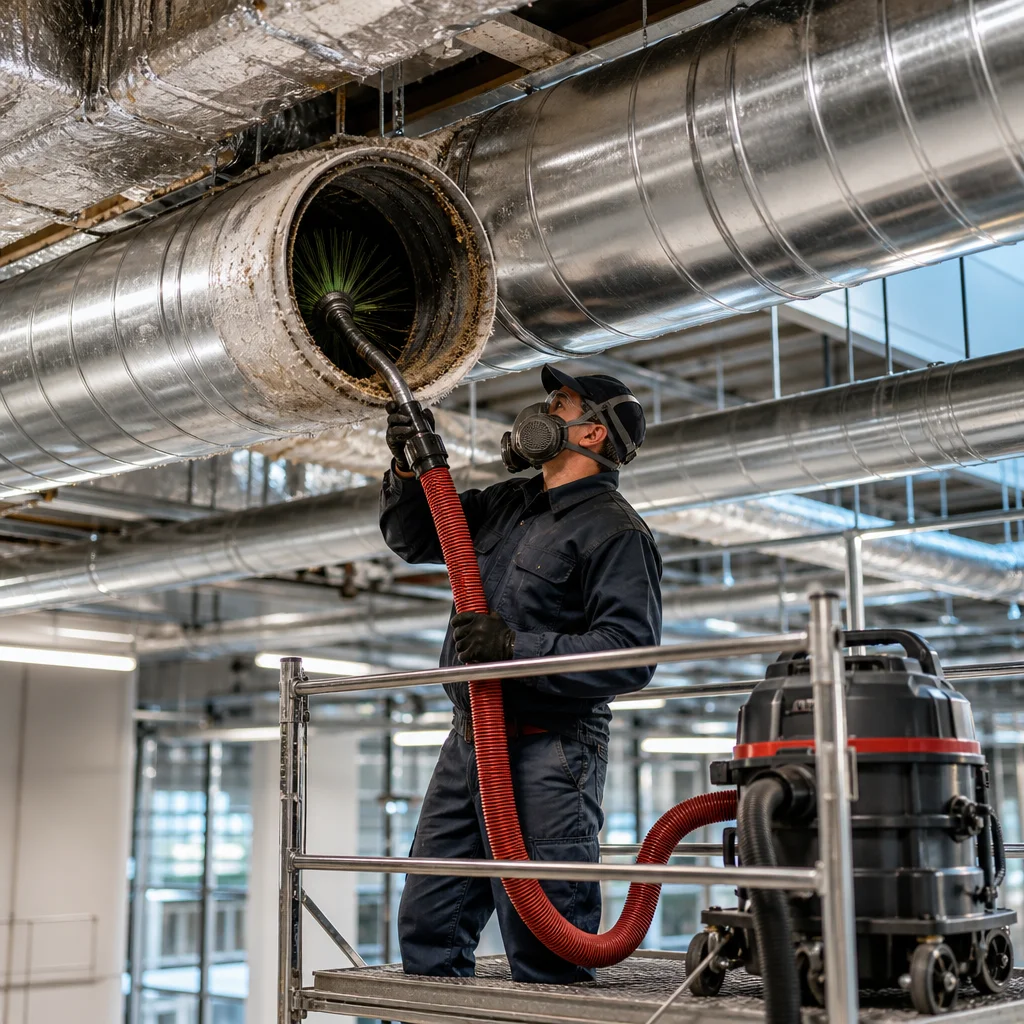
The insulation you’ve already paid for can’t deliver full value unless the ducts distributing air are clean and properly sealed. Professional cleaning unlocks your insulation investment.
Energy Loss Through Neglected Air Distribution Systems
Air distribution systems in commercial buildings are engineered with specific pressure drops and flow rates. When ducts accumulate buildup, friction inside the duct walls increases dramatically. Your blower motor must work harder to push the same volume of air, consuming significantly more energy to maintain building comfort.
We measure this using industry-standard testing equipment. In a typical San Antonio office building we serviced, ductwork contamination had increased static pressure in the system by 40%, meaning the HVAC equipment was consuming 40% more electrical energy just to overcome the resistance. After cleaning, that facility recovered approximately 18-22% in overall HVAC energy consumption.
Duct leakage compounds the problem. Contaminated, corroded, or damaged ductwork allows conditioned air to escape before reaching occupied spaces. Your system conditions air that never benefits your tenants or staff. Leaks can represent 20-30% of total energy consumption in poorly maintained systems, especially in older commercial buildings where original ductwork hasn’t been inspected or sealed in decades.
Real consequences include:
- Higher peak demand charges during hot Austin summers and cold San Antonio winters
- Reduced capacity to handle peak occupancy loads, forcing equipment to run longer
- Uneven temperature distribution requiring zones to compensate with longer run times
- Accelerated HVAC equipment wear, shortening the life of expensive mechanical systems
Professional cleaning restores design airflow, reduces system strain, and immediately lowers your energy consumption profile.
Our Professional Commercial Duct Cleaning Process
Our cleaning process is thorough, systematic, and designed specifically for the Texas commercial environment where humidity and dust loads are significant. We don’t use shortcuts or generic approaches.
We begin with a complete ductwork inspection using camera equipment and industry diagnostics. This identifies contamination severity, leaks, and any structural issues before we begin cleaning. You get a detailed report showing what we found and what we’ll address.
Our cleaning methodology includes:
- Source removal – We isolate work areas, seal returns and vents, and use negative pressure extraction to pull contamination from ductwork into our mobile collection systems
- Mechanical agitation – Specialized brushes and air whips dislodge buildup from duct interiors without damaging ductwork or insulation
- High-powered vacuum extraction – We remove loosened debris using truck-mounted or portable HEPA-filtered systems that capture particles down to microscopic levels
- Sanitization – For commercial facilities with mold or biological contamination, we apply EPA-approved antimicrobial treatments
- Duct sealing – We identify and seal leaks discovered during inspection, restoring system efficiency
- Post-cleaning verification – We conduct follow-up measurements to confirm airflow restoration and document your energy recovery
We follow best duct cleaning practices established by industry standards and maintain NADCA certification for professional-grade service. Our technicians are trained to minimize facility disruption while delivering comprehensive cleaning.
Measuring Your Actual Energy Savings After Cleaning
Numbers matter when you’re making a facility investment. We help you understand your actual return through pre- and post-cleaning energy documentation.
Before cleaning, we capture baseline metrics:
- Building energy consumption (typically from your utility bills and HVAC system monitoring)
- HVAC system runtime hours and cycle frequency
- Static pressure readings in your ductwork
- Airflow measurements at key vents and returns
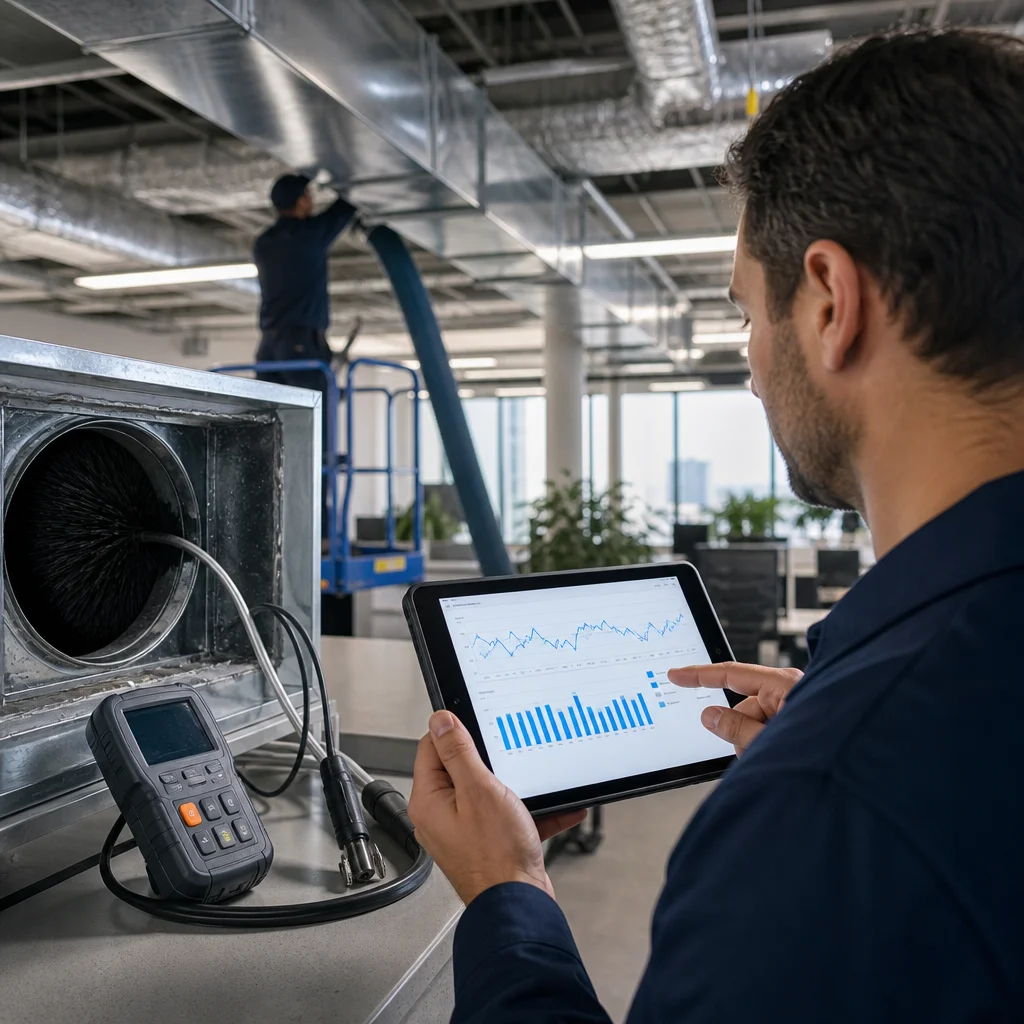
After cleaning, we remeasure those same parameters. Most commercial facilities see measurable improvements within the first billing cycle. Typical energy savings range from 8-20% depending on initial contamination severity, system age, and building envelope efficiency.
A 12,000 square-foot Austin office building we serviced showed a 14% reduction in HVAC energy consumption over the following quarter. At current Texas commercial electricity rates, that translated to approximately $1,200 in quarterly savings, or nearly $5,000 annually. The cleaning service paid for itself within the first two months of operation.
We also document non-energy improvements like improved temperature consistency across zones, reduced HVAC runtime needed to maintain setpoints, and quieter system operation (reduced strain on equipment produces less noise).
Action step: Request an energy audit assessment when you schedule your duct cleaning. We’ll establish your baseline and help you track actual savings over time.
Optimizing Insulation Performance with Clean Ductwork
Once ducts are clean, your insulation performs at design specification. This is where the combined effect becomes powerful: clean ducts plus optimized insulation creates a highly efficient thermal envelope.
For commercial properties considering insulation upgrades, cleaning ducts first is essential. You want your new insulation working with a clean, efficient air distribution system from day one. Installing high-performance insulation behind dirty, leaky ducts is like adding a high-end air filter to an engine with a clogged fuel line. You’re only solving half the problem.
We often recommend a coordinated approach: clean ducts, seal identified leaks, verify insulation condition, then upgrade or reinforce insulation where needed. This ensures every dollar spent on efficiency improvements works together rather than fighting against a compromised distribution system.
In commercial buildings across San Antonio and Austin, we’ve seen insulation effectiveness improve measurably after duct cleaning because:
- Air circulation around insulation improves when ductwork isn’t forcing bypass airflow
- Moisture accumulation near ducts decreases as condensation issues resolve
- Thermal stratification reduces when distribution becomes balanced
- Equipment operates at lower intensity, reducing vibration and damage to surrounding insulation
Clean ductwork is the foundation that makes all other efficiency investments work properly.
Why Building Managers Choose Our Certified Technicians
Professional certification matters more than you might expect. Our technicians hold certifications from NADCA (National Air Duct Cleaners Association) and maintain current EPA and Texas HVAC licensing. This means we understand building codes, industry standards, and local regulatory requirements that apply to commercial facilities.
Building managers and facility directors choose us because we:
- Arrive on time with properly equipped vehicles and don’t require extended facility closures
- Maintain liability insurance and bonding appropriate for commercial work
- Provide detailed documentation suitable for your facility records and insurance purposes
- Respect occupied buildings and minimize disruption to daily operations
- Stand behind our work with service guarantees and transparent pricing
Our Austin commercial duct cleaning and San Antonio service teams have spent years working in commercial environments. We understand the difference between residential cleaning and professional-grade commercial work. Your building is our priority, not just another job.
We also coordinate with your existing maintenance team, provide recommendations for preventive care schedules, and help you develop a long-term indoor air quality strategy.
Real Results from San Antonio and Austin Commercial Properties
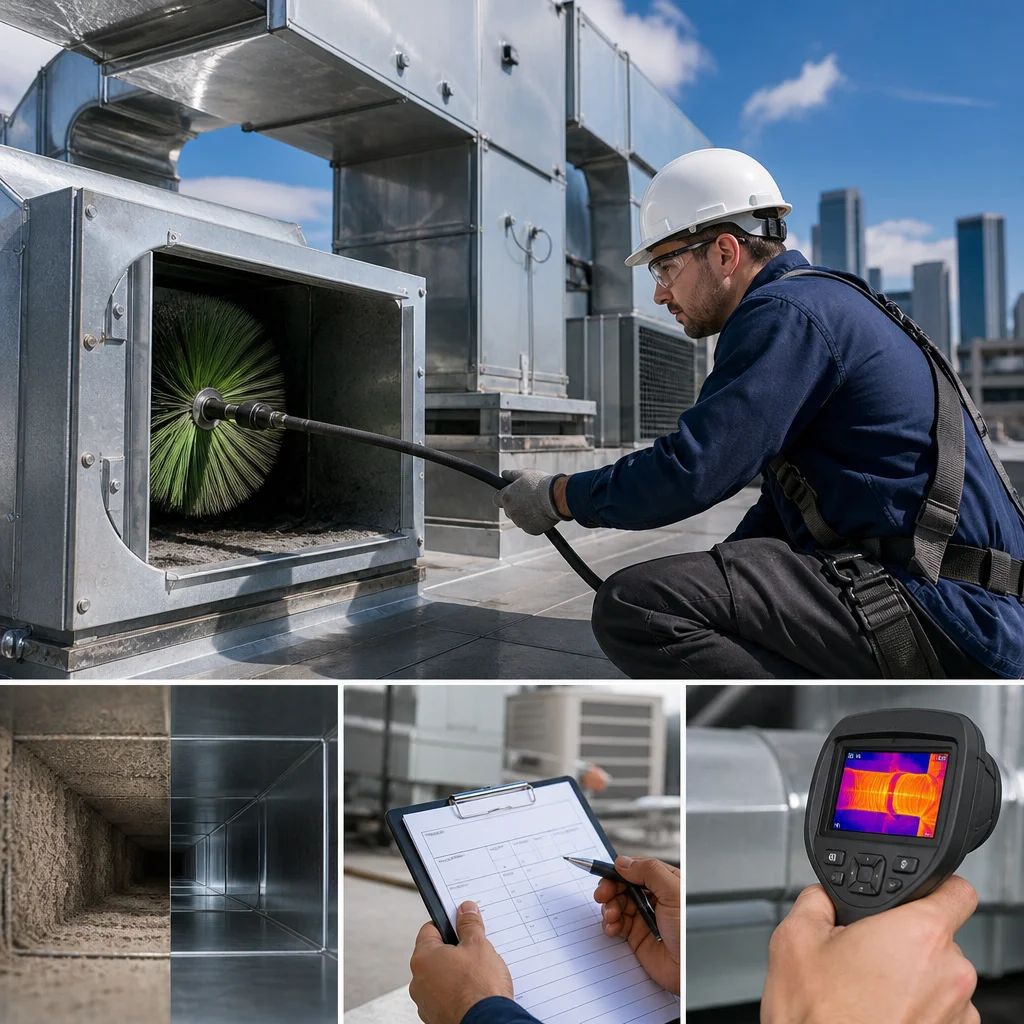
Our portfolio includes office buildings, retail centers, multi-tenant complexes, and professional service facilities throughout Texas. Real-world results speak louder than promises.
A mid-size law office in San Antonio had experienced consistent complaints about uneven temperatures between floors. After our inspection revealed 60% ductwork blockage and multiple unsealed leaks, we cleaned the entire system and sealed identified gaps. Result: uniform temperature distribution, staff complaints eliminated, and 16% reduction in monthly HVAC energy consumption.
An Austin medical office facility discovered mold growth inside return air ducts during our inspection. We cleaned and sanitized the entire ductwork, replaced compromised ductboard sections, and installed upgraded filtration. The facility eliminated air quality complaints, improved patient and staff satisfaction, and reduced their energy consumption as a secondary benefit.
A retail shopping center in San Antonio with multiple HVAC zones had experienced rising energy costs for three years. Our comprehensive cleaning and leak sealing restored the system to near-original efficiency specifications. The facility reduced annual HVAC energy consumption by approximately 22%, saving over $8,000 annually.
These aren’t outlier cases. They’re typical results we see when building managers prioritize clean, efficient ductwork and insulation systems.
Getting Started with Your Commercial Duct Assessment
Your first step is straightforward: schedule a professional assessment. We’ll inspect your ductwork, measure baseline efficiency metrics, and provide a detailed report showing what we find and what we recommend.
There’s no obligation and no cost for the evaluation. We want you to have complete information before making any decisions about your facility’s air quality and energy efficiency.
Contact us for a free commercial duct assessment in Austin or San Antonio. We’ll answer your questions, explain how cleaning and duct sealing impacts your specific building, and help you understand the return on investment for your facility’s situation.
Your building’s insulation and HVAC efficiency depend on clean, sealed ductwork. We’re here to ensure both components work together to minimize your energy costs and maximize indoor air quality for everyone using your facility.
If you’re dealing with dust, poor airflow, mold in your ducts, or a clogged dryer vent — don’t wait. These issues can affect your health and safety. Go Air Ducts Group are the local experts in air duct cleaning, mold removal, dryer vent cleaning, and attic insulation. Call now for a free inspection and same-day service in Austin and San Antonio.
Frequently Asked Questions (FAQ)
How much can we help you save on energy costs through commercial duct cleaning?
We typically see energy savings between 15-30% after our professional duct cleaning service, depending on how contaminated your system was before we started. The exact amount depends on your building’s size, insulation condition, and how long it’s been since your ducts were last cleaned. We provide a detailed energy assessment during your free estimate so you’ll know what realistic savings to expect for your specific property.
Why does dirty ductwork make your insulation less effective?
When our technicians clean your ducts, we’re removing the dust and debris that block airflow and force your HVAC system to work harder to maintain temperature. This extra strain undermines your insulation’s performance because your system can’t distribute conditioned air efficiently, causing hot and cold spots throughout your building. Clean ducts work together with quality insulation to create a balanced, efficient system that keeps your energy costs down.
What’s included in our commercial duct cleaning process?
We start with a thorough inspection using video equipment to identify problem areas, then we use specialized equipment to clean your entire duct system and remove contaminants at the source. After cleaning, we seal any leaks we find and test airflow to confirm everything is working at peak efficiency. Our certified technicians document all findings and provide you with before-and-after reports so you can see exactly what we removed from your system.