
🕑 13 min read
Table of Contents
- Why Your San Antonio Attic R-Value Matters More Than You Think
- Common R-Value Mistakes That Cost Texas Homeowners Thousands
- R-Value Requirements for San Antonio's Hot Climate
- How Blown-In Insulation Improves Your Home's Energy Efficiency
- Calculating the Right R-Value for Your Attic Space
- The Connection Between Insulation and Indoor Air Quality
- Why Professional Installation Ensures Maximum R-Value Performance
- Our Go Air Ducts Insulation Assessment Process
- Combining Insulation Upgrades with Air Duct Cleaning for Best Results
- Energy Savings and Comfort Benefits You'll Experience
- Getting Your Free Insulation and HVAC Evaluation Today
- Frequently Asked Questions (FAQ)





Why Your San Antonio Attic R-Value Matters More Than You Think
Your attic’s R-value is essentially your home’s thermal resistance. It measures how effectively insulation slows heat transfer between your living space and the harsh Texas sun above. In San Antonio, where summer temperatures regularly exceed 95 degrees and humidity can make cooling costs spike, this number directly impacts your monthly energy bill and indoor comfort.
Think of R-value like a shield. A higher number means thicker, more effective protection. Without adequate insulation, your air conditioning system works overtime pushing cool air into an attic that’s absorbing 150+ degree heat. We’ve seen homeowners lose $1,500 to $3,000 annually in wasted cooling costs simply because their attic insulation fell short of what San Antonio’s climate demands.
The relationship between R-value and comfort is equally important. Proper insulation keeps radiant heat from penetrating your ceiling, which means your living spaces maintain consistent temperatures and your HVAC system cycles less frequently. This reduces strain on equipment and extends its lifespan significantly.
Actionable takeaway: If your home was built before 2005 or you’ve never had your attic insulation evaluated, schedule an assessment. Most older San Antonio homes are severely under-insulated by today’s standards.
Common R-Value Mistakes That Cost Texas Homeowners Thousands
We see the same errors repeatedly when inspecting San Antonio attics. The most costly is assuming that existing insulation is adequate. Many homeowners inherit older fiberglass batts or settled cellulose that has lost significant performance over decades. Settled insulation can drop 30-50% below its original R-value as it compacts and gaps form around joists and pipes.
Another widespread mistake is installing uniform R-value throughout the attic without considering local hot spots. Your attic isn’t one temperature zone. Roof areas directly above south-facing walls absorb exponentially more heat, yet many installations treat these high-load areas identically to shaded north sections. This creates cold spots in living areas and forces your AC to compensate elsewhere.
Homeowners also underestimate the cost of poor air sealing before insulation installation. Blown-in insulation alone can’t compensate for gaps around penetrations, recessed lights, or ductwork. We’ve found homes where $2,000 in insulation was negated because air leaks around the attic hatch and plumbing vents weren’t sealed first.
DIY installation shortcuts represent another major issue. Many San Antonio residents attempt partial insulation jobs, leaving installation gaps, creating vapor barrier problems, or blocking soffit vents that your attic critically needs for moisture management and air circulation.
Next step: Have a professional evaluate whether your existing insulation is performing. We check depth, compression, coverage gaps, and air leakage during every inspection.
R-Value Requirements for San Antonio’s Hot Climate
San Antonio falls within IECC (International Energy Conservation Code) Zone 8A, which has specific insulation requirements based on building codes and climate data. For residential attics in this zone, current standards recommend R-38 to R-49 depending on ceiling type and desired efficiency level.
However, “meets code” doesn’t mean “optimal for San Antonio.” Code compliance is a baseline. Given our extreme summer heat, we typically recommend R-49 to R-60 for maximum performance and energy savings. Homes with high-performance cooling systems or those in neighborhoods with afternoon solar exposure benefit most from the higher end of this range.
Your specific R-value should also account for whether you have:
- Existing insulation that can be topped up versus complete removal and reinstallation
- Attic ventilation (ridge vents, soffit vents) that requires air space
- HVAC ducts or equipment in the attic requiring accessible clearances
- Moisture concerns from high humidity or plumbing leaks
San Antonio’s 97-98% humidity levels during summer create unique challenges. Blown-in insulation performs best when moisture management is addressed through proper ventilation and air sealing. An R-60 installation with poor air sealing performs worse than R-38 with excellent sealing.
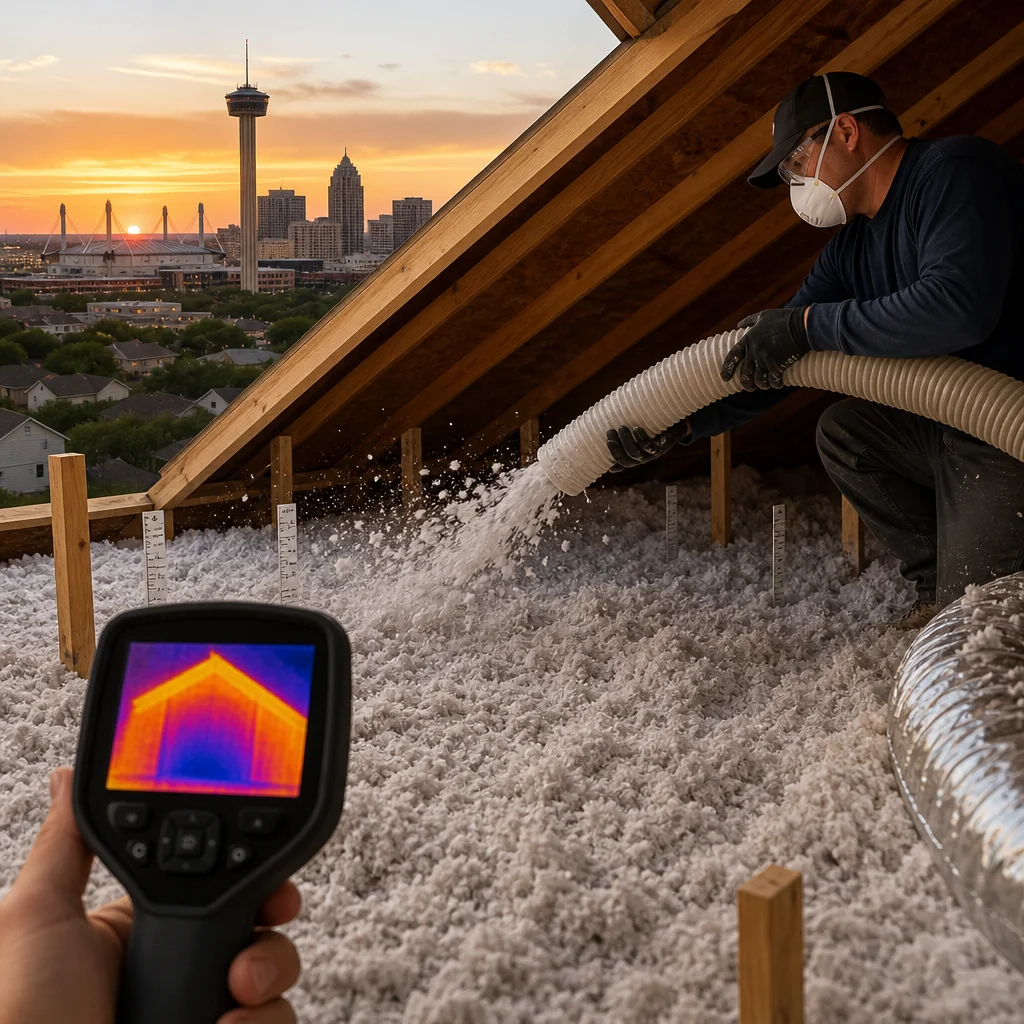
Practical guidance: Don’t use national average recommendations. Get a heat load calculation specific to your San Antonio home. We provide this at no charge during our evaluation.
How Blown-In Insulation Improves Your Home’s Energy Efficiency
Blown-in insulation (typically cellulose or fiberglass) offers distinct advantages over older batts, especially when upgrading existing attics. We can install it directly over settled material without complete removal, reducing labor time and waste. The result is faster project completion with lower costs than total replacement.
The thermal performance improvement is substantial. We’ve documented energy bill reductions of 15-25% for San Antonio homeowners who upgraded from R-19 to R-49 blown-in insulation. Cooling loads decrease because your attic temperature rises less dramatically, reducing the temperature differential that drives heat transfer into living spaces below.
Blown-in insulation also eliminates many installation gaps that occur with batts. When installed correctly, it creates a continuous thermal blanket over your entire attic floor, filling around obstacles, wiring, and structural elements seamlessly. No gaps means no thermal bridging.
The material itself contributes to indoor air quality as well. Modern blown-in insulation resists settling better than older materials. It maintains consistent R-value for 15-20 years with minimal degradation, whereas compressed batts continue declining in effectiveness over time.
Conversion point: Upgrading your attic insulation is one of the highest ROI home improvements. Most San Antonio homeowners recover costs in 3-4 years through energy savings alone.
Calculating the Right R-Value for Your Attic Space
Determining your ideal R-value requires three key calculations. First, measure your current insulation depth and type. Fiberglass batts typically provide R-3.2 to R-3.8 per inch of thickness. Cellulose typically offers R-3.6 per inch. If your 1960s attic has 4 inches of settled fiberglass, you’re likely at R-12 or less, well below functional standards.
Second, calculate your attic’s square footage and heat load exposure. A 2,000-square-foot home with significant roof orientation toward the southwest absorbs more solar radiation than an identical home facing north. This difference justifies 10-15% higher R-value investment.
Third, factor in your cooling system’s capacity and efficiency rating. Homes with older, undersized AC units benefit more from aggressive insulation (R-55 to R-60) because reducing load directly prevents overflow and burnout. Newer, high-efficiency systems handle standard loads well with R-38 to R-45.
We also recommend accounting for future climate trends. San Antonio has experienced a documented 1-2 degree temperature increase over the past 20 years. Installing R-49 today provides a safety margin for tomorrow’s conditions.
What to do: Use your current cooling bills as a baseline. We calculate projected savings during our free assessment, showing exactly what R-value upgrade makes financial sense for your situation.
The Connection Between Insulation and Indoor Air Quality
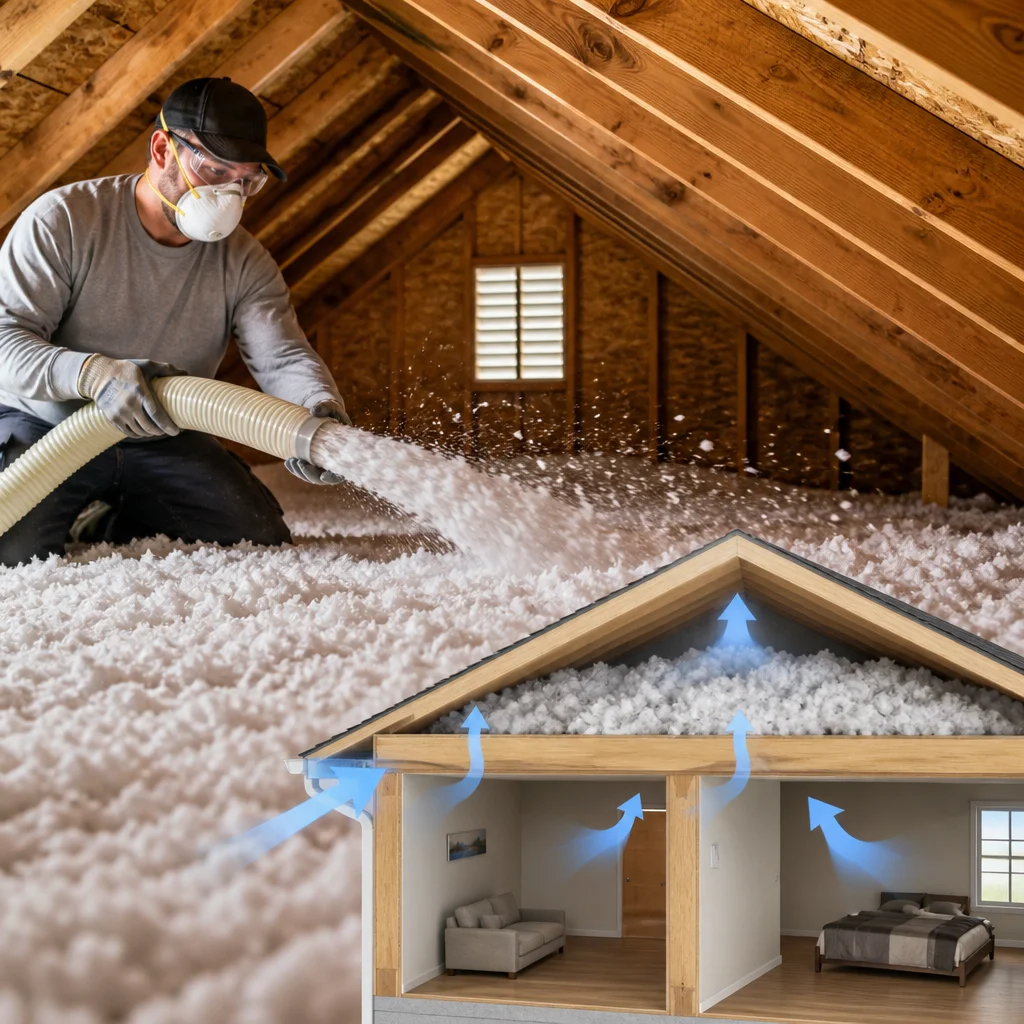
Insulation and air quality are linked in ways many San Antonio homeowners don’t immediately recognize. Attic air leaks pull unfiltered, dusty, or moldy attic air into living spaces through ceiling penetrations, recessed lights, and ductwork. This bypass contamination undermines your HVAC system’s filtration.
Proper attic insulation requires air sealing, which stops these leaks at the source. When we install blown-in insulation, we first seal gaps around electrical boxes, plumbing penetrations, and ductwork. This prevents attic air from entering your home, reducing dust, allergens, and potential mold spores from circulating.
San Antonio’s humidity also connects insulation and air quality. Without adequate attic ventilation paired with insulation, moisture accumulates in your attic, creating conditions for mold growth. Blown-in insulation, when combined with proper soffit and ridge venting, maintains the air circulation needed to prevent moisture buildup.
We’ve found that homes with attic insulation mold prevention measures report fewer allergy symptoms and respiratory issues. The improvement results from stopping contaminated attic air from entering breathing spaces, not from the insulation itself.
Health benefit: If your family experiences unexplained allergy symptoms or your HVAC filter clogs faster than normal, attic air leakage is often the culprit. Sealing and insulating your attic typically shows results within weeks.
Why Professional Installation Ensures Maximum R-Value Performance
DIY blown-in insulation sounds straightforward until you encounter real obstacles. Attic floors aren’t uniform. Joists vary in depth, wiring runs in unexpected directions, and HVAC ducts occupy space irregularly. Professional installers navigate these obstacles to maintain consistent density and R-value across the entire attic.
Installation depth is critical for achieving advertised R-values. Underinstalling by just 2 inches drops your effective R-value by 20%. We use depth guides and professional-grade equipment to ensure consistency. Equipment matters significantly. Rental-grade blowers can’t achieve the air speed or distribution of commercial machines. This results in uneven installation and settling over time.
Professional installation also identifies and addresses safety and code issues. We check for recessed light clearances (which require 3-inch minimum clearance from insulation to prevent fire hazard), verify proper ventilation isn’t blocked, and ensure exhaust vents aren’t buried in insulation. Missing these details creates fire risks and code violations.
Our technicians also assess your attic’s structural integrity, moisture conditions, and existing HVAC performance before installation. This comprehensive approach means your insulation upgrade accounts for your specific home’s needs rather than applying generic solutions.
Why it matters: A professionally installed R-49 system outperforms a DIY R-60 installation with density problems and gaps. We guarantee our work with multi-year warranties covering settling and performance.
Our Go Air Ducts Insulation Assessment Process
We begin every insulation project with a detailed attic inspection, not just a quote over the phone. Our certified technicians photograph your current conditions, measure existing insulation depth and type, and document air leakage points. This inspection typically takes 30-45 minutes and reveals opportunities specific to your home.
During the assessment, we evaluate your attic ventilation status, check for moisture or mold concerns, and identify any HVAC or electrical hazards that affect installation approach. We also measure your attic’s square footage precisely rather than estimating from outside dimensions.
We then provide you with a customized recommendation showing your current R-value, the recommended upgrade level, projected energy savings, and exact material and labor costs. Our estimates are binding, with no surprise charges or upsell tactics. If you have questions about R-value calculations or material choices, our technicians explain your options in clear terms.
We schedule installation at your convenience and complete most attic projects within one day. Our team handles cleanup, hauls away old insulation if removal is needed, and provides documentation showing the new R-value installed.
Next action: Call us or visit our website to book your free assessment. We serve San Antonio, Austin, Dallas, and Houston with same-day scheduling available for many areas.
Combining Insulation Upgrades with Air Duct Cleaning for Best Results
Attic insulation and air duct performance work together to optimize your HVAC efficiency. Dusty or contaminated air ducts force your system to work harder and distribute dust-laden air throughout your home. Installing new insulation without addressing duct cleanliness means your investment doesn’t reach full potential.
When we inspect your attic for insulation, we assess your ductwork simultaneously. Many San Antonio homes have flexible ducts that have accumulated years of dust, mold, or pest debris. This buildup reduces airflow by 20-30%, which means your AC system cycles longer to reach temperature, negating insulation improvements.
We recommend combining insulation and air duct cleaning projects. The insulation reduces your system’s cooling load, while clean ducts allow that cooled air to reach every room efficiently. Together, these upgrades typically reduce energy consumption by 25-35%.
Our integrated approach also addresses duct sealing. Leaky attic ducts lose 15-30% of conditioned air before it reaches living spaces. We seal duct joints and connections during attic work, ensuring your system’s efficiency isn’t compromised by escaped air.
Efficiency gain: Pairing insulation with duct cleaning delivers savings that neither project achieves independently. We can show you the combined savings estimate during your assessment.
Energy Savings and Comfort Benefits You’ll Experience
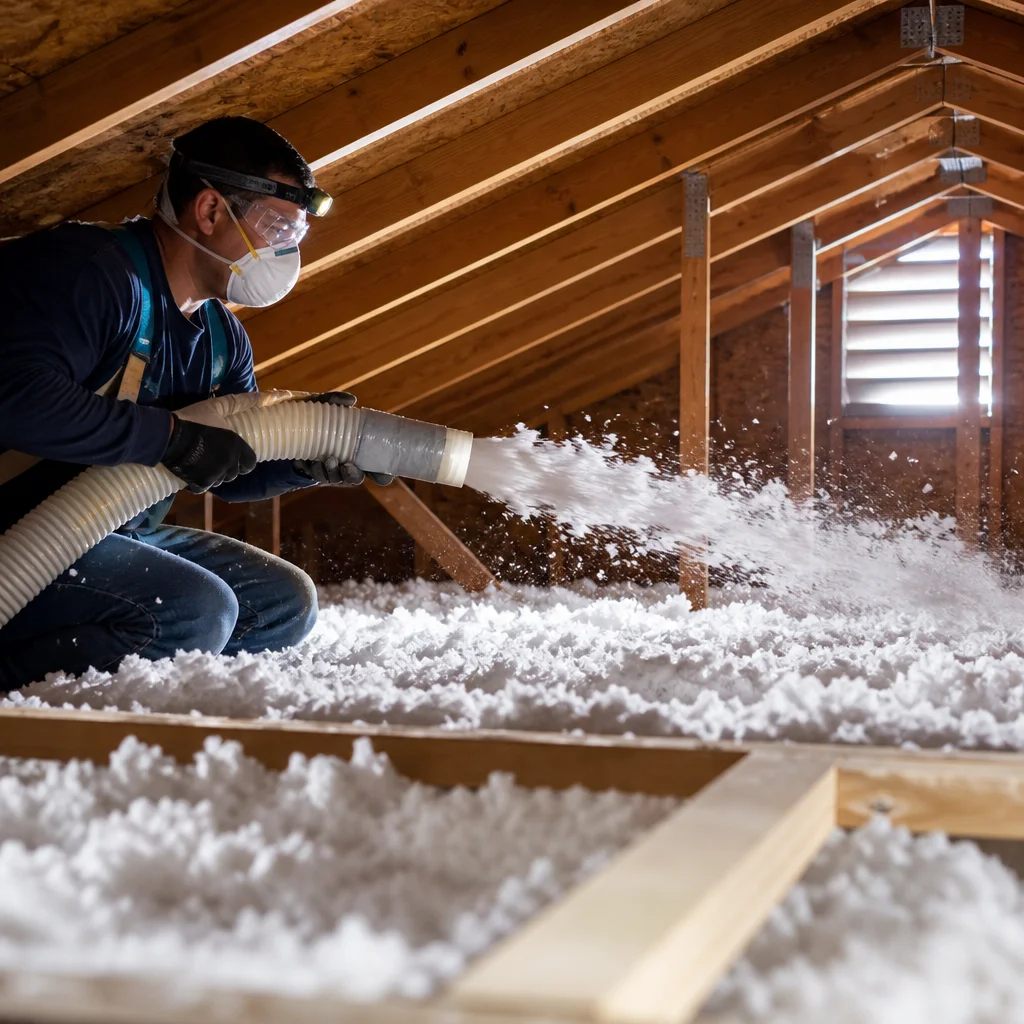
The financial impact of proper insulation is immediate and measurable. San Antonio homeowners typically see cooling bills drop $100-$250 monthly during summer after R-49 installation. Over a 15-year period, this represents $18,000-$45,000 in savings for a single upgrade.
Beyond dollars, comfort improvements appear within days. Your home’s temperature becomes more consistent. Rooms that were previously 3-5 degrees hotter than your thermostat setting cool to temperature faster. Your AC system cycles less frequently, which means quieter operation and extended equipment life.
You’ll also notice reduced dust accumulation on surfaces and fewer allergy symptoms if air sealing was performed during installation. Your HVAC filter clogs less quickly because your system isn’t pulling unfiltered attic air.
Winter benefits are equally valuable for San Antonio residents. While we don’t experience harsh winters, proper insulation prevents heat loss when temperatures drop below 50 degrees. This reduces heating costs and maintains comfortable temperatures throughout your home without forcing furnace cycling.
Long-term, you’re protecting one of your largest assets. A well-insulated attic prevents premature HVAC equipment failure, reduces risk of heat-related roof damage, and maintains consistent indoor conditions that protect flooring, cabinetry, and furnishings from temperature-related expansion and contraction.
Investment return: Most San Antonio homeowners recover their insulation investment within 4 years through energy savings. After that, everything is pure savings plus comfort and reliability improvements.
Getting Your Free Insulation and HVAC Evaluation Today
We’re here to help you make the right decision about your attic insulation. Our free assessment includes a complete attic inspection, R-value calculation, HVAC and insulation upgrade recommendations, and binding cost estimates with no obligation to proceed.
Contact us through our website at https://goairducts.com/ or call for same-day scheduling in San Antonio and Austin. We typically complete evaluations within 48 hours and can begin installation shortly after you approve the quote.
If you have existing concerns about air quality, energy bills, or attic conditions, mention them when scheduling. We’ll address those specific issues during your inspection and include them in our recommendations.
Your San Antonio home deserves insulation that works as hard as your AC system. Let’s talk about how we can help you save money, improve comfort, and protect your home for years to come.
If you’re dealing with dust, poor airflow, mold in your ducts, or a clogged dryer vent — don’t wait. These issues can affect your health and safety. Go Air Ducts Group are the local experts in air duct cleaning, mold removal, dryer vent cleaning, and attic insulation. Call now for a free inspection and same-day service in Austin and San Antonio.
Frequently Asked Questions (FAQ)
What R-value does my San Antonio attic actually need?
We recommend R-38 to R-60 for most San Antonio homes, depending on your attic’s current insulation and your cooling costs. Our climate runs hot most of the year, so higher R-values help keep that heat out and reduce strain on your air conditioning system. We can assess your specific attic during a free inspection to tell you exactly what level makes sense for your home.
Why does professional installation matter for blown-in insulation?
We see homeowners lose 20-30% of their insulation’s effectiveness when DIY installation leaves gaps, compression, or uneven coverage. Our certified technicians ensure even density, proper ventilation around soffit areas, and consistent R-value performance across your entire attic. Correct installation is the only way you’ll actually see the energy savings and comfort improvements that insulation is supposed to deliver.
How does better attic insulation connect to indoor air quality?
We find that proper insulation works alongside clean air ducts to prevent hot spots in your attic that can draw in dust, moisture, and outdoor pollutants into your living spaces. When your insulation is performing at the right R-value, your HVAC system doesn’t have to work as hard to maintain even temperatures, which reduces pressure imbalances that pull contaminated air through cracks and leaks. We often recommend combining our air duct cleaning with insulation upgrades for the best results on both energy efficiency and air quality.