
Table of Contents
- 1. Reduces Heat Loss and Gain in Attics
- 2. Minimizes Ductwork Energy Waste
- 3. Lowers Thermostat Strain and Runtime
- 4. Prevents Air Leaks Around Insulation Gaps
- 5. Improves Temperature Consistency Throughout Your Home
- 6. Extends HVAC System Lifespan
- 7. Decreases Monthly Energy Bills Significantly
- Frequently Asked Questions (FAQ)
1. Reduces Heat Loss and Gain in Attics
Your air conditioning system is working hard every single day in Texas heat. But here’s the truth we’ve discovered after thousands of home evaluations across Austin, San Antonio, Dallas, and Houston: no amount of HVAC maintenance alone will fix an under-insulated home. Your cooling and heating efficiency depends heavily on how well your home is insulated. When insulation is inadequate or installed incorrectly, your HVAC system becomes a hamster on a wheel, running constantly without delivering the comfort you paid for.
We’ve seen homeowners spend hundreds monthly on energy bills while their attics leak conditioned air like a bucket with holes. The good news is that upgrading or installing proper insulation is one of the most effective ways to improve HVAC performance and cut energy waste. Let’s walk through exactly how insulation improves HVAC efficiency and why it should be part of your long-term home comfort strategy.
Your attic is where most of your home’s thermal energy escapes or enters. In Texas summers, that uninsulated or poorly insulated attic becomes a 140-degree oven that radiates heat straight down into your living space. Your HVAC system then has to work overtime to cool air that’s already been heated from above.
Proper attic insulation acts as a thermal barrier. It slows the transfer of heat from your roof into your home during summer and prevents warm air from rising and escaping during winter. We typically recommend an R-value of R-38 to R-60 for attics in Central and South Texas, depending on your specific climate zone.
The difference is measurable. A well-insulated attic can reduce the temperature differential between your attic and living space by 10-20 degrees, meaning your air conditioning doesn’t have to run as hard to maintain your desired temperature. This directly translates to lower compressor cycles and reduced energy consumption.
Actionable next step: Schedule a free attic insulation assessment to determine your current R-value and identify gaps or settling that reduce effectiveness.
2. Minimizes Ductwork Energy Waste
Your air ducts carry conditioned air from your HVAC unit to every room in your home. If those ducts run through unconditioned spaces like attics, crawl spaces, or exterior walls without insulation, you’re losing 10-30% of your conditioned air before it even reaches the room you’re trying to cool.
Uninsulated ducts in a hot attic lose cold air rapidly. Wrapped or foam-insulated ducts maintain the temperature of the air moving through them, so more of that expensive cooled air reaches your living areas. This means your HVAC unit cycles less frequently and your system achieves your target temperature faster.
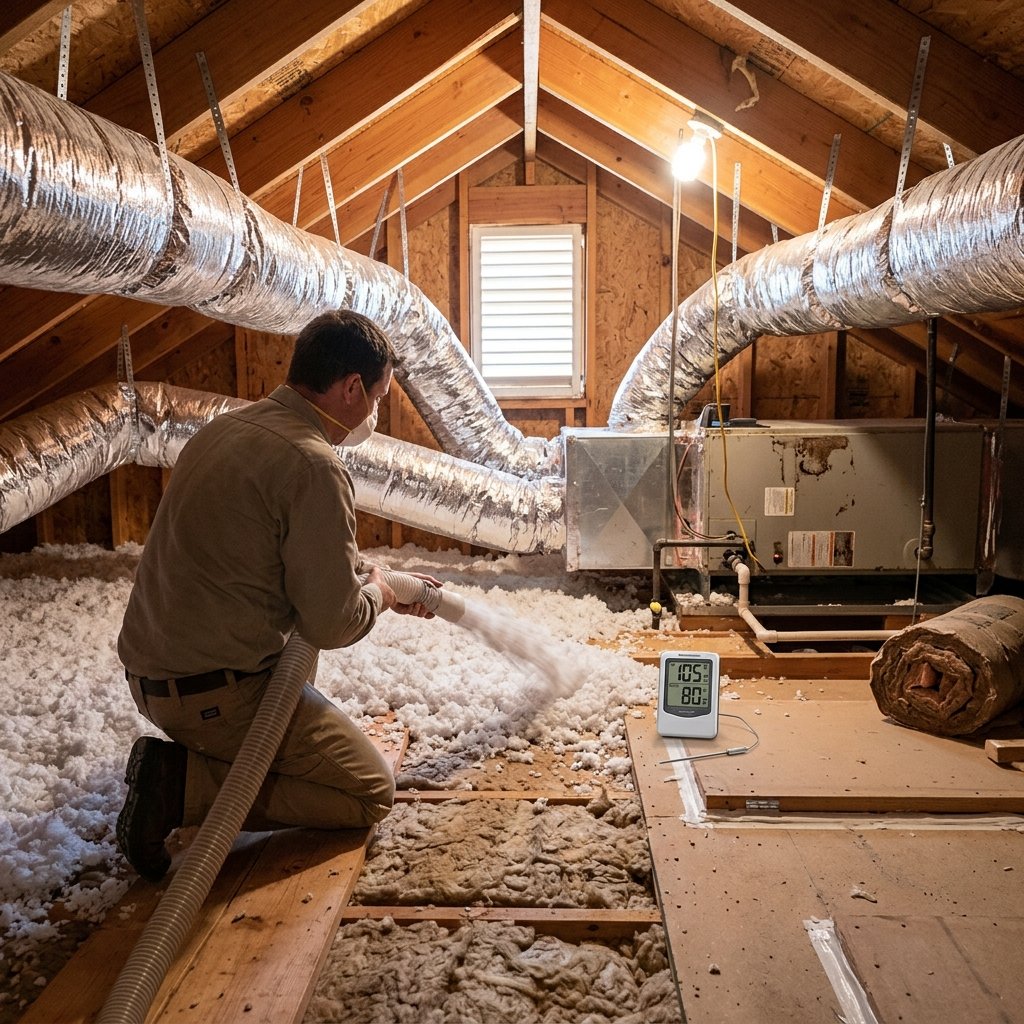
We’ve measured real differences in ductwork temperature with thermal imaging. Bare metal ducts in a 120-degree attic can lose 15-20 degrees of cooling capacity along their length. Insulated ducts maintain temperature consistency, delivering cooler air further into your home and reducing the load on your HVAC unit.
Additionally, proper ductwork insulation reduces noise transmission and prevents moisture condensation on ducts in humid climates. This protects your ductwork integrity and prevents mold growth inside ducts, which we address during our air duct cleaning and inspection services.
3. Lowers Thermostat Strain and Runtime
When your home is under-insulated, your thermostat has to work harder to maintain your set temperature. The system cycles on and off more frequently, and your HVAC unit runs longer per day. This constant strain accelerates wear on your compressor, blower motor, and electrical components.
With adequate insulation, indoor temperatures remain more stable. Your thermostat doesn’t sense rapid temperature swings, so the system cycles less often and runs for shorter periods. This reduction in runtime is where real energy savings happen. A system that runs 40% less during the cooling season uses 40% less electricity for that portion of operation.
Imagine setting your thermostat to 72 degrees. In an under-insulated home, that temperature might drift to 76 degrees within 30 minutes of your AC cycling off. Your system kicks back on immediately. In a well-insulated home, that temperature holds steady for hours. The difference compounds across every day of the year.
We recommend scheduling a comprehensive energy efficiency audit that evaluates both your insulation levels and your HVAC system’s runtime patterns. Knowing these numbers helps you understand exactly where improvements will make the biggest impact.
4. Prevents Air Leaks Around Insulation Gaps
Insulation that’s missing, damaged, or improperly installed creates thermal bridges and air leaks. Gaps around roof penetrations, poorly sealed ceiling cavities, and settling insulation allow conditioned air to escape and outside air to infiltrate your home.
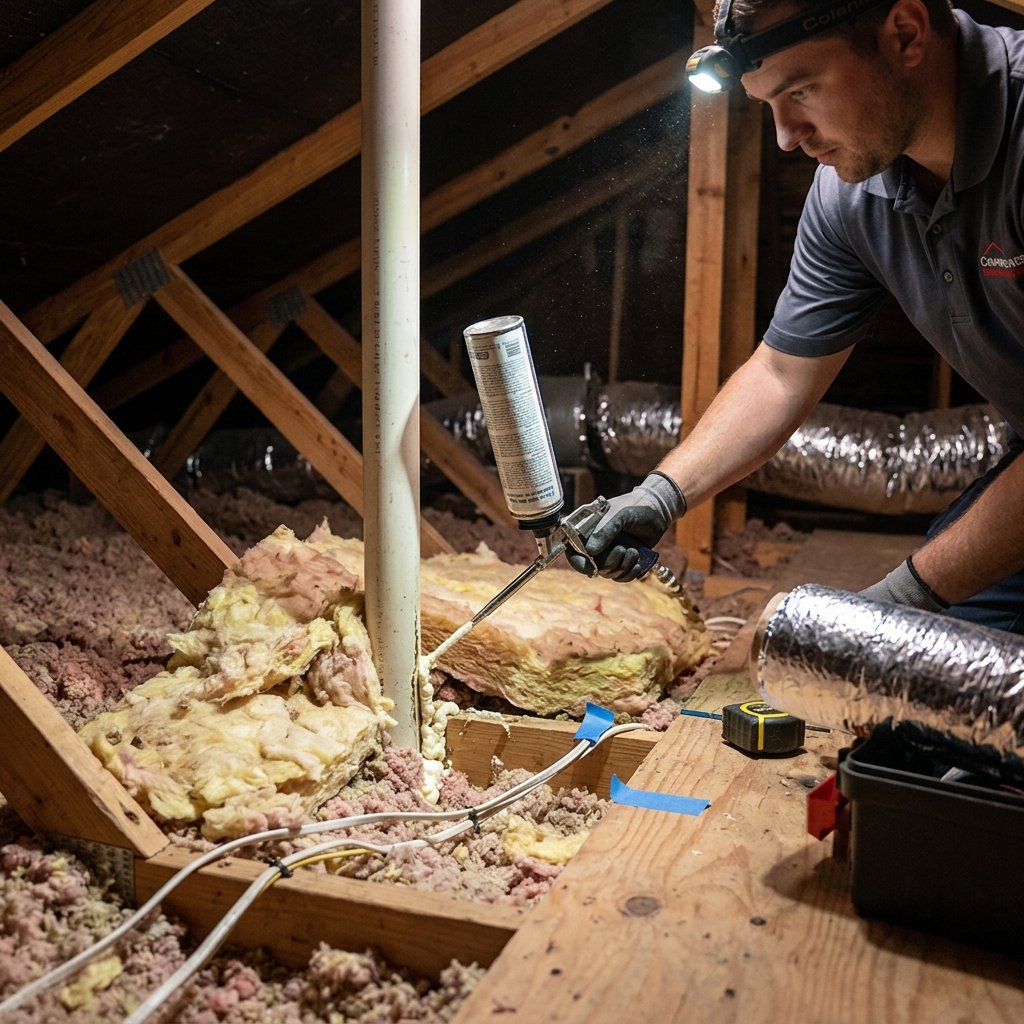
These aren’t small leaks. We regularly find attics where insulation has settled to half its original depth in certain areas, or where it’s completely missing around exhaust fans and vent pipes. Those gaps are direct pathways for conditioned air to escape and outdoor heat to enter.
Proper insulation installation includes sealing air leaks before insulation is installed. We fill gaps around electrical boxes, pipe penetrations, and attic access hatches with spray foam or caulk, then install insulation that’s fitted properly and reaches the recommended depth uniformly across your attic.
The result is an air-tight thermal envelope that significantly reduces the “conditioning leakage” that forces your HVAC system to work longer. Combined with addressing existing duct leaks and air quality concerns, a sealed insulation system creates a truly efficient home.
5. Improves Temperature Consistency Throughout Your Home
One of the most common complaints we hear is that certain rooms are always too hot or too cold while others are comfortable. This is a symptom of inadequate insulation creating uneven thermal conditions. Rooms on the south or west side of an under-insulated home absorb more solar heat. Rooms above poorly insulated crawl spaces stay cooler.
Insulation equalizes the thermal performance of different areas of your home. An attic with uniform, high-quality insulation prevents external walls from absorbing excessive heat. A crawl space with proper insulation keeps first-floor temperatures stable. Exterior wall insulation or spray foam in wall cavities reduces temperature swings based on sun exposure.
When temperature is consistent, your thermostat maintains your set point with minimal system cycling. Your HVAC equipment doesn’t have to make dramatic adjustments between zones or compensate for uncontrolled heat gain. This stability improves both energy efficiency and occupant comfort.
Better temperature control also reduces the strain on your air distribution system. If you’ve experienced issues with uneven airflow or poor humidity control, our team often finds that insulation upgrades work alongside proper HVAC maintenance and humidity management to create the balanced conditions homeowners expect.
6. Extends HVAC System Lifespan
Your HVAC equipment has a finite lifespan measured in operating hours. A system that runs 24/7 due to poor insulation will fail years sooner than a system that runs efficiently in a well-insulated home. We’re talking about replacing a unit at 8-10 years instead of 15-20 years.
Constant runtime also increases mechanical stress on the compressor and motor. Higher operating temperatures and frequent cycling create wear that compounds over time. A system that cycles less frequently, reaches its target temperature faster, and runs for shorter periods per day will last significantly longer.
Most of our customers don’t realize that insulation is one of the highest-return investments for extending HVAC lifespan. The cost of upgrading insulation is typically a fraction of replacing a compressor or an entire HVAC unit. Investing in insulation now prevents the emergency replacement call in five years.
Beyond lifespan, better insulation means your system operates at lower temperatures, which improves efficiency and reliability. Your air conditioning doesn’t have to push itself to maximum capacity just to reach your set point.
7. Decreases Monthly Energy Bills Significantly
All of the efficiency gains we’ve discussed combine into one bottom-line number: lower monthly energy bills. The energy savings from proper insulation are substantial and immediate.
In our experience, homeowners with under-insulated attics often see monthly cooling costs that are 20-35% higher than homes with similar square footage and modern insulation. That’s $40-$80+ more per month during the cooling season alone. Over a year, the difference is hundreds of dollars.
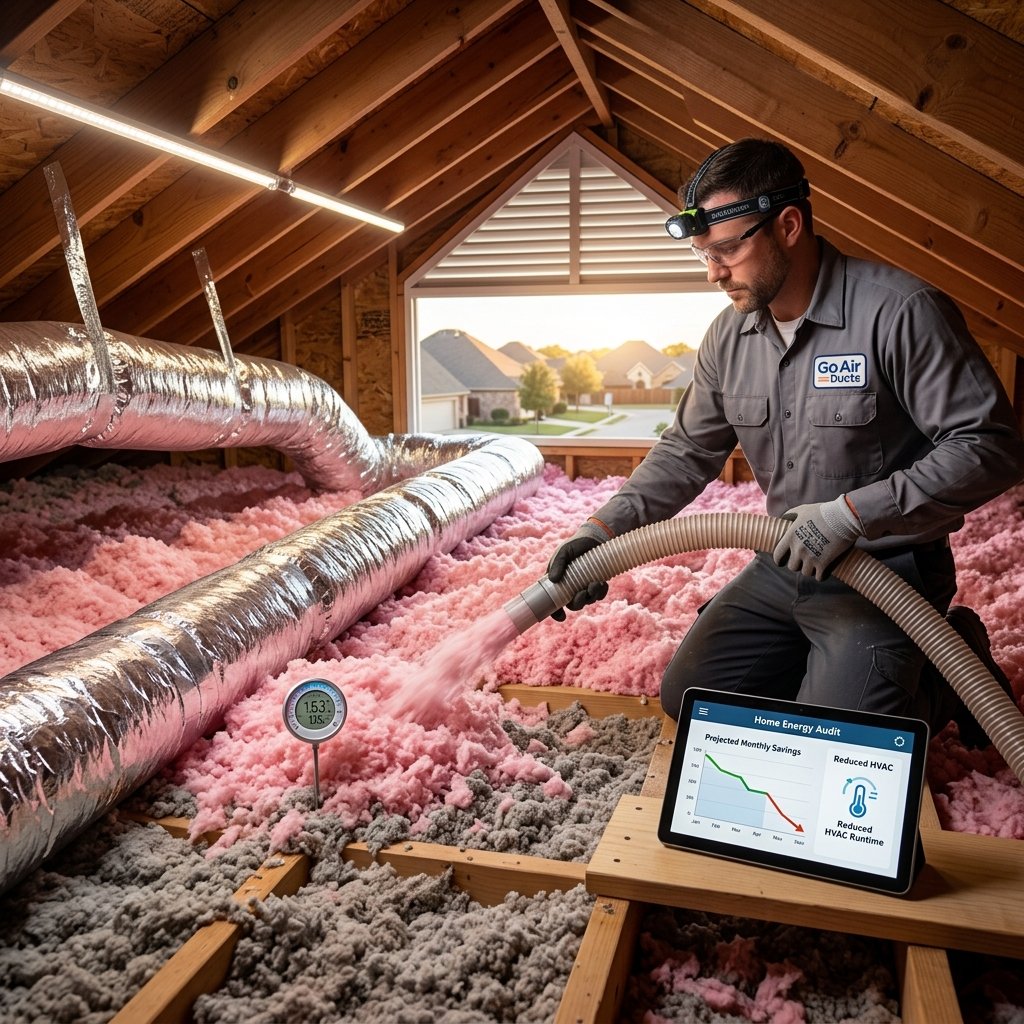
When we upgrade insulation in addition to addressing ductwork inefficiencies and air quality issues, customers typically report energy bill reductions of 15-30% within their first full billing cycle. That savings repeats every month for as long as you own your home.
The return on investment is compelling. A $3,000-$5,000 attic insulation upgrade often pays for itself within 5-7 years through energy savings alone. After that, it’s pure savings. Plus, better insulation increases your home’s resale value and appeal to buyers.
Our recommendation: Start with a no-cost energy assessment that includes insulation evaluation, HVAC system inspection, and ductwork review. We identify exactly where your home is losing energy and which upgrades will deliver the fastest payback.
We’re ready to help you transform your home’s energy efficiency. Our certified technicians have completed thousands of insulation installations, air duct cleanings, and HVAC optimizations across Austin, San Antonio, Dallas, and Houston. We offer free service estimates and can often schedule installation within days.
Contact us today to book your complimentary home energy assessment. Let’s get your HVAC system working smarter, not harder.
If you’re dealing with dust, poor airflow, mold in your ducts, or a clogged dryer vent — don’t wait. These issues can affect your health and safety. Go Air Ducts Group are the local experts in air duct cleaning, mold removal, dryer vent cleaning, and attic insulation. Call now for a free inspection and same-day service in Austin and San Antonio.
Frequently Asked Questions (FAQ)
How much can we save on energy bills by upgrading our insulation?
We typically see our customers reduce their monthly energy costs by 15-30% after upgrading their insulation, though savings depend on your current insulation levels, home age, and local climate. Homes with poor attic insulation or air leaks experience the most dramatic savings since your HVAC system won’t have to work as hard to maintain your desired temperature. We recommend getting a free estimate from our team so we can assess your specific situation and give you a realistic projection based on your property.
Why does our HVAC system run constantly even though we have a thermostat set?
When insulation is inadequate or has gaps, your home loses conditioned air rapidly, forcing your HVAC system to cycle more frequently to keep up with temperature changes. This constant runtime not only wastes energy but also wears out your equipment faster and drives up your utility bills. We can inspect your attic, ductwork, and insulation to identify where air is escaping and recommend the most cost-effective upgrades to reduce strain on your system.
Should we insulate around our air ducts if they’re already in the attic?
Absolutely – we often find that ductwork in uninsulated or poorly insulated attics loses 20-30% of cooled or heated air before it reaches your rooms. Adding insulation directly around ducts, especially in hot Texas summers and cold winters, significantly improves efficiency and helps your HVAC deliver more conditioned air where you need it. We can evaluate your duct layout during a free inspection and recommend whether additional duct insulation or whole-attic upgrades make the most sense for your home.