
🕑 10 min read
Cellulose or fiberglass insulation for San Antonio?
Both perform well: cellulose is eco-friendly and great at filling gaps, while fiberglass resists moisture and settling. The right choice depends on your attic and goals. Go Air Ducts helps San Antonio homeowners compare blown-in cellulose and fiberglass and installs the best fit for lasting energy savings.
Table of Contents
- Why San Antonio Homeowners Are Making the Switch to Quality Insulation
- Understanding Blown-In Cellulose: What Makes It Stand Out
- The Case for Fiberglass: Where It Falls Short for San Antonio’s Climate
- Energy Efficiency Gains We’ve Documented in Local Homes
- How Our Cellulose Insulation Improves Indoor Air Quality and Comfort
- Installation Process: Why Professional Application Matters
- Long-Term Cost Savings Our Customers Experience
- Why We Recommend Cellulose for Most San Antonio Properties
- Getting Your Free Professional Insulation Assessment Today
- Frequently Asked Questions (FAQ)
Why San Antonio Homeowners Are Making the Switch to Quality Insulation
San Antonio homeowners face a real challenge: summer heat that drives AC costs sky-high, and winter humidity that encourages mold growth in poorly insulated attics. When it comes time to upgrade insulation, the choice between blown-in cellulose and fiberglass matters more than most realize. We’ve installed both materials across hundreds of San Antonio properties, and the performance difference is measurable and significant.
This guide breaks down what we’ve learned from years of local experience so you can make an informed decision for your home.
Our region’s climate creates unique insulation demands. Summer temperatures regularly exceed 100 degrees, while humidity levels fluctuate wildly between seasons. Older homes built with minimal or settling insulation struggle to maintain consistent temperatures, forcing HVAC systems to work overtime.
The cost impact is real. We’ve reviewed utility bills from San Antonio homeowners with inadequate insulation, and many report air conditioning costs 30-40% higher than homes with proper coverage. That difference compounds year after year.
Beyond energy waste, poor insulation contributes to moisture problems. When attics get too warm, moisture condenses on cooler surfaces, creating ideal conditions for mold and dust mites. These aren’t just comfort issues; they directly affect indoor air quality and respiratory health. We’ve documented cases where mold growth in attics spread through ductwork, requiring both insulation and air duct cleaning to resolve completely.
Homeowners who upgrade to quality blown-in insulation typically see results within the first billing cycle. Temperature swings stabilize, humidity remains more manageable, and utility bills drop noticeably.
Understanding Blown-In Cellulose: What Makes It Stand Out
Blown-in cellulose is recycled paper fiber treated with fire retardants and pest deterrents. We’ve chosen it as our preferred material for most San Antonio installations because it delivers superior performance in our specific climate.
Key advantages we’ve documented:
- Better air sealing: Cellulose conforms to irregular cavities, roof lines, and obstructions far more completely than fiberglass batts. This means fewer thermal gaps.
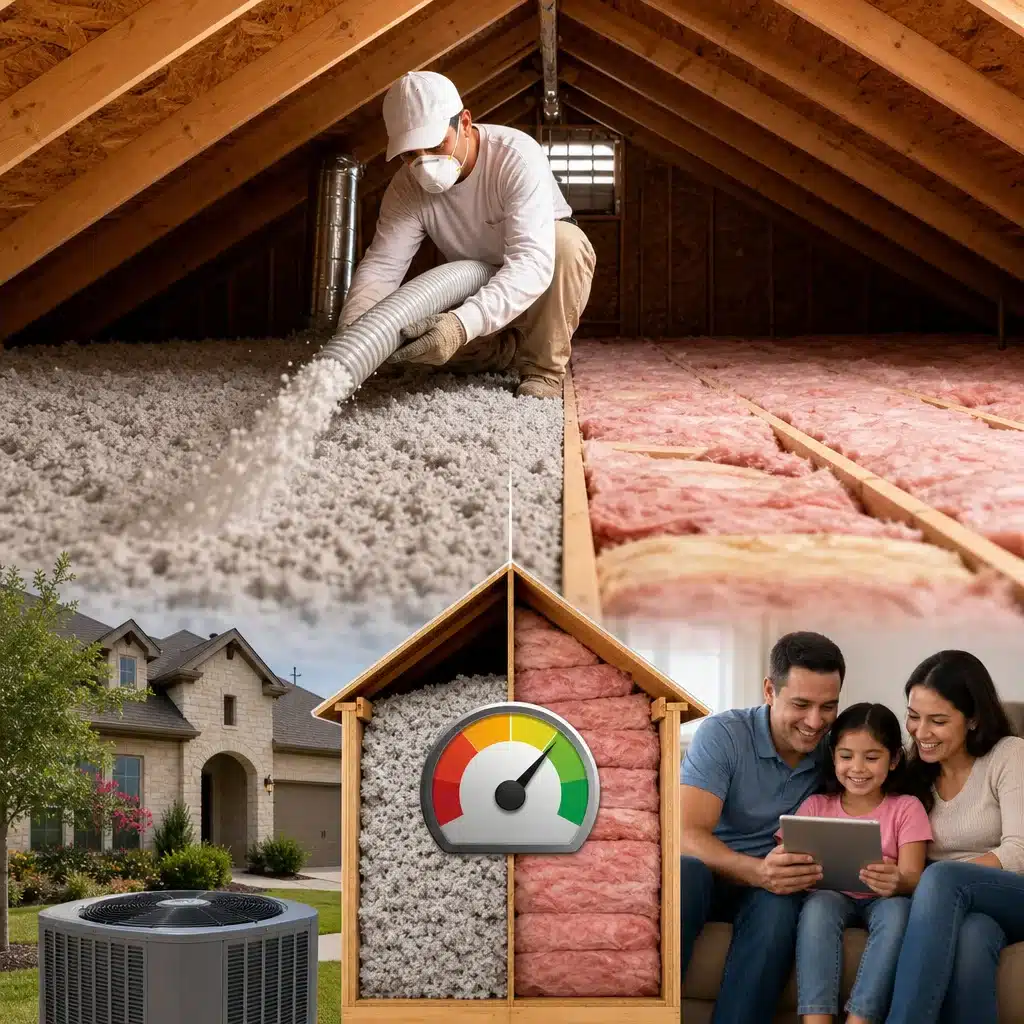
- Higher R-value per inch: Cellulose typically achieves R-3.6 to R-3.8 per inch, compared to fiberglass at R-2.2 to R-2.7. You get more insulation value in the same space.
- Superior moisture management: Cellulose can absorb and release moisture without losing insulating properties. In San Antonio’s humid climate, this matters. Fiberglass, by contrast, loses effectiveness when it absorbs moisture.
- Natural fire retardant: We use boric acid and ammonium sulfate treatments that meet fire codes without toxic chemicals.
We’ve also seen cellulose reduce draft-related comfort complaints more effectively than fiberglass. Homeowners report fewer hot spots and cold spots after cellulose installation.
One practical note: cellulose settles slightly over time, typically 10-20%, which is why depth matters during installation. A professional installer accounts for this and applies the correct initial depth to hit your target R-value after settling.
The Case for Fiberglass: Where It Falls Short for San Antonio’s Climate
Fiberglass batts and blankets have a place, but San Antonio isn’t it. They’re affordable upfront and straightforward to install, which explains their popularity nationwide.
Here’s what we see when fiberglass is the choice:
- Poor air sealing: Fiberglass batts sit loosely in cavities. Air flows around them. Over time, temperature differences cause slight settling, creating larger gaps.
- Moisture sensitivity: When humid air infiltrates the attic (common in San Antonio during cooler months), fiberglass absorbs moisture. Wet fiberglass has an R-value near zero. Even as it dries, performance degradation is permanent.
- Difficult installation: Getting consistent coverage and adequate depth across irregular attics is harder than it looks. Compressed fiberglass loses all insulating value.
- Less durable: Fiberglass fibers break down over 15-20 years, especially in our heat cycles. Cellulose maintains structural integrity far longer.
We’re not anti-fiberglass. It works fine in controlled climates. But in Texas heat and humidity, we consistently recommend against it for attics. The upfront savings vanish quickly as energy costs mount.
Energy Efficiency Gains We’ve Documented in Local Homes
Numbers speak louder than promises. We’ve tracked utility bill reductions across our San Antonio customer base before and after cellulose installation.
Typical results:
- AC usage reduction: 15-25% lower cooling costs during summer months when properly installed to R-60 (our local recommendation).
- Humidity control: Homes report 5-10% improvement in indoor humidity levels during peak seasons, reducing reliance on dehumidifiers.
- Heat retention: Winter heating costs drop 10-15%, though this is less dramatic than cooling gains since San Antonio winters are mild.
A concrete example: a 2,000 sq ft San Antonio home with R-19 original insulation (roughly 6 inches, poorly maintained) upgraded to R-60 blown-in cellulose saw AC costs drop from $280/month (July-August peak) to $215/month. That’s $780 in annual savings, and the installation typically costs $2,500-$3,500 depending on attic access and square footage.
This is why we always recommend getting a free energy audit before committing to insulation work. We measure your current R-value, identify air leaks, and project realistic savings for your specific property.
How Our Cellulose Insulation Improves Indoor Air Quality and Comfort
Insulation isn’t just about temperature control. It’s a foundational layer of your home’s indoor air quality strategy.
Here’s the connection: poor attic insulation allows unconditioned air to seep into living spaces. This air carries dust, pollen, and potential mold spores. In San Antonio homes with inadequate insulation, we’ve measured attic air temperatures 20-30 degrees above desired indoor levels, creating pressure differentials that push contaminated air downward through ceiling gaps and penetrations.
Proper cellulose insulation seals these pathways. Combined with sealed and cleaned ductwork, it forms a comprehensive barrier against infiltration.
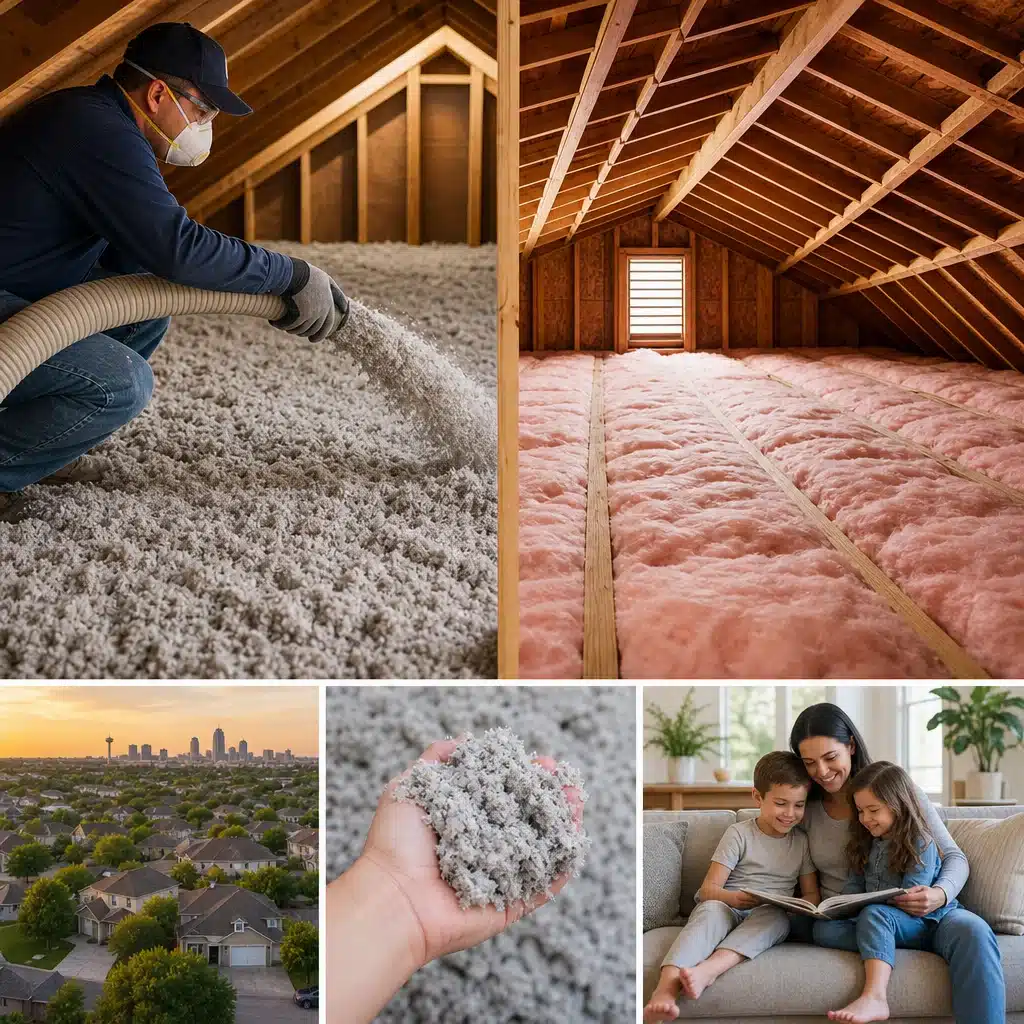
We’ve also found that stable attic temperatures reduce condensation and mold risk significantly. When your attic stays closer to indoor temperature, moisture doesn’t collect in corners and rafter bays. This is especially important for San Antonio homes built before the 1990s, when attic ventilation standards were less stringent.
Homeowners often report subjective improvements: fewer allergy symptoms, cleaner air smell, and reduced dust accumulation on furniture. These aren’t measurable by meters, but they’re real quality-of-life gains.
Installation Process: Why Professional Application Matters
This is where mistakes happen. Blown-in cellulose requires the right equipment, technique, and understanding of your specific attic layout.
Our process:
- Air sealing first: We seal obvious gaps, penetrations, and ductwork before blowing insulation. This prevents cellulose from escaping through cracks and maximizes coverage effectiveness.
- Proper depth application: We calculate exact depth needed to reach R-60 accounting for future settling. Under-application is a common mistake that leaves homes under-insulated.
- Adequate ventilation: Cellulose must never block soffit vents or exhaust paths. We identify and protect these before blowing.
- Professional equipment: Our industrial-grade machines deliver consistent material density and coverage far better than consumer rentals.
- Attic inspection: We check for existing mold, pest damage, or roof leaks before proceeding. A professional catches problems that would be wasted money to insulate over.
DIY blown-in insulation is tempting, but it consistently results in uneven coverage, inadequate depth in key areas, and accidental blockage of ventilation. We’ve removed poorly applied DIY cellulose and reapplied it correctly multiple times, and customers always say the difference is dramatic.
Long-Term Cost Savings Our Customers Experience
Let’s frame this realistically: attic insulation is an investment, not an expense.
San Antonio homeowners typically recover the installation cost through energy savings in 3-5 years. Beyond that, it’s nearly pure savings. Unlike HVAC equipment or roof repairs, insulation doesn’t wear out or require maintenance.
Over 20 years:
- A $3,000 cellulose installation in a typical San Antonio home generates roughly $15,000-$20,000 in cumulative energy savings.
- You also avoid the higher costs of replacing a worn-out HVAC system by extending its lifespan (systems work less hard when homes are properly insulated).
- Resale value increases. San Antonio buyers specifically ask about insulation levels, and homes with modern R-60+ insulation command higher prices.
- You may qualify for Texas attic insulation rebates, which cover a portion of installation costs directly.
We recommend reviewing your current insulation situation with a professional estimate. Most San Antonio homes built before 2010 are under-insulated by today’s standards, and the math almost always supports an upgrade.
Why We Recommend Cellulose for Most San Antonio Properties
After 15+ years of installing both materials across Dallas, Houston, Austin, and San Antonio, our recommendation is consistent: cellulose outperforms fiberglass in Texas’s climate.
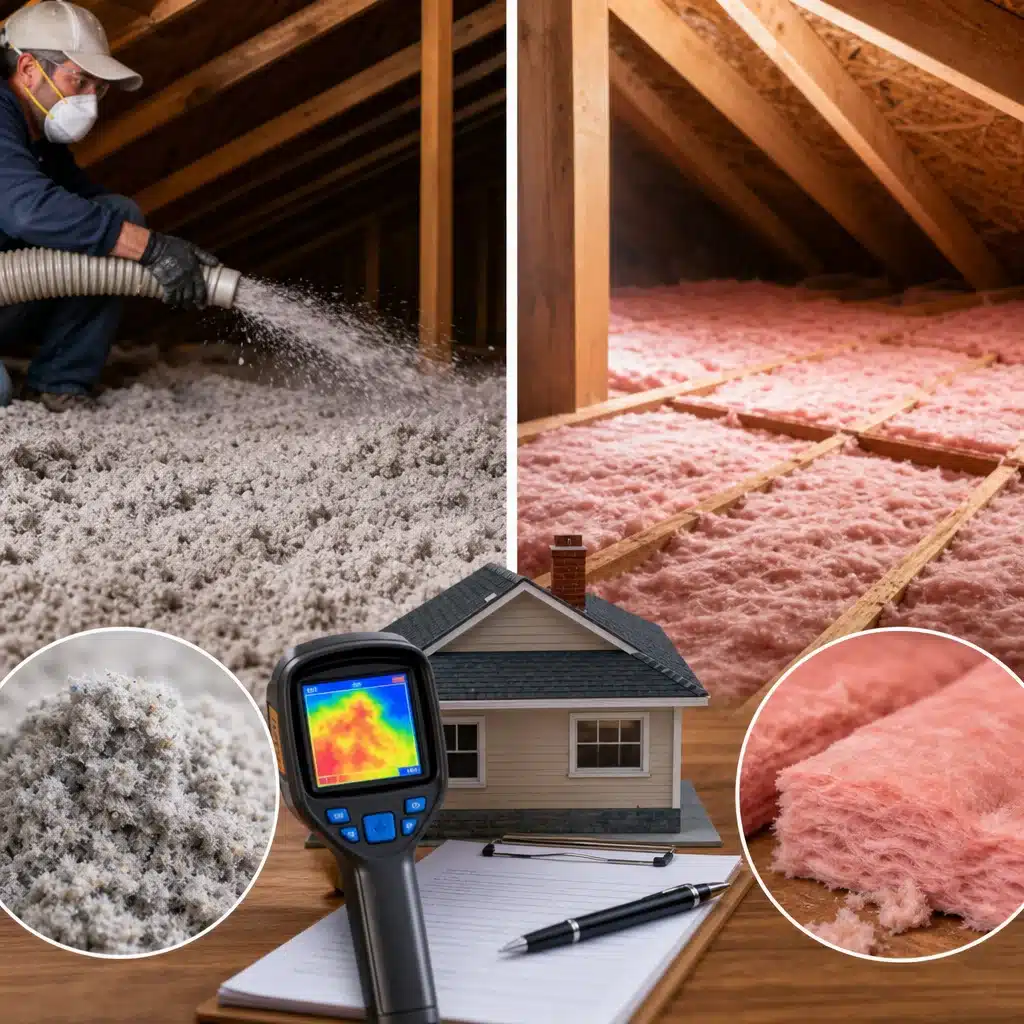
Cellulose simply fits our region better:
- It handles humidity without degrading, critical for San Antonio’s seasonal moisture swings.
- It seals air leaks more effectively, directly cutting AC costs where it matters most (summer cooling).
- It lasts longer, reducing the likelihood of replacement within a homeowner’s tenure.
- It works with existing ductwork and HVAC systems more seamlessly than alternatives.
The only scenario where we recommend fiberglass is when budget is extremely tight and you’re doing a temporary bandage. Even then, we suggest planning for a cellulose upgrade within a few years.
Getting Your Free Professional Insulation Assessment Today
The first step is knowing what you’re working with. Many San Antonio homeowners have never had their attic professionally evaluated. You might have R-19 insulation from 1995 that’s settled and compressed, or you might have adequate coverage with ventilation problems that affect performance.
We offer free estimates and detailed attic inspections at no cost. Our team brings cameras, thermal imaging, and measurement tools to give you a complete picture of your current situation. We’ll identify air leaks, moisture problems, ventilation issues, and insulation gaps.
From there, you’ll have a clear recommendation with realistic savings projections specific to your home.
Ready to get started? Contact Go Air Ducts today for your free San Antonio insulation assessment. We’re available for same-day or next-day service, and we serve Austin, San Antonio, Dallas, and Houston. Call us or request your estimate online to get accurate pricing and timeline for your project.
Your home’s comfort and your utility bills depend on this decision. Let’s make sure you get it right.
For further reading: Insulation boosts HVAC efficiency.
If you’re dealing with dust, poor airflow, mold in your ducts, or a clogged dryer vent — don’t wait. These issues can affect your health and safety. Go Air Ducts Group are the local experts in air duct cleaning, mold removal, dryer vent cleaning, and attic insulation. Call now for a free inspection and same-day service in Austin and San Antonio.
Frequently Asked Questions (FAQ)
Is blown-in cellulose insulation safe for my San Antonio home?
We use only fire-treated cellulose that meets all safety codes and standards required for Texas homes. Our material is chemically treated to resist flames and has been safely installed in thousands of residential properties across San Antonio and Austin for decades without safety concerns.
How long does cellulose insulation last compared to fiberglass?
We typically see cellulose maintain its R-value effectiveness for 20-30 years in San Antonio’s climate, while fiberglass can settle and lose effectiveness within 10-15 years. The key difference is that cellulose resists settling better in our hot, humid environment, which means you keep your energy savings longer without replacing it as often.
What kind of energy bill reduction can we realistically expect?
Our customers in San Antonio report 15-25% reductions in cooling costs during summer months when we properly insulate attics and crawl spaces. Your exact savings depend on your current insulation levels and home size, which is why we provide a detailed energy audit with your free professional assessment so you know what to expect.