
Table of Contents
- Why Your Current Air Ducts Are Wasting Energy and Money
- Signs Your Ductwork Needs Replacement, Not Just Cleaning
- How Poorly Sealed Ducts Affect Your HVAC System Performance
- The True Cost of Delaying Air Duct Replacement
- Our Professional Air Duct Replacement Process
- Energy Savings You Can Expect After Duct Replacement
- Why DIY Duct Solutions Fail: A Cautionary Tale
- How We Size and Install Ducts for Maximum Efficiency
- Combining Duct Replacement with Insulation Upgrades
- Our Certified Technicians Handle Every Step of the Installation
- Getting Your Free Energy Efficiency Assessment Today
- Protecting Your Investment with Maintenance and Warranties
- Frequently Asked Questions (FAQ)
Why Your Current Air Ducts Are Wasting Energy and Money
Your HVAC system works hard to keep your Texas home comfortable, but if your ductwork is damaged, leaking, or poorly installed, you’re essentially paying to cool or heat the outdoors. We’ve seen countless Austin and San Antonio homeowners shocked to discover their air ducts are costing them hundreds of dollars annually in wasted energy. The good news is that energy efficient air duct replacement can cut those losses and deliver measurable savings on your utility bills.
Most homes built before 2010 have ductwork that doesn’t meet today’s efficiency standards. Over time, ducts develop gaps, disconnections, and deteriorating seals that allow conditioned air to escape before it reaches your living spaces. In Texas, where cooling demands are high from May through October, these leaks compound quickly.
We regularly encounter homes where 25-30% of conditioned air never reaches the intended rooms. That means your air conditioner cycles longer, consumes more electricity, and your thermostat works harder to maintain temperature. The result is energy bills that creep up year after year, even as your system ages.
Poor ductwork also creates uneven temperatures throughout your home. Some rooms stay uncomfortably warm while others remain cool, forcing you to adjust your thermostat constantly. This constant cycling wastes energy and reduces your system’s lifespan.
Action step: Request a free energy efficiency assessment to identify where you’re losing conditioned air. We’ll measure your system’s actual performance and show you exactly where leaks exist.
Signs Your Ductwork Needs Replacement, Not Just Cleaning
Duct cleaning is valuable for removing dust and improving air quality, but it won’t fix structural problems. If your ducts show these warning signs, replacement is the smarter investment:
- Visible damage, crushed sections, or separated joints when you access your attic
- Ducts that are more than 20-25 years old with deteriorated insulation
- Flexible ducts that sag or have kinks restricting airflow
- Temperature differences greater than 3-4 degrees between rooms
- Rising energy bills despite regular HVAC maintenance
- Rooms that remain hot or cold no matter how you adjust the thermostat
We’ve also found that ductwork buried in attics becomes exposed to Texas heat, causing insulation to deteriorate faster. Attic temperatures can exceed 140 degrees on summer days, aging duct material and degrading the sealant around joints.
If your ducts show signs of leaks or age-related wear, cleaning alone won’t restore efficiency. Replacement addresses the root cause rather than treating the symptom.
How Poorly Sealed Ducts Affect Your HVAC System Performance
Your HVAC system is precisely engineered to deliver a specific volume of air at a specific pressure. When ducts leak, that system fails to deliver what it was designed to provide. Your furnace or air conditioner must work harder to compensate, which accelerates wear and reduces efficiency.
Here’s what happens: Leaky ducts create pressure imbalances in your home. Supply leaks (where air escapes going into rooms) reduce the pressure in your living spaces, which pulls unconditioned air in from your attic, crawlspace, or outside through every crack and gap. Return air leaks (where ducts pull in return air before it reaches your furnace) draw in hot, humid, or dusty air from uncontrolled spaces.
Both scenarios compromise indoor air quality. In San Antonio and Austin, summer humidity can reach 70% or higher. When your system pulls humid air from your attic or crawlspace, that moisture travels into your ducts and can promote mold growth. Over time, mold-contaminated ducts circulate spores throughout your home, affecting allergies and respiratory health.
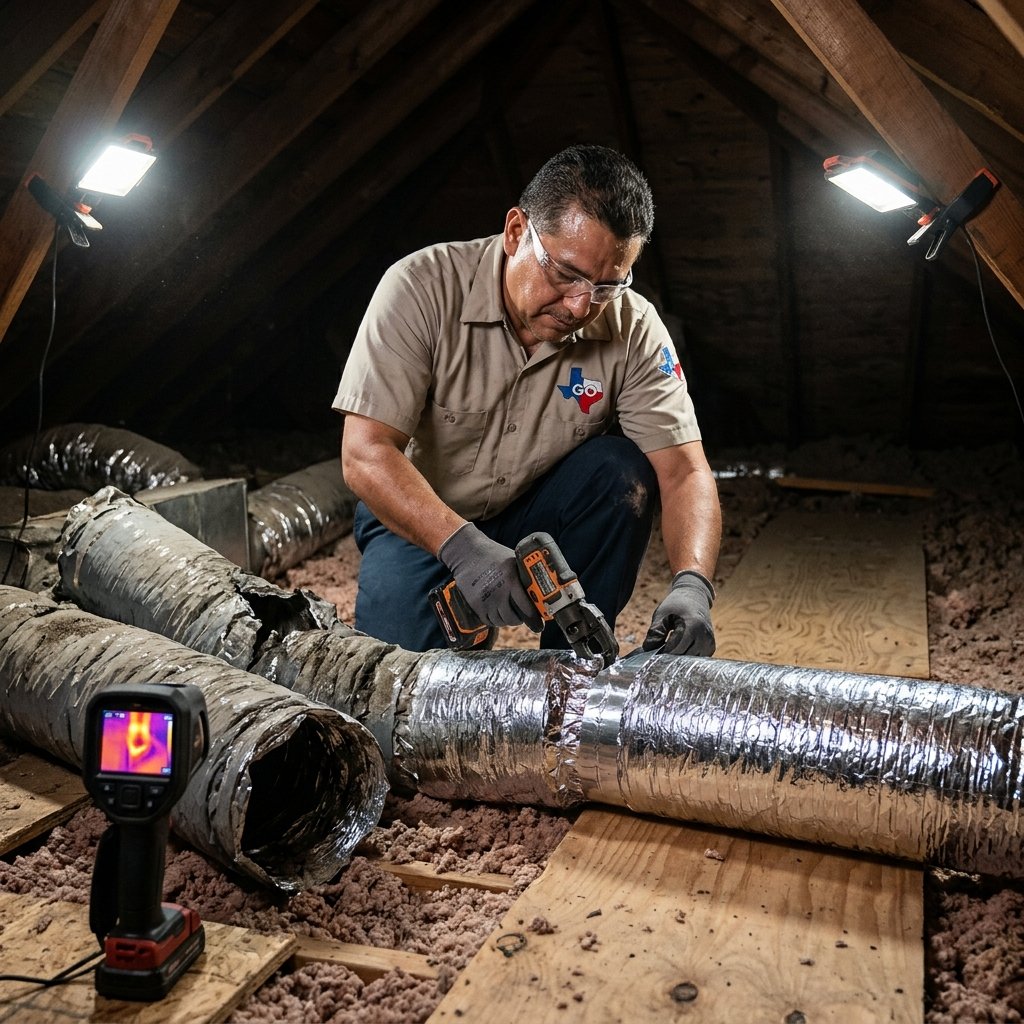
Additionally, leaky ducts force your compressor and blower motor to run longer cycles. This continuous strain shortens equipment life and increases the likelihood of expensive emergency repairs.
The True Cost of Delaying Air Duct Replacement
Postponing duct replacement costs more than the replacement itself. Every month you delay represents money flowing out through leaks and wasted cooling or heating.
Consider this scenario: A typical Austin homeowner with leaky ducts might spend an extra $40-80 per month on energy costs. That’s $480-960 annually just from inefficiency. Over five years, you’ve lost $2,400-4,800 in unnecessary utility charges. Meanwhile, your HVAC system ages faster, bringing forward the day you’ll need a $5,000-8,000 unit replacement.
We also see indoor air quality decline. Dust, pollen, and mold accumulate in damaged ducts, aggravating allergies and asthma. Health costs and reduced comfort add to the true expense.
New ductwork is an investment that pays for itself through energy savings within 3-7 years, depending on your current system’s efficiency and local electricity rates. After that payback period, you enjoy years of lower bills and improved home comfort.
Our Professional Air Duct Replacement Process
We approach every duct replacement systematically to ensure maximum efficiency and durability. Our process begins with a detailed assessment of your current system, including ductwork layout, insulation condition, and airflow patterns.
Next, we perform a blower door test and duct leakage measurement to quantify exactly where and how much air you’re losing. These measurements guide our design, ensuring we right-size new ducts for your specific home and HVAC equipment.
We then install new rigid or semi-rigid ductwork using best practices:
- Properly sized ducts matched to your furnace or air conditioner capacity
- Sealed joints using mastic sealant and fiberglass tape (no duct tape, which fails over time)
- Insulation wrapped around ducts to minimize temperature loss in unconditioned spaces
- Secure bracing and support to prevent sagging or damage
- Final testing to confirm proper airflow and minimal leakage
Our certified technicians handle all connections to your equipment, returns, and supply registers. The entire process typically takes 1-3 days depending on your home’s complexity and existing ductwork layout.
Energy Savings You Can Expect After Duct Replacement
Most homeowners in our Texas service areas see energy savings between 15-30% after duct replacement, assuming they also maintain their HVAC system properly. The exact savings depend on several factors:
- How much leakage existed in your old ducts (measured in cubic feet per minute)
- The age and efficiency rating of your current HVAC equipment
- Your local utility rates and seasonal cooling/heating demands
- How well you maintain temperature through thermostat settings
A homeowner with significant duct leakage might save $80-150 monthly during peak cooling season. In winter, savings are typically lower unless you also upgrade to a high-efficiency furnace.
Beyond dollars, you’ll experience better comfort within days. Rooms that were difficult to condition now reach your desired temperature faster. Your system cycles less frequently, running quieter and causing fewer temperature fluctuations.
Why DIY Duct Solutions Fail: A Cautionary Tale
We’ve attended to many homes where previous owners or contractors attempted DIY duct repairs using spray foam, putty, or duct tape. These quick fixes create expensive problems.

Spray foam expands and hardens inside ducts, restricting airflow and trapping moisture that promotes mold. Duct tape adhesive deteriorates within 2-3 years, especially in hot attics, leaving gaps that render the repair useless. Store-bought duct sealant (putty) cracks when ducts expand and contract with temperature changes, which happens daily in Texas attics.
Professional mastic sealant, by contrast, remains flexible and maintains its seal for 20+ years. It’s applied properly to all joints and seams, not just obvious gaps.
We also see situations where DIY repairs address only obvious leaks while missing the real problem. A disconnected duct joint at the return side, for example, might be hidden behind insulation or framing. Incomplete repairs waste time and money without solving the underlying inefficiency.
Actionable insight: If you’ve already attempted repairs, we recommend a professional assessment to identify what was missed and what needs correction.
How We Size and Install Ducts for Maximum Efficiency
Proper duct sizing is critical to efficiency. Undersized ducts create excessive air velocity, causing turbulence, noise, and pressure drops that force your system to work harder. Oversized ducts reduce velocity, resulting in inadequate air distribution to distant rooms.
We use ACCA (Air Conditioning Contractors of America) Manual D calculations to design your ductwork based on:
- Your furnace or air conditioner’s CFM (cubic feet per minute) capacity
- The layout and square footage of each room
- The length of duct runs and number of bends
- Equivalent friction loss through the entire system
This engineering-based approach ensures each room receives adequate airflow at proper velocity. Your system operates at peak efficiency, cycling less frequently and consuming less energy.
We also consider duct material carefully. For new installations, we typically recommend rigid fiberglass ductboard for main trunk lines, with flexible ducts only for final connections to registers. Rigid ductwork maintains its shape, provides better insulation, and resists crushing or kinking that reduces airflow.
Combining Duct Replacement with Insulation Upgrades
New ducts alone deliver significant efficiency gains, but coupling duct replacement with attic insulation upgrades maximizes your energy savings. Hot attics in summer pull heat through any ductwork, even when ducts are sealed and insulated. Upgrading attic insulation (typically to R-38 or R-49) reduces that heat load substantially.
When you upgrade insulation alongside duct replacement, you’re addressing two major sources of energy loss simultaneously. Homes that complete both upgrades often achieve 30-40% total energy savings compared to their pre-upgrade baseline.
Improved attic insulation also stabilizes attic temperature, which protects your new ducts from extreme heat exposure and extends their lifespan. In addition, better insulation reduces humidity levels in your attic, lowering the risk of mold growth in ducts and on framing.
Our Certified Technicians Handle Every Step of the Installation
Our technicians hold EPA certifications, NATE (North American Technician Excellence) credentials, and current licenses required to serve Austin, San Antonio, Dallas, and Houston. This training means they understand refrigeration principles, electrical safety, and ductwork aerodynamics, not just how to connect pipes and wires.
During installation, our team coordinates with your existing HVAC equipment to ensure proper connections at the furnace, air conditioner, and equipment disconnect points. They verify that blower motor settings are appropriate for your new ductwork configuration and that proper thermostat operation supports efficient cycling.
After installation, we conduct thorough testing with blower door and duct leakage measurements to confirm performance meets design specifications. You receive documentation of the work completed and baseline efficiency metrics you can reference in future years.
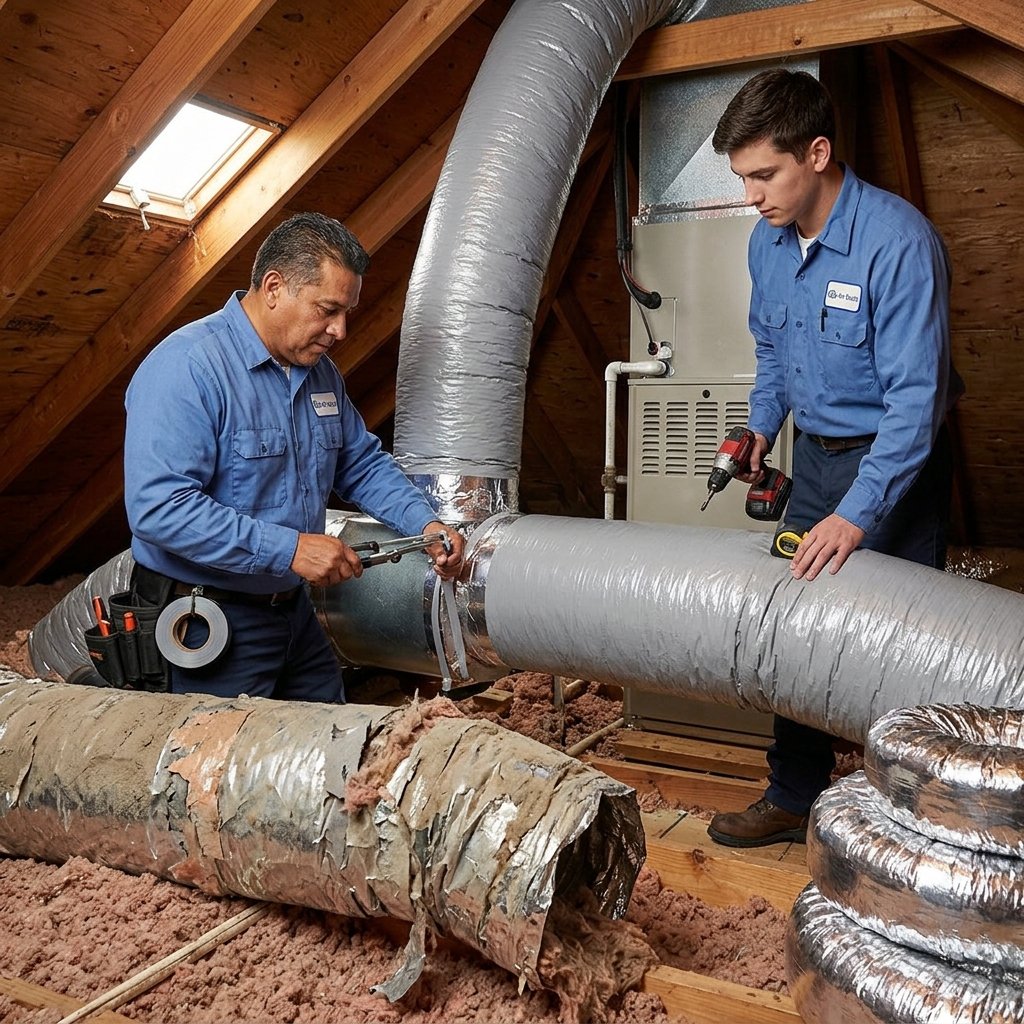
This comprehensive approach protects your investment and ensures you realize the energy savings we’ve projected.
Getting Your Free Energy Efficiency Assessment Today
The first step toward lower energy bills is understanding exactly where your home is losing efficiency. We offer free assessments that include a visual inspection of your ductwork, measurement of duct leakage, and a detailed report showing recommended improvements with projected savings.
During your assessment, our technician discusses your comfort concerns, reviews your recent utility bills, and explains your replacement options in plain language. You’ll understand what’s wrong, why it matters, and what the solution costs before making any commitment.
To schedule your free assessment in Austin, San Antonio, Dallas, or Houston, visit our website or call us for same-day or next-day availability. We’re committed to responding quickly because we know that inefficient ductwork affects your home every single day.
Protecting Your Investment with Maintenance and Warranties
New ductwork is built to last 20-30 years, but regular maintenance keeps it performing optimally. We recommend annual HVAC maintenance before heating and cooling seasons, which includes checking duct connections, verifying airflow, and identifying any emerging issues early.
We back all our duct replacement installations with comprehensive warranties covering materials and labor. Specific warranty terms are provided at completion and documented in your service agreement. Our local presence in Texas means we’re here to support you long after installation is finished.
Additionally, we recommend having your ducts inspected every 3-5 years, even if they’re relatively new. Texas humidity and temperature extremes can stress ductwork over time. Early detection of issues prevents small problems from becoming expensive repairs.
Taking action today to replace inefficient ductwork sets your home up for comfort, better air quality, and measurable savings for decades to come. Contact Go Air Ducts to schedule your free energy efficiency assessment and discover how much you can save.
For further reading: Humidity effects on ducts.
If you’re dealing with dust, poor airflow, mold in your ducts, or a clogged dryer vent — don’t wait. These issues can affect your health and safety. Go Air Ducts Group are the local experts in air duct cleaning, mold removal, dryer vent cleaning, and attic insulation. Call now for a free inspection and same-day service in Austin and San Antonio.
Frequently Asked Questions (FAQ)
How much can I expect to save on energy bills after replacing my air ducts?
Most of our Texas customers see energy savings between 15-30% after we complete a professional air duct replacement, though your specific savings depend on how severely your current ducts are leaking and how efficiently your HVAC system operates. We typically recover the installation cost within 3-7 years through lower monthly utility bills, and many homeowners experience noticeable comfort improvements even sooner. We recommend getting a free estimate from us so we can assess your current ductwork and give you a personalized savings projection.
What’s the difference between air duct cleaning and replacement?
Air duct cleaning removes dust and debris from inside your existing ducts, which we recommend every 3-5 years for maintenance, but it won’t fix structural leaks, poor connections, or undersized ducts that waste energy. Replacement involves installing new, properly sized and sealed ductwork that’s engineered for your specific home and HVAC system. During our free inspection, we’ll tell you honestly whether your ducts just need cleaning or if replacement would actually solve your efficiency and comfort problems.
Why shouldn’t I attempt duct replacement myself?
Improperly sized or installed ducts create airflow problems that actually make your energy bills worse, and DIY sealing methods typically fail within months because they lack the equipment and expertise we use. Our certified technicians understand Texas building codes, proper duct sizing calculations, and installation techniques that our warranties cover. We handle everything from equipment to cleanup so you get results that last and perform as designed.