
🕑 11 min read
Do you need a permit for duct replacement in Texas?
Often yes. Texas building codes may require permits and inspections for duct replacement, especially larger jobs, to ensure safety and compliance. Go Air Ducts handles duct replacement in Texas correctly, understanding permit and code requirements so your project is done safely, legally, and to standard.
Table of Contents
- Why Duct Replacement Permits Matter for Your Home
- Understanding Texas HVAC Building Codes and Standards
- Permit Requirements Across Austin, San Antonio, Dallas, and Houston
- The Inspection Process We Handle for You
- Cost Implications of Proper Permitting and Compliance
- How We Navigate Local Code Requirements
- Signs Your Ducts Need Replacement and When Permits Apply
- Energy Code Updates and Your Ductwork
- Common Permit Mistakes Homeowners Make
- Our Certified Technicians Manage the Entire Process
- Timeline and Next Steps for Your Duct Project
- Frequently Asked Questions (FAQ)
Why Duct Replacement Permits Matter for Your Home
When it comes to replacing ductwork in your Texas home, most homeowners don’t realize that a permit isn’t just paperwork to check off. It’s your legal protection and a guarantee that your system meets current safety and efficiency standards. We’ve guided hundreds of homeowners through this process, and the ones who handle it right save money, avoid costly rework, and gain peace of mind.
Whether you’re in Austin, San Antonio, Dallas, or Houston, duct replacement involves local codes that vary by city and county. Skipping permits can lead to failed home inspections, issues during resale, or worse, a system that doesn’t perform properly. Let us walk you through what you need to know.
A permit serves three critical purposes: it ensures your ductwork installation meets current building codes, it creates an official record for your property, and it protects you legally if something goes wrong. When we pull a permit on your behalf, we’re committing to standards that protect both your home and your investment.
Your homeowner’s insurance may not cover damage from unpermitted HVAC work. More importantly, if you ever sell your home, a disclosure of unpermitted work can tank the deal or force you into expensive remediation before closing. Many title companies now require proof that major HVAC work was permitted and inspected.
Beyond legal protection, permits ensure your ducts are sized correctly, sealed properly, and installed to maximize energy efficiency. A poorly sized duct system can waste 20-30% of your heating and cooling energy, costing you hundreds per year.
Action Step: If you’ve had ductwork done in the past without a permit, reach out for a free inspection. We can assess whether your system needs correction and discuss options with no pressure.
Understanding Texas HVAC Building Codes and Standards
Texas follows the International Energy Conservation Code (IECC) and the International Mechanical Code (IMC), which set standards for duct material, sealing, insulation, and airflow. These codes are updated every few years, so what was acceptable in 2020 may not meet today’s requirements.
The key standards we follow include:
- Duct sealing: All ductwork joints must be sealed with mastic sealant or metal-backed tape to prevent leakage.
- Insulation requirements: Ducts in unconditioned spaces like attics must be insulated to R-6 or R-8 depending on your climate zone.
- Duct size calculations: Ducts must be sized based on airflow requirements, not guesswork.
- Accessibility: Return air ducts cannot pull from certain areas (like garages or mechanical rooms) to avoid contaminated air.
Texas also recognizes the National Comfort Institute standards for ductwork balance and performance. This means your new ducts won’t just move air; they’ll deliver it evenly to every room.
We stay current on these codes because they change, and your local inspector will catch any shortcuts.
Permit Requirements Across Austin, San Antonio, Dallas, and Houston
Each city has its own permitting process, though the core requirements are similar. Here’s what you’ll encounter:
Austin: The City of Austin requires a mechanical permit for any duct replacement. The permit process typically takes 5-7 business days, and an inspector will verify the work before sign-off. Austin has been aggressive about energy code compliance, so expect detailed duct sealing and insulation inspections.
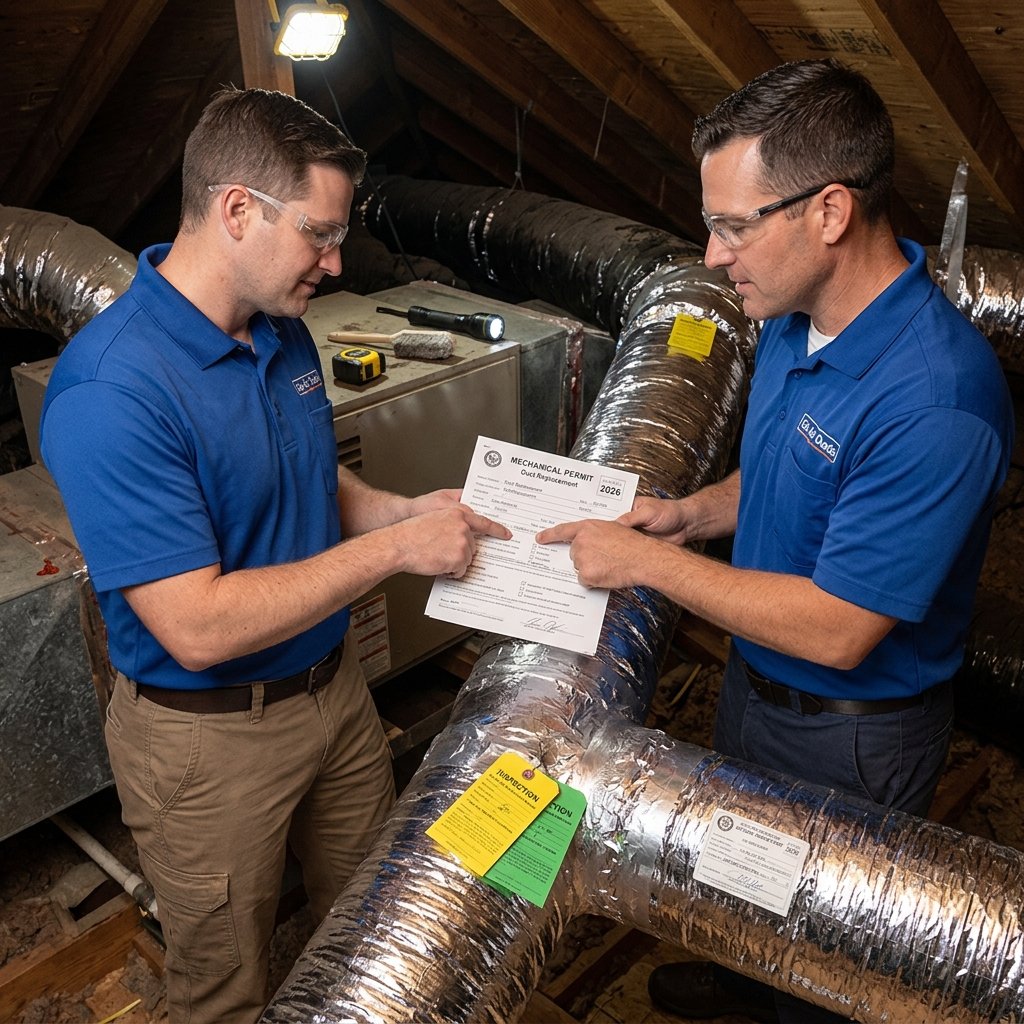
San Antonio: San Antonio’s permitting is slightly faster, usually 3-5 days. The city follows the same IMC standards but emphasizes proper duct support and clearance from other utilities.
Dallas: Dallas permits are straightforward but require coordination with their inspections department. Plan for 5-7 days, and the inspector will verify duct sizing and sealing before final approval.
Houston: Houston’s process is similar to Dallas, though their inspectors are particularly thorough about duct leakage testing in humid climates. Expect a full inspection including pressure testing.
Each municipality has different fees (usually $100-300 depending on the scope), and some require a licensed contractor to pull the permit. We handle all of this for you as part of our service.
The Inspection Process We Handle for You
Once we’ve installed your new ductwork, the city inspector will visit to verify that the installation meets code. This isn’t a quick rubber stamp. The inspector will check:
- Proper sealing of all joints and connections
- Correct duct sizing based on airflow calculations
- Insulation coverage in unconditioned spaces
- Duct support and clearance requirements
- Return air source (no garage air, no contaminated sources)
- Proper connection to your HVAC unit
We make sure everything is in order before the inspection. We’ve found that duct problems discovered during inspections often stem from sizing mistakes or incomplete sealing, both of which add cost and delay your project.
Our certified technicians document all work with photos and measurements, so when the inspector arrives, approval is typically immediate.
Action Step: Ask us for a pre-inspection walkthrough. We’ll show you exactly what the inspector will check and explain why each detail matters.
Cost Implications of Proper Permitting and Compliance
A proper duct replacement with permitting typically costs 10-15% more than skipping the permit. However, consider what you’re paying for:
- Professional installation that meets current code
- City-verified quality and performance
- Legal protection during home resale
- Improved energy efficiency (often recouped in utility savings within 5-7 years)
- Manufacturer warranty validity (many require permitted installation)
If you skip the permit, you might save $300-500 upfront. But if you need to sell your home and disclose unpermitted work, you could lose $5,000-15,000 in negotiation or be forced to redo the work entirely.
Additionally, leaky ducts waste energy and cost you money every month. A proper installation with sealing and insulation typically reduces your cooling costs by 15-20% in Texas summers.
We provide a detailed estimate upfront that breaks down permit costs, materials, labor, and projected energy savings so you can see the real value.
How We Navigate Local Code Requirements
Our team stays certified on the latest Texas building codes and maintains active relationships with inspectors across Austin, San Antonio, Dallas, and Houston. This means we know exactly what each city requires before we break ground.
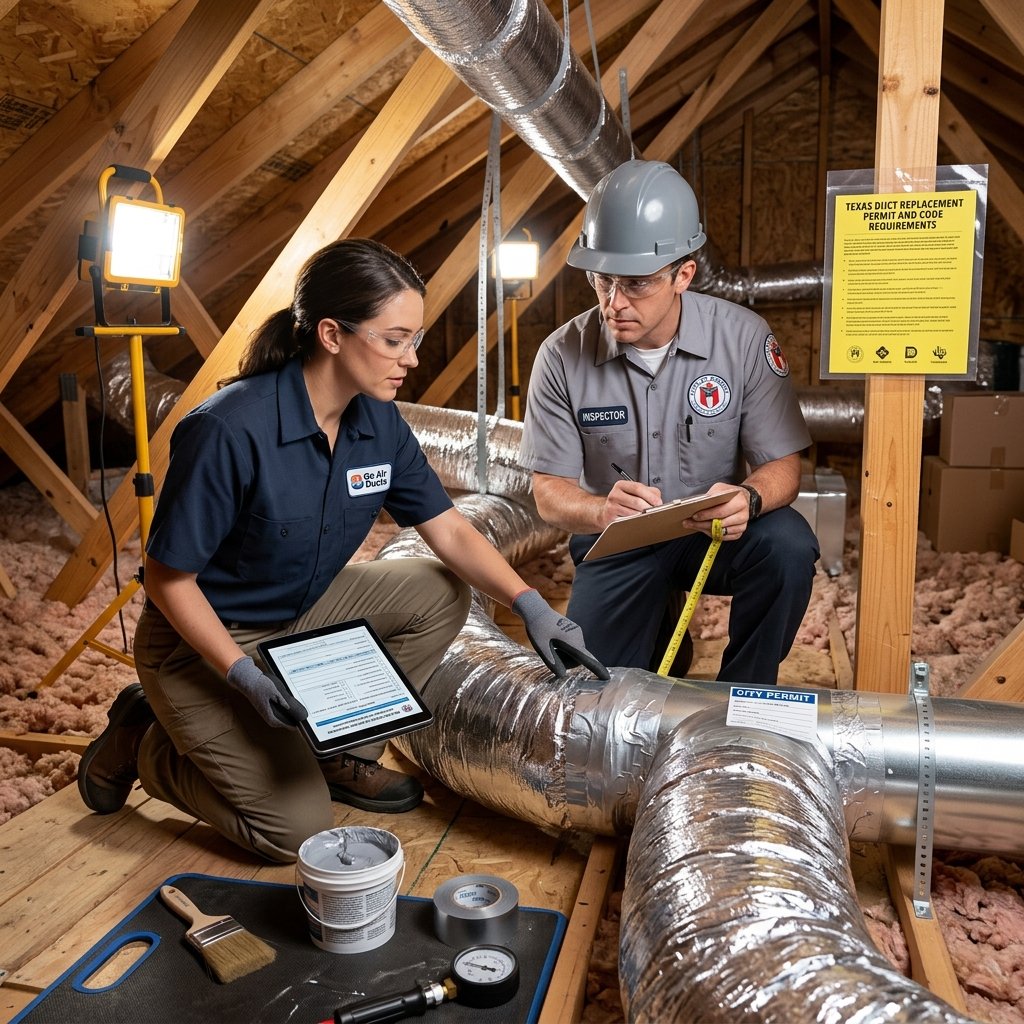
When we visit your home for an estimate, we review local code requirements specific to your address. We assess your current ductwork, identify deficiencies, and design a replacement plan that exceeds minimum code. We also coordinate the permit application, schedule the inspection, and manage any corrections needed.
Our process eliminates guesswork and ensures your project moves smoothly from start to finish. We’ve learned which inspectors want to see specific documentation, which require pressure testing, and which have additional local requirements. That expertise saves you time and prevents costly rework.
Signs Your Ducts Need Replacement and When Permits Apply
Not every duct issue requires a full replacement. Patching, resealing, or cleaning might solve the problem. But certain situations demand new ducts and, therefore, a permit:
- Age: Ducts over 20-25 years old often have seal degradation and insulation breakdown. Replacement is safer than repair.
- Significant leakage: If more than 15% of your conditioned air is leaking into your attic, new ducts are more cost-effective than patching.
- Mold or contamination: If ducts have mold growth or rodent damage, replacement is the best solution. Check our HVAC diagnostic checklist to assess your ducts.
- Undersized or oversized ducts: If your system is delivering uneven airflow or your energy bills are unusually high, improper sizing is often the culprit.
- Damage from renovations: If renovations have crushed, punctured, or disconnected ducts, replacement may be necessary.
A repair or cleaning doesn’t require a permit. A replacement or major reconfiguration does.
Energy Code Updates and Your Ductwork
Texas has tightened energy code requirements over the past five years, particularly around duct sealing and insulation. The 2024 Texas Energy Code now requires all ducts to be sealed with mastic (not just tape) and insulated to higher R-values than before.
If your current ducts don’t meet these standards, they’re creating energy waste. Older homes often have ducts that leak significantly, especially in attic spaces where heat or humidity can damage seals over time. Texas humidity affects ductwork and HVAC efficiency in ways many homeowners don’t realize.
When you replace your ducts with a permitted, code-compliant system, you’re not just fixing a problem. You’re investing in a system that will perform better for the next 20+ years and meet resale standards.
Common Permit Mistakes Homeowners Make
We’ve seen homeowners and contractors cut corners, and it always costs more to fix later:
- Hiring unlicensed contractors: Only licensed HVAC contractors can pull permits in Texas. Unlicensed work voids warranties and creates liability.
- Oversizing ducts to save money: Bigger isn’t better. Oversized ducts reduce airflow velocity and efficiency. Our engineers calculate the correct size based on your specific needs.
- Using improper sealants: Duct tape doesn’t work (it’s actually called “duck” tape). Mastic sealant and metal-backed tape are code-compliant.
- Skipping insulation in unconditioned spaces: Uninsulated ducts in your attic can lose 30% of your cooled air before it reaches your room.
- Pulling a permit but not scheduling the inspection: A permit is worthless without the final inspection sign-off. We handle this to ensure your project is legally complete.
Action Step: Before hiring anyone for duct replacement, ask for their HVAC contractor license and proof of current insurance. We’re happy to provide both.
Our Certified Technicians Manage the Entire Process
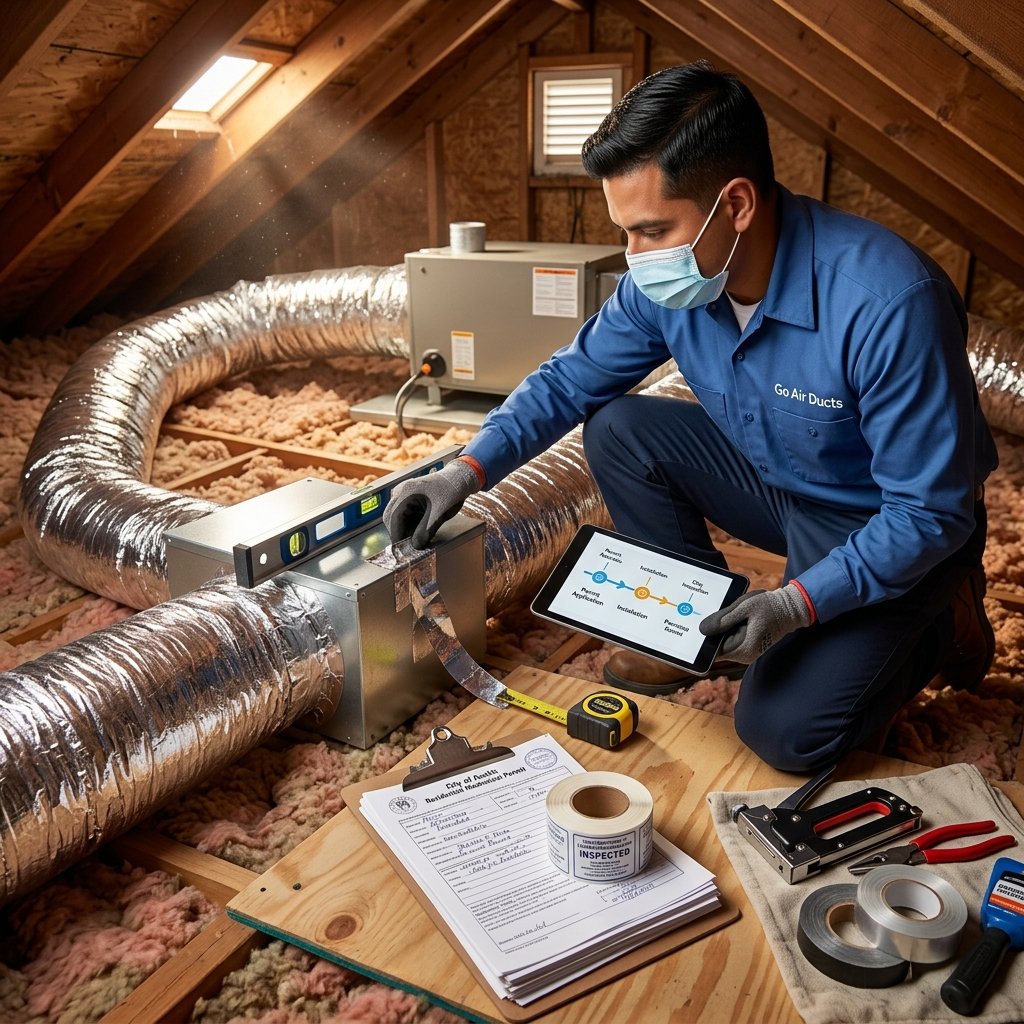
From your initial free estimate through final inspection sign-off, we handle every step. Our certified technicians are licensed, insured, and trained on the latest code requirements across all four major Texas cities we serve.
Here’s what our process looks like:
- Free inspection and estimate: We assess your ducts, identify issues, and outline your options with no obligation.
- Permit application: We pull the permit and manage all paperwork with your local city.
- Professional installation: Our team follows code requirements exactly, with proper sealing, insulation, and support.
- Inspection coordination: We schedule the city inspection and are present during the walkthrough.
- Final documentation: You receive a copy of the permit and inspection sign-off for your records.
We stand behind our work with a full warranty and the confidence that your system meets or exceeds local code.
Timeline and Next Steps for Your Duct Project
Here’s a realistic timeline for a duct replacement project in Texas:
- Week 1: Free inspection and estimate, permit application
- Week 2: Permit approval (3-7 days depending on city), scheduling installation
- Week 3: Installation (typically 2-3 days depending on system size)
- Week 4: City inspection and final sign-off
From start to finish, expect 3-4 weeks. Urgent situations can sometimes move faster if we prioritize scheduling.
Your next step is simple: contact us for a free, no-obligation inspection. We’ll assess your current ductwork, explain what’s needed, and provide a clear estimate including permitting costs and timeline. Call us today or visit our website to book an appointment. We serve Austin, San Antonio, Dallas, and Houston with same-day and next-day availability.
Let us handle the complexity of permits and codes so you can focus on enjoying a more efficient, healthier home.
If you’re dealing with dust, poor airflow, mold in your ducts, or a clogged dryer vent — don’t wait. These issues can affect your health and safety. Go Air Ducts Group are the local experts in air duct cleaning, mold removal, dryer vent cleaning, and attic insulation. Call now for a free inspection and same-day service in Austin and San Antonio.
Frequently Asked Questions (FAQ)
Do we handle the permit application process for duct replacement in Texas?
Yes, we manage the entire permit application process for you. Our certified technicians understand the specific requirements for Austin, San Antonio, Dallas, and Houston, and we’ll handle all paperwork and submissions to ensure your ductwork meets local building codes. This takes the complexity off your shoulders so you can focus on what matters.
What code standards do our ducts need to meet in Texas?
Our work complies with current Texas building codes and energy standards for HVAC systems, including proper duct sizing, sealing, and insulation requirements that vary by city. We stay current on energy code updates so your new ductwork performs efficiently and passes inspection on the first attempt. Each municipality has specific requirements, and we know them all.
Why is getting a permit important before we replace our ducts?
Unpermitted ductwork can create liability issues if you sell your home, void warranties, and fail future inspections or insurance claims. We obtain permits to guarantee your replacement meets all safety and efficiency standards while protecting your investment and home value long-term.